 ChatGPT
 Perplexity
 Claude
 Gemini
 Grok
Grok



Most "best AI video generator software" lists hand you 20 names and leave you to figure out which one actually fits your job. This one is shorter and more honest. We build Pexo, one of the tools on this list, so read this as an informed insider's guide rather than a neutral outsider's. To rank these seven we compared each one on the factors that decide a purchase: output quality, how much work stands between you and a finished video, the inputs it accepts, and price, drawing on each tool's documented capabilities, current pricing, and third-party reviews. The job we kept in mind throughout is the common one: turning a single product photo into a short, ready-to-post vertical ad.
A quick note before the list. "AI video generator software" now covers two very different jobs. Some tools are raw generative models that turn a typed prompt into cinematic footage. Others are partners that handle the whole video for you: script, visuals, voice, pacing, and the final cut. The "best" one depends entirely on which job you are doing, so we labeled each pick with the job it wins. Here is how the seven stack up.
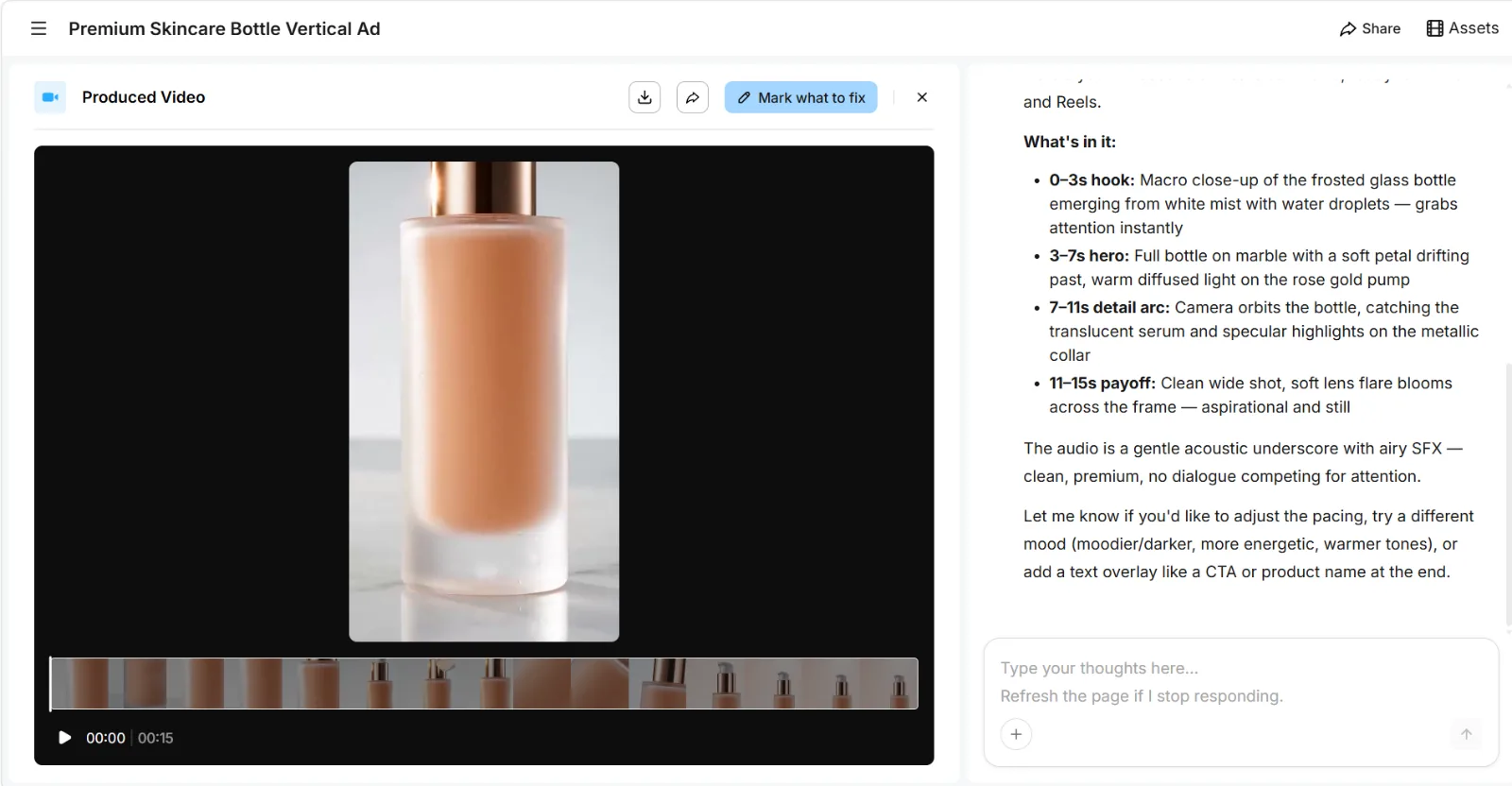 Inside the Pexo workspace: the actual 15-second vertical skincare ad it produced for this guide from a single one-line brief, alongside the shot-by-shot breakdown Pexo wrote for it. No editing pass.
What Is AI Video Generator Software?
AI video generator software is any tool that produces video from a non-video input such as text, an image, a URL, or audio, using generative models instead of a camera and a timeline. You describe what you want, the software generates it, and you get a clip back without filming or manual editing. That is the shared promise across all seven tools in this guide.
In practice the category splits three ways. Prompt-to-video models (Kling, Veo 3, Runway, Luma) take a written prompt and render short cinematic shots, typically 5 to 10 seconds per generation, with the visual quality rising fast in 2026. Avatar and talking-head tools (Synthesia, HeyGen) turn a script into a presenter-led video in 40 to 140+ languages, which is ideal for training and corporate content but not for ads or B-roll. Conversational AI video partners (Pexo) sit on top of multiple models and assemble a finished, edited video from a single conversation.
The limitation that sends people shopping for alternatives is almost always the same: most generative models stop at a raw 5 to 10 second clip and expect you to write a precise prompt to get it. You still have to know prompt syntax, stitch shots together, add sound, and pace the cut yourself. That gap between "a clip" and "a finished video" is exactly where the tools below differ most.
The Best AI Video Generators at a Glance
Here is the quick comparison. Pricing is verified as of June 2026; free tiers and entry paid plans change often, so check each official page before you buy.
| Tool | Best for | Standout strength | Free option | Paid from |
|---|---|---|---|---|
| Pexo | Idea to finished video without prompts | Conversational workflow across many models | Free to start | $30/mo |
| Kling AI | Cinematic realism | Top-ranked visual fidelity and motion | Free daily credits | ~$6.99/mo |
| Google Veo 3 | Prompt-accurate storytelling | Native audio plus tight prompt following | Limited via Gemini | ~$20/mo (Google AI Pro) |
| Runway | Creative control | Fine-grained camera and motion tools | Free trial credits | $12/mo |
| Synthesia | Talking-head business video | 230+ avatars, 140+ languages | Free demo only | ~$18/mo |
| HeyGen | Multilingual AI avatars | Avatars speaking 40+ languages | 3 videos/mo (watermark) | $29/mo |
| Luma Dream Machine | Fast prototyping | Quick generations, low learning curve | Free monthly credits | ~$10/mo |
The table is the fast answer. The sections below explain why each landed where it did, with a real screenshot, honest limitations, and the job each one is genuinely best at.
How We Evaluated These Tools
We judged every tool on four decision factors, weighted for the question most people actually have: can this get me a finished video I can post?
- Output quality: sharpness, motion stability, and how natural the result looks.
- Idea-to-finished-video speed: how much work sits between your input and something postable, not just how fast a single clip renders.
- Input flexibility: whether it accepts text only, or also images, URLs, and audio.
- Price transparency: free tier limits and honest paid entry cost.
To keep the comparison concrete, we framed every tool against one common job: turning a single product photo into a 15-second vertical ad with upbeat pacing. Because we build Pexo, we actually ran that brief through it and show the result at the top of this guide. For the competitors, which sit behind their own accounts and credit systems, we assessed how close each tool's documented workflow gets you to that finished ad, where it leaves you with a raw clip to assemble yourself, and what its published capabilities and pricing deliver. Those judgments are grounded in public data points such as G2 ratings, language counts, and independent benchmarks, cross-referenced against third-party review sites like G2 and current as of June 2026.
The 7 Best AI Video Generator Software Tools
1. Pexo, Best for Idea to Video Without Prompts
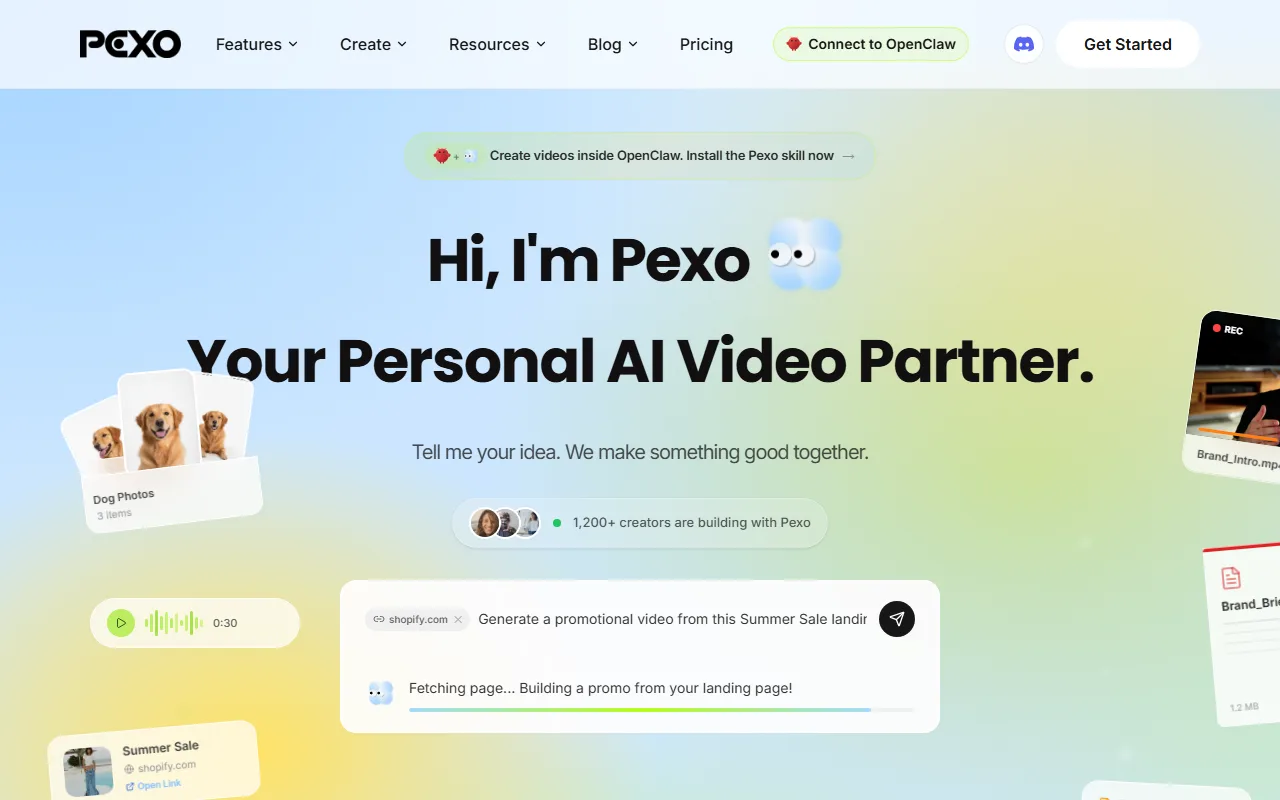 You describe the ad in plain language in Pexo's chat, and it returns a complete cut rather than a raw fragment.
Pexo takes a different shape from everything else on this list. Instead of a prompt box, it gives you a conversation: you describe the video you want the way you would text a friend, and Pexo thinks with you, picks the right model behind the scenes, and hands back a finished video with transitions, pacing, and sound already done. On the product-ad job, Pexo returned a postable cut from a single line of description: the ad at the top of this guide is that output, generated from one brief with no editing pass.
Its real differentiator is what it removes: there is no prompt to engineer and no model to choose. Most tools on this list are a single model behind a prompt box; Pexo works with Seedance, Sora, Kling, and more and routes each job to the model that fits, so you never write prompt syntax or weigh one model against another yourself. It accepts text, an image, a URL, or audio as the starting point, so you can turn a product photo into a video or run a full text-to-video brief in the same chat.
Who it is for: marketers, e-commerce sellers, and founders who want a finished ad or social clip without learning a generator. Where it falls short: if you are a VFX artist who wants frame-level manual control over a single shot, a raw model like Runway gives you more low-level levers than a conversational partner does. Pexo is designed to finish the video, not to be a manual editing suite. Pricing: free to start, with paid plans from $30/month (Pro), $60/month (Elite), and $100/month (Max), all credit-based with no watermarks on paid tiers. It is not the cheapest option here; the value is in skipping the prompt-and-edit work entirely.
2. Kling AI, Best for Cinematic Realism
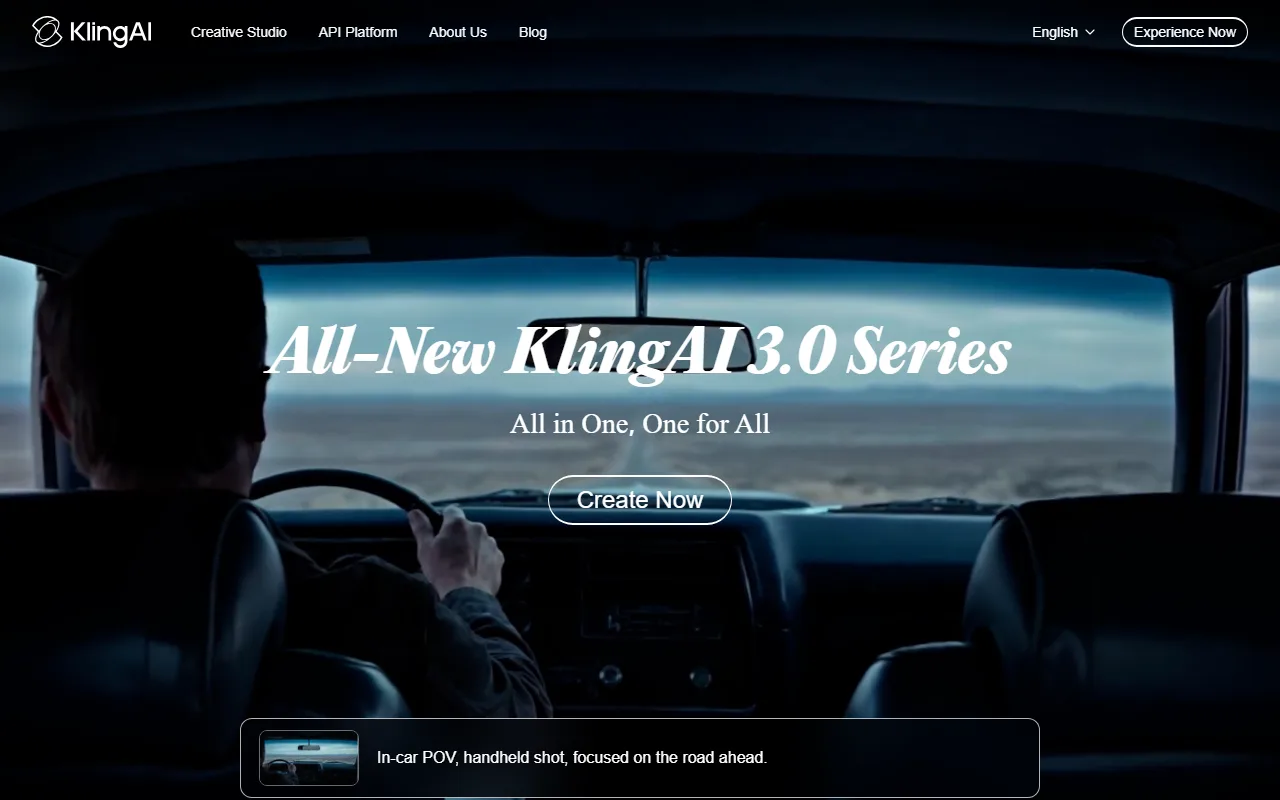 Kling AI's web interface, where you prompt high-fidelity cinematic shots.
Kling AI, built by Kuaishou and now on its 3.0 series, sits at the top of most 2026 video-quality benchmarks, ranking at or near the highest visual fidelity of any prompt-based model in independent tests. If your job is a single hero shot that needs to look genuinely cinematic, with realistic human motion, stable physics, and convincing lighting, Kling is the model to beat.
Its standout strength is raw output quality and motion consistency. Characters keep their proportions across a shot, and camera moves feel intentional rather than warped. The 3.0 generation renders up to 1080p and has extended single-clip length and prompt control over earlier versions, which is why it is widely regarded as a quality leader. Who it is for: creators and ad teams who want premium B-roll or a standout cinematic clip and are comfortable writing prompts to get it. Where it falls short: Kling generates a clip, not a finished video. You still write the prompt, generate short segments (typically 5 to 10 seconds each), then assemble, sound, and pace the final cut in another tool. The free daily credits deplete quickly, and the interface is heavier than beginner-friendly tools like Luma. It is a model, not a workflow. Pricing: free daily credits to try it; paid plans from roughly $6.99/month (Standard, 660 credits) up to about $25.99/month (Pro, 3,000 credits), with credits consumed per generation. You can read more about the underlying model on Kling's official page.
3. Google Veo 3, Best for Prompt-Accurate Storytelling
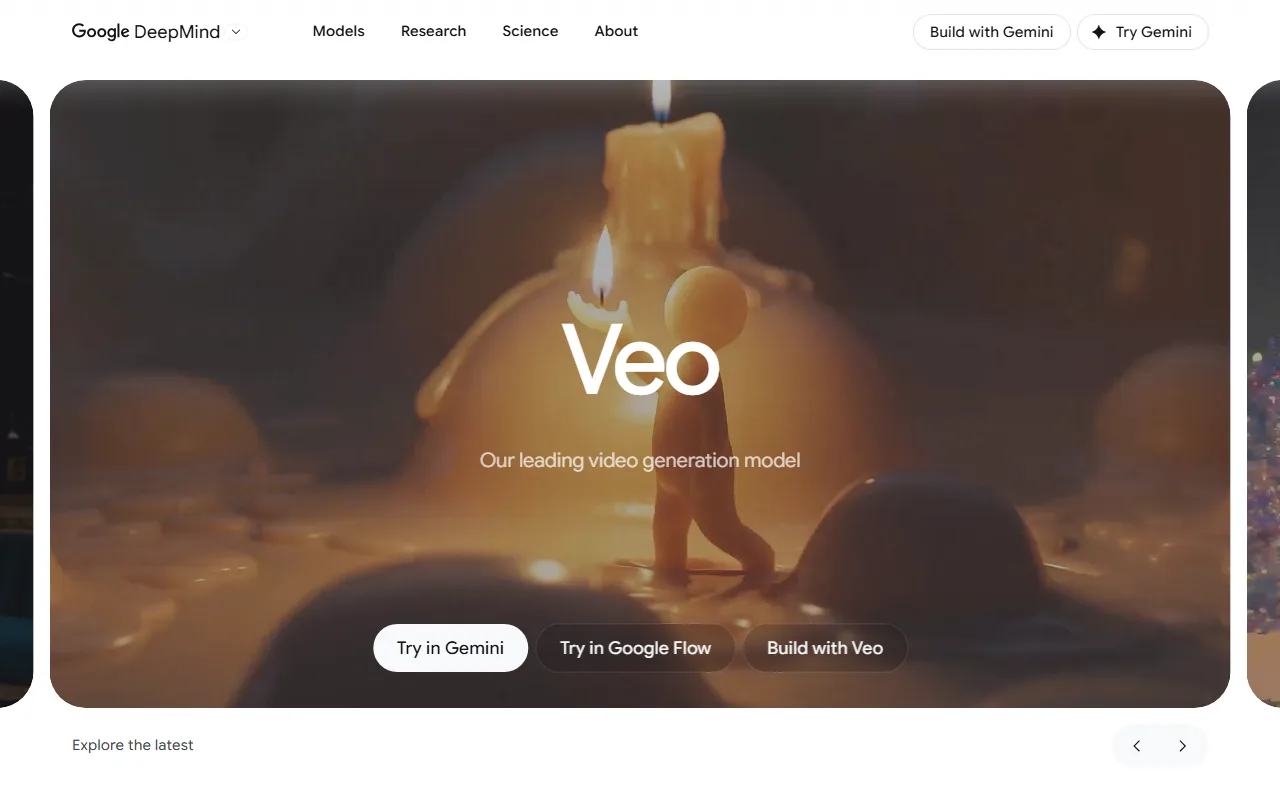 Google DeepMind's Veo model page, the entry point for its prompt-to-video generation.
Google DeepMind's Veo, on its Veo 3.1 generation as of June 2026, is the prompt-follower of the group. It tends to render exactly what you describe, with fewer hallucinations than most rivals, and it generates native audio (dialogue, ambient sound, effects) alongside the visuals, which most prompt-to-video models still cannot do. For narrative shots where the prompt is detailed and accuracy matters, it is excellent.
Its differentiator is the combination of tight prompt adherence and built-in sound, generating clips up to around 8 seconds at 1080p, with higher resolution on the top Ultra tier. You can use it inside the Gemini app for quick clips or in Google Flow, Google's dedicated AI filmmaking workspace, for stitching scenes into a longer piece. Who it is for: filmmakers, storytellers, and brand teams producing polished narrative or premium visuals who want output that matches a specific creative direction. Where it falls short: access is gated through Google's Gemini app and Flow rather than a standalone video studio, generation quotas on lower tiers are tight, and like the other raw models it produces shots, not an edited final video. Pricing: limited access through the Gemini free tier; fuller access via Google AI Pro at roughly $20/month, with higher Ultra tiers (around $250/month) for heavy or higher-resolution use. Details are on Google's Veo page.
4. Runway, Best for Creative Control
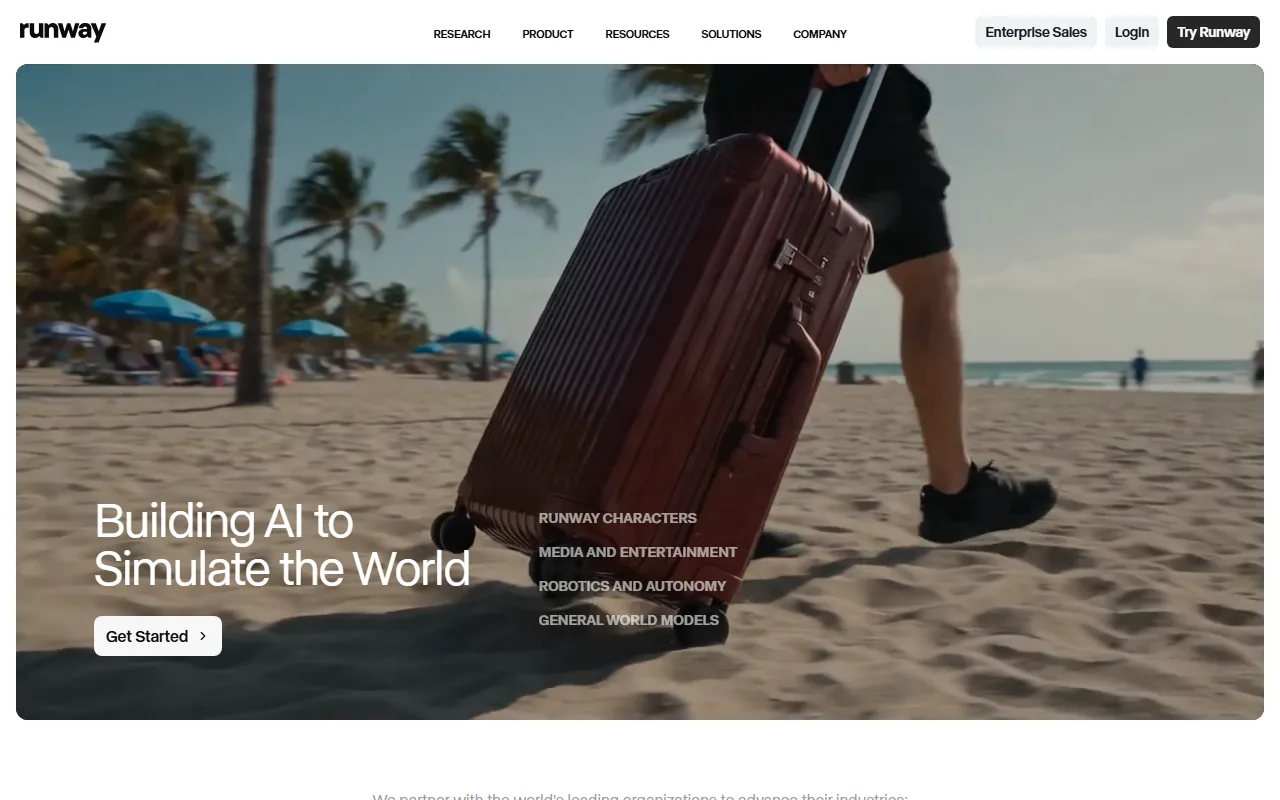 Runway's homepage, gateway to its motion and camera control suite.
Runway is the tool for people who want to direct the shot themselves. Its Gen-4 model plus a deep kit of motion brushes, camera controls, and director-style tools give you more low-level control than any other option here, and it carries a strong reputation among creative professionals, holding roughly 4.5 out of 5 across hundreds of G2 reviews. If you treat AI video as a craft and want to shape every move, Runway rewards that.
Its standout strength is granular creative control. Tools like motion brush (paint where movement happens), camera controls, and Act-One (drive a character's performance from a video of your own face) give you director-level levers no other tool here matches. Who it is for: video editors, motion designers, and VFX-minded creators who want to fine-tune output rather than accept a one-shot result. Where it falls short: that control is also the learning curve. Beginners regularly find the interface and the credit system overwhelming, the per-second credit burn adds up on longer projects, and you are still assembling a finished video from generated pieces. Runway has also been used on professional film and TV VFX work, which signals how high its ceiling goes in the right hands. Pricing: a free trial with limited one-time credits; paid plans from $12/month per user (annual) or $15/month (monthly) for Standard, scaling up for Pro, Unlimited, and Enterprise tiers. See Runway's official site for current limits.
5. Synthesia, Best for Talking-Head Business Video
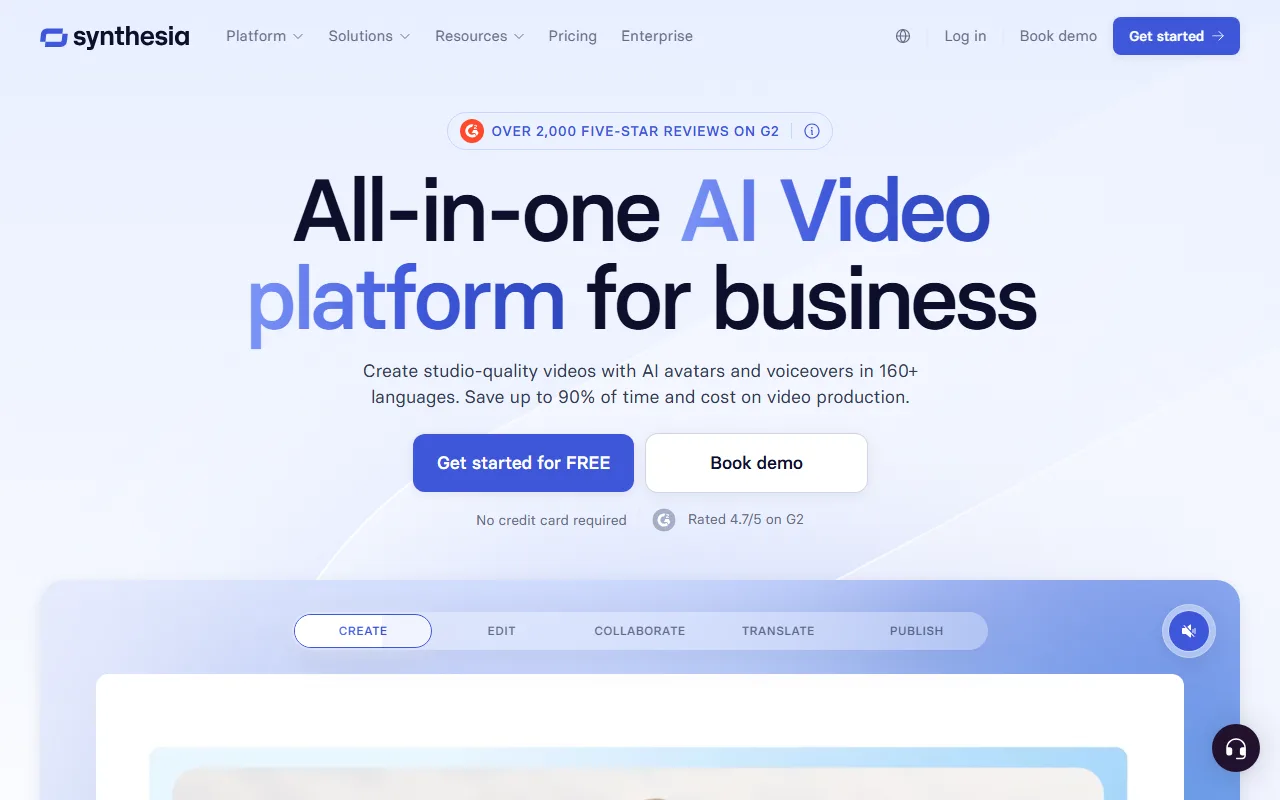 Synthesia's homepage, the all-in-one avatar video platform for business.
Synthesia owns the corporate avatar niche. You type a script, pick from 230+ AI avatars, and get a presenter-led video in 140+ languages, no camera, studio, or actor required. For training modules, internal comms, and how-to content at scale, it is the category leader and a recognized G2 favorite in the AI video space.
Its differentiator is breadth of avatars and languages plus a workflow built for repeatable business video, and the company reports being used by a large share of the Fortune 100 for internal content. You can also create a custom avatar of a real person, which is why it dominates enterprise training. Who it is for: L&D teams, HR, and SaaS companies producing localized training and explainer content at volume. Where it falls short: it is a talking-head tool, not a generative video model. It will not produce a cinematic product ad, dynamic B-roll, or anything outside the presenter format, the lower tiers cap you tightly on minutes, and there is no true free plan, only a demo. Synthesia also carries enterprise-grade security (SOC 2 and GDPR compliance), which matters for regulated teams choosing a video platform. Pricing: free demo to preview; paid plans from roughly $18/month (Starter, billed annually) with about a 10-minute monthly video cap, scaling to Creator and Enterprise. Current plans are on Synthesia's pricing page.
6. HeyGen, Best for Multilingual AI Avatars
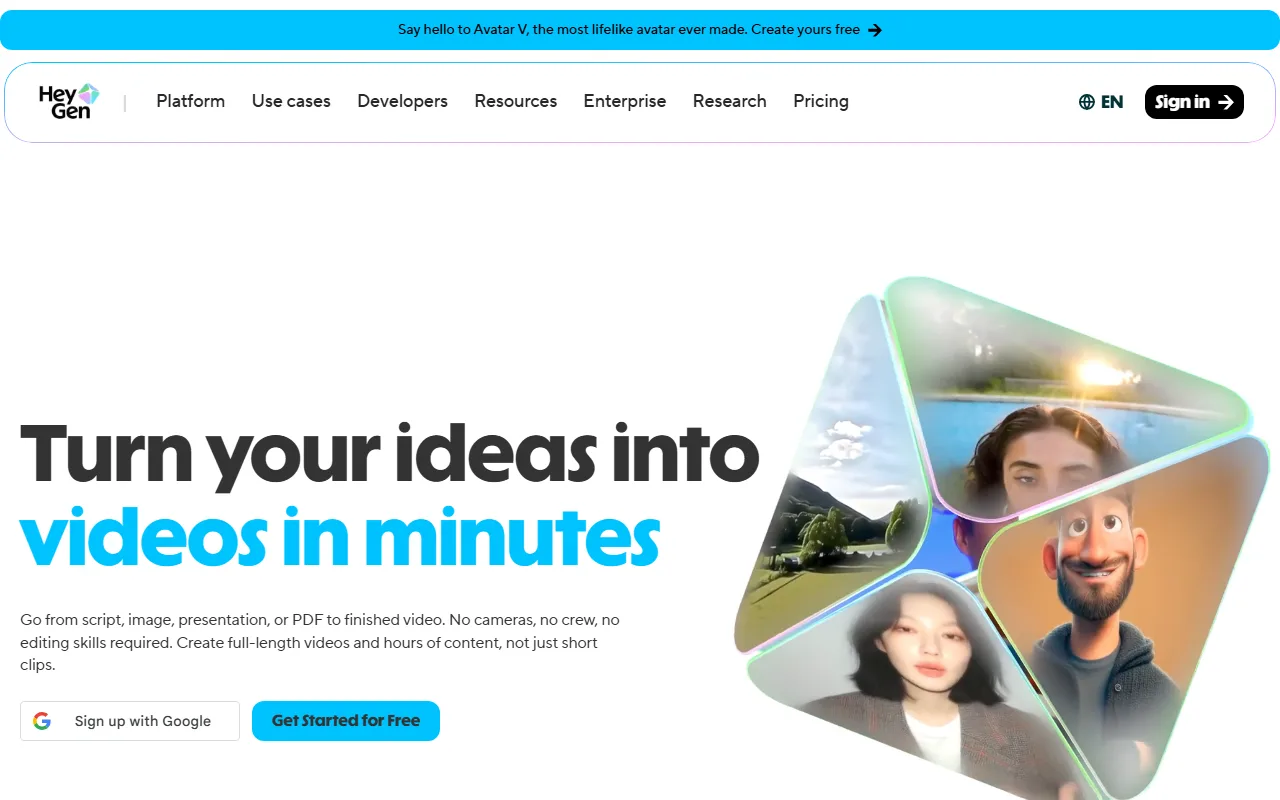 HeyGen's homepage, built around avatars and realistic voice translation.
HeyGen is Synthesia's closest rival and the better pick if multilingual reach and a usable free tier matter. Its avatars speak 40+ languages with strong lip-sync, and its video-translation feature is among the best for turning one recording into many localized versions. It is the rare avatar tool that lets you actually test the output free before paying.
Its standout strength is multilingual avatar quality and translation. You can spin up an instant avatar from a short webcam recording, and the video-translation feature preserves the speaker's voice across languages, which is a genuine time-saver for global campaigns. Who it is for: marketers and creators localizing spokesperson videos, plus anyone who wants to try avatar video without a paywall. Where it falls short: like Synthesia, it is avatar-first, so it is not the tool for generative ads or cinematic scenes, the free plan watermarks output and caps you at 3 videos per month, and credit limits on paid tiers can bite if you produce heavily. It also holds a strong reputation for output reliability, sitting around 4.8 out of 5 across thousands of G2 reviews. Pricing: free plan with 3 videos/month (watermarked); Creator plan at $29/month with unlimited videos plus 200 monthly credits, scaling to Team and Enterprise. See HeyGen's pricing for details.
7. Luma Dream Machine, Best for Fast Prototyping
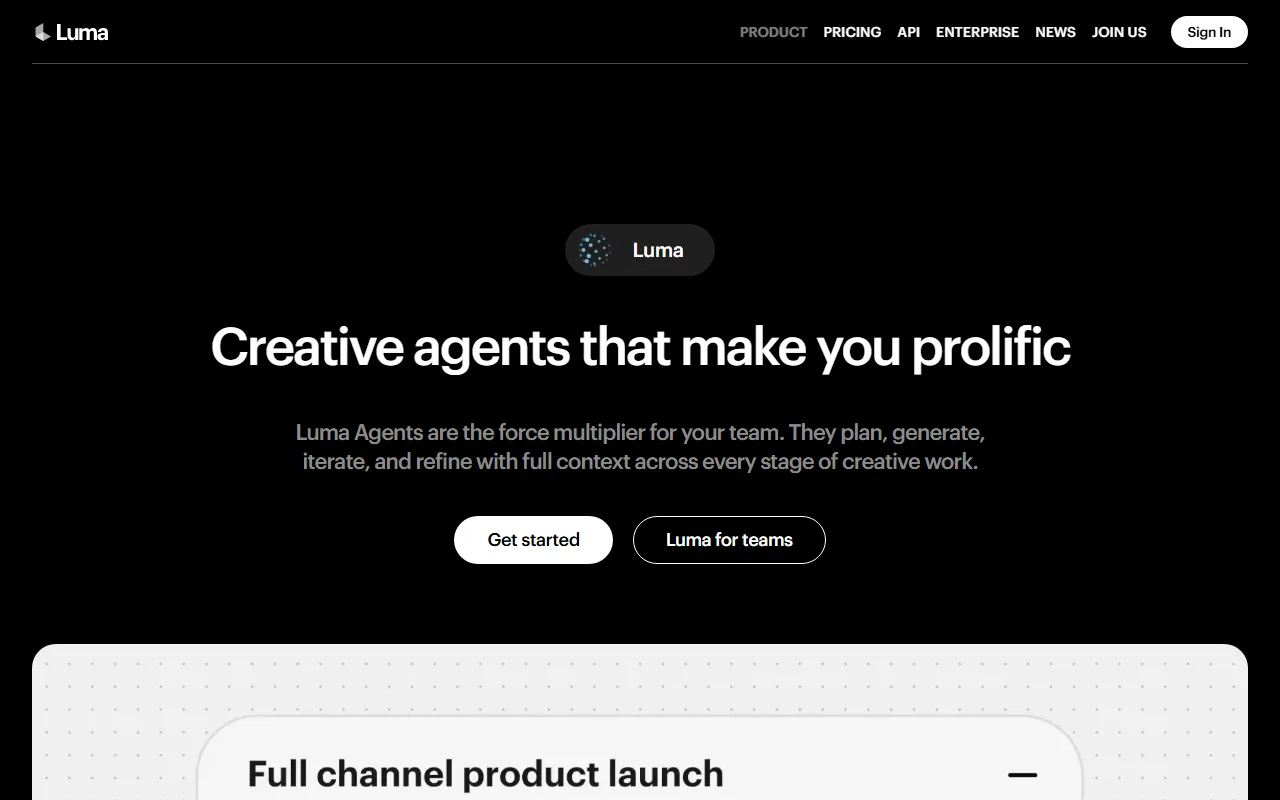 Luma's product site, home of the Dream Machine generation model.
Luma's Dream Machine is the quick-iteration option. Running on its Ray2 model, it generates short clips fast and with a low learning curve, which makes it ideal for prototyping a concept or testing a visual idea before committing real production time. When you just need to see whether an idea works, Luma gets you there with the least setup.
Its differentiator is speed and simplicity for early ideation. Ray2 generates short clips in well under a minute, and keyframe controls let you set a start and end image to guide the motion, which is handy for testing a transition idea. Who it is for: creators and teams who want to rapidly storyboard or sketch a visual concept before committing to a heavier tool. Where it falls short: quality and prompt accuracy trail Kling and Veo on demanding shots, clips run short at roughly 5 to 10 seconds, and free monthly credits are limited, so heavy testing runs out fast. It is a prototyping model, not a finishing tool. Luma also exposes an API and a companion image model (Photon), so teams can build the fast generations into their own pipelines. Pricing: free tier with limited monthly generations; paid plans from roughly $10/month (Lite), scaling up for more credits, faster rendering, and commercial use. See Luma Labs for current plans.
How to Choose the Right AI Video Generator
Match the tool to the job, not the hype. Here is the short decision guide based on what you are actually making.
- You want a finished ad or social video from an idea or a product photo, fast: start with Pexo. The conversational workflow means no prompt syntax and no manual editing, and you can make a video ad from a single photo in one chat.
- You need one cinematic hero shot and you can write prompts: Kling AI for raw quality, or Veo 3 if you also need native audio and exact prompt accuracy.
- You want to direct every motion yourself: Runway gives you the deepest manual control.
- You are producing training or spokesperson videos at scale: Synthesia for avatar breadth, HeyGen if you need a free tier and heavy multilingual localization.
- You are just testing whether an idea works: Luma Dream Machine for the fastest prototype.
The honest summary: the raw models win on a single shot, the avatar tools win on presenters, and a conversational partner wins when you want the whole video done without becoming a prompt engineer or an editor.
Conclusion
There is no single "best AI video generator software," only the best one for the job in front of you. If your work is cinematic single shots, Kling AI and Google Veo 3 lead on raw quality. If it is localized training video, Synthesia and HeyGen are the safe picks. But if you want to go from a rough idea to a finished, ready-to-post video without learning prompt syntax or stitching clips together, Pexo is the one built for that exact gap. You describe what you want, it picks the right model and finishes the cut, and you stay in the conversation the whole way.
Ready to skip the prompts? Start creating with Pexo and turn your next idea into a finished video in one conversation.