 ChatGPT
 Perplexity
 Claude
 Gemini
 Grok
Grok


If you came here to pick between InVideo and Sora in 2026, I have news that settles half the debate before we start: Sora's consumer apps are gone. OpenAI discontinued the Sora web and mobile experiences on April 26, 2026, and the Sora API is scheduled to follow on September 24, 2026. So the real question for most people is no longer "which one makes better video," it is "InVideo is what's left, so is it actually any good?"
I went in to test both. One of them I couldn't test at all anymore, and the other one would not finish a single video for me on its free plan. Here is the honest picture, with screenshots.## At a Glance: InVideo vs Sora (June 2026)
| InVideo | Sora | |
|---|---|---|
| Status | Live and active | Apps discontinued Apr 26, 2026; API ends Sep 24, 2026 |
| What it is | AI video agent (script, footage, voiceover, edit) | Raw text to video generation model (OpenAI) |
| Best at | Finishing a whole video from a prompt | Photoreal, physically accurate clips (while it lasted) |
| Free tier | Yes, but a few credits only (≈ not one full video) | No longer available |
| Entry price | Plus from $17/mo billed annually ($200/yr) | N/A (shut down) |
| Can you use it today? | Yes | No |
A side by side snapshot of where both tools stand as of June 2026.
What Happened to Sora (and What It Means for You)
This is not a rumor, so let me anchor it to the source. OpenAI's own help center confirms it plainly: "The Sora web and app experiences were discontinued on April 26, 2026," and "The Sora API will be discontinued on September 24, 2026." You can read it on the official OpenAI Sora discontinuation notice.
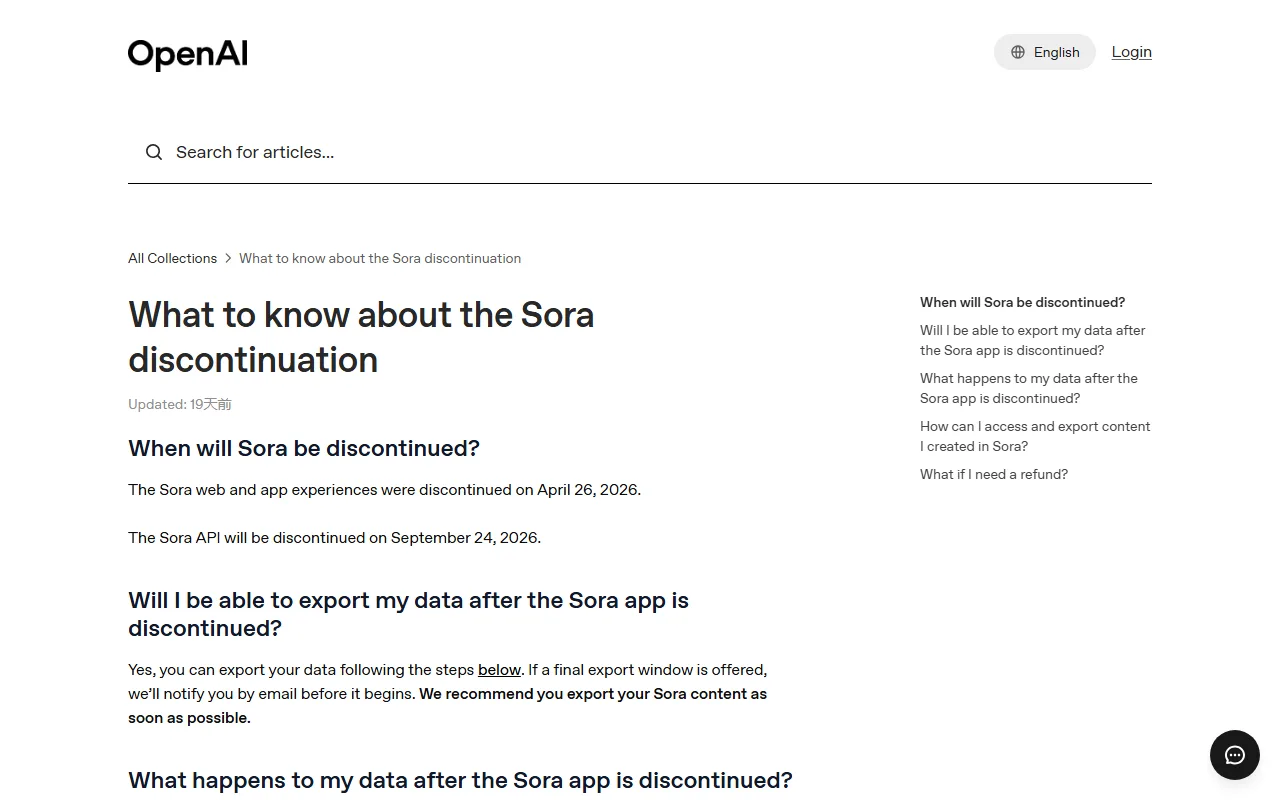 OpenAI's official notice: the Sora apps closed in April 2026 and the API closes in September 2026.
In practice that means three things. First, sora.com and the Sora iOS and Android apps no longer work, so there is nothing to log into. Second, if you had a ChatGPT plan and used Sora through it, that access ended too. Third, if you ever made anything in Sora, OpenAI says to export your data before the cutoff, because after these dates the account data is deleted. As for why, OpenAI did not give a single official reason, but widely reported coverage) tied the shutdown to the cost of running video generation, which is far more expensive than text or images, with reporting putting Sora's compute bill in the neighborhood of a million dollars a day. Whatever the cause, the outcome for you is the same: Sora is not a tool you can choose anymore.
What InVideo Is in 2026: An Agent, Not Just a Generator
InVideo did not stand still. The product I logged into is built around "Agent One," an AI agent that takes your prompt, writes a plan, and then tries to build the video for you across several steps. The pitch is that you describe what you want and it handles the script, the footage, the voiceover, and the assembly. On paid plans it also routes to outside generation models for the raw clips, so the heavy lifting is done by whatever model fits, not by InVideo alone.
That is genuinely a different shape from Sora. Sora handed you a single raw clip. InVideo tries to hand you a finished, narrated, edited video. When it works, that is less assembly for you. The catch, as I found out, is that "when it works" has a price tag attached well before you see a result.
My Hands-On: I Asked InVideo for One 8 Second Clip
I gave InVideo a simple, single prompt: a golden retriever puppy running through a sunlit autumn park, leaves swirling as it leaps, cinematic and shallow depth of field, 8 seconds. Nothing exotic. The agent picked it up, asked "Ready to make it real?", and when I said yes it spun up a plan: one brief, two phases, and three tasks.
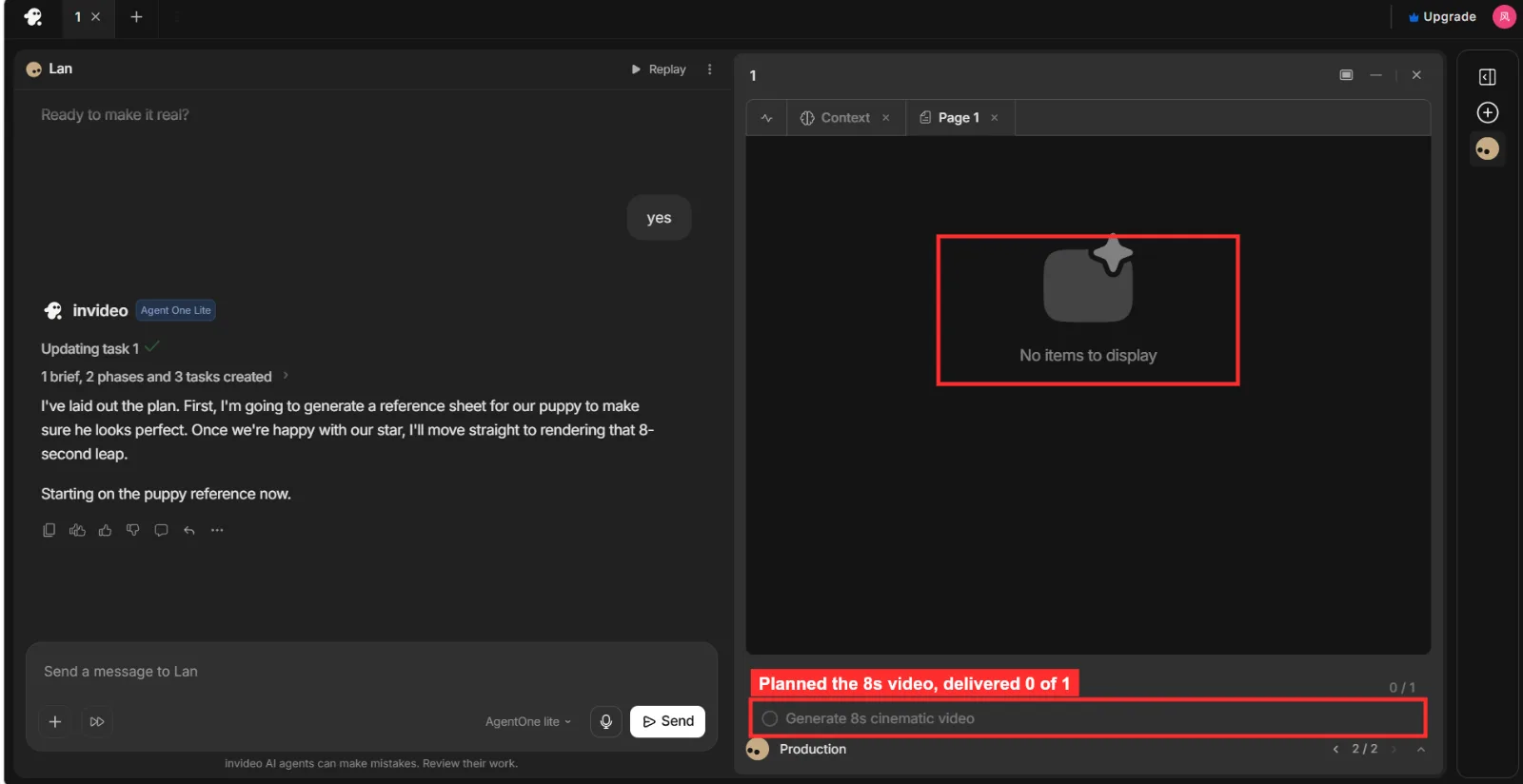 InVideo's agent created a plan and a "Generate 8s cinematic video" task, but the output panel stayed empty.
Then it told me its approach: it would first generate a "reference sheet" to lock the puppy's look, then render the 8 second leap. It did produce that reference sheet, a tidy grid of puppy stills. And that is exactly where the run ended. Checking billing, the agent reported it needed about 14.6 credits for the generations, while my free balance sat at roughly 3.3, and it asked me to upgrade or buy credits to continue.
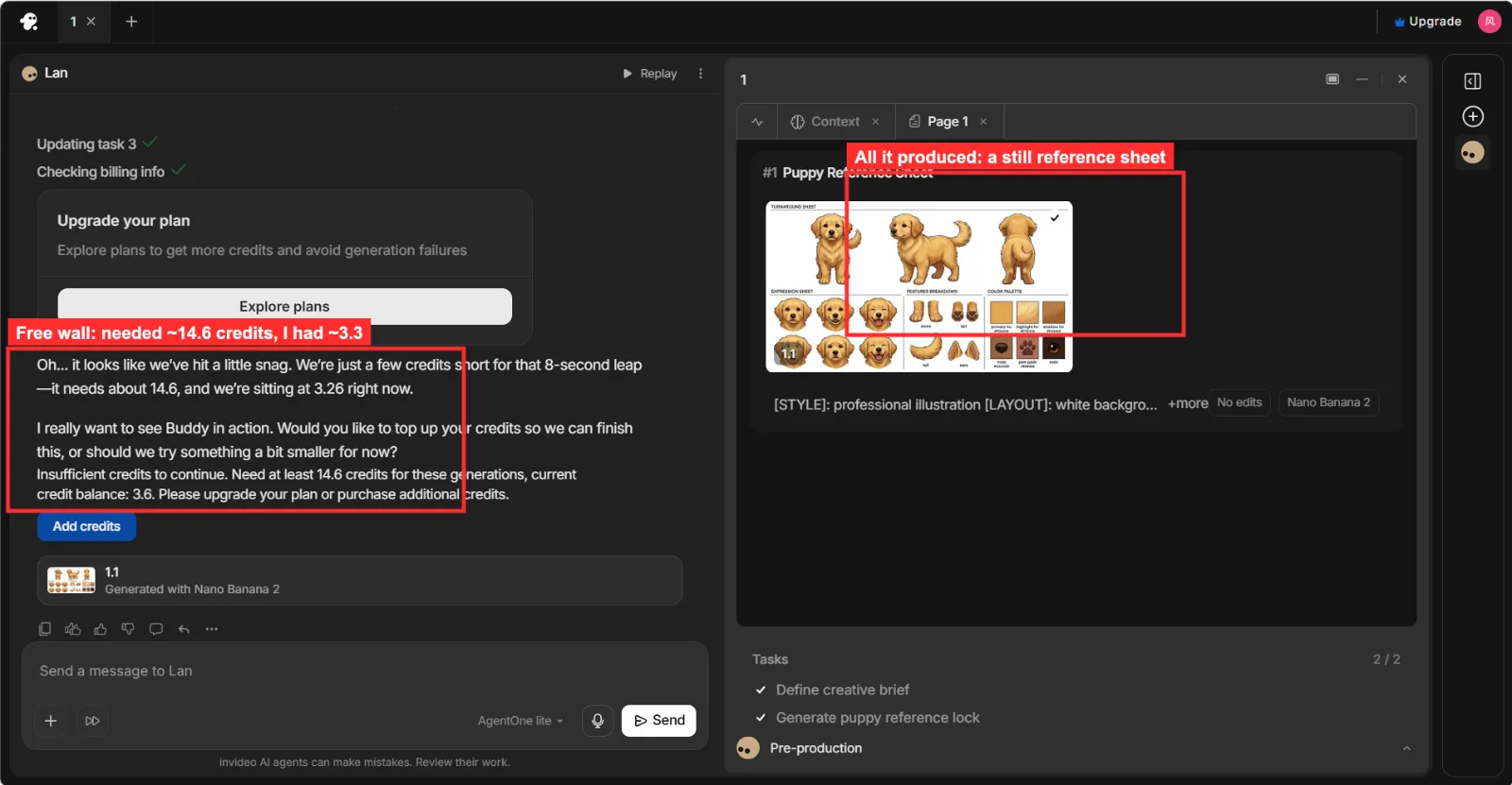 The free run stopped at a credit wall. It needed about 14.6 credits, I had about 3.3, and the only thing it produced was a still image.
So the honest scorecard for my test: InVideo produced a still reference image and zero seconds of video before asking for money. I never saw the puppy move. To be fair, this is a free tier doing what free tiers do, and a paying user would have sailed past it. But if your plan was to "try it for free and see," know that one short clip is more than the free balance allows.
What It Actually Costs to Finish a Video
I want to be careful here, because price is not the whole story and the numbers move. As of June 2026, InVideo's pricing page lists Plus at $17/mo billed annually ($200/year) for 75 credits a month, Max at $85/mo annually for 390 credits, Generative at $170/mo for 800 credits, and an Elite tier at $900/mo. Everything is denominated in credits now, and credits are consumed per generation.
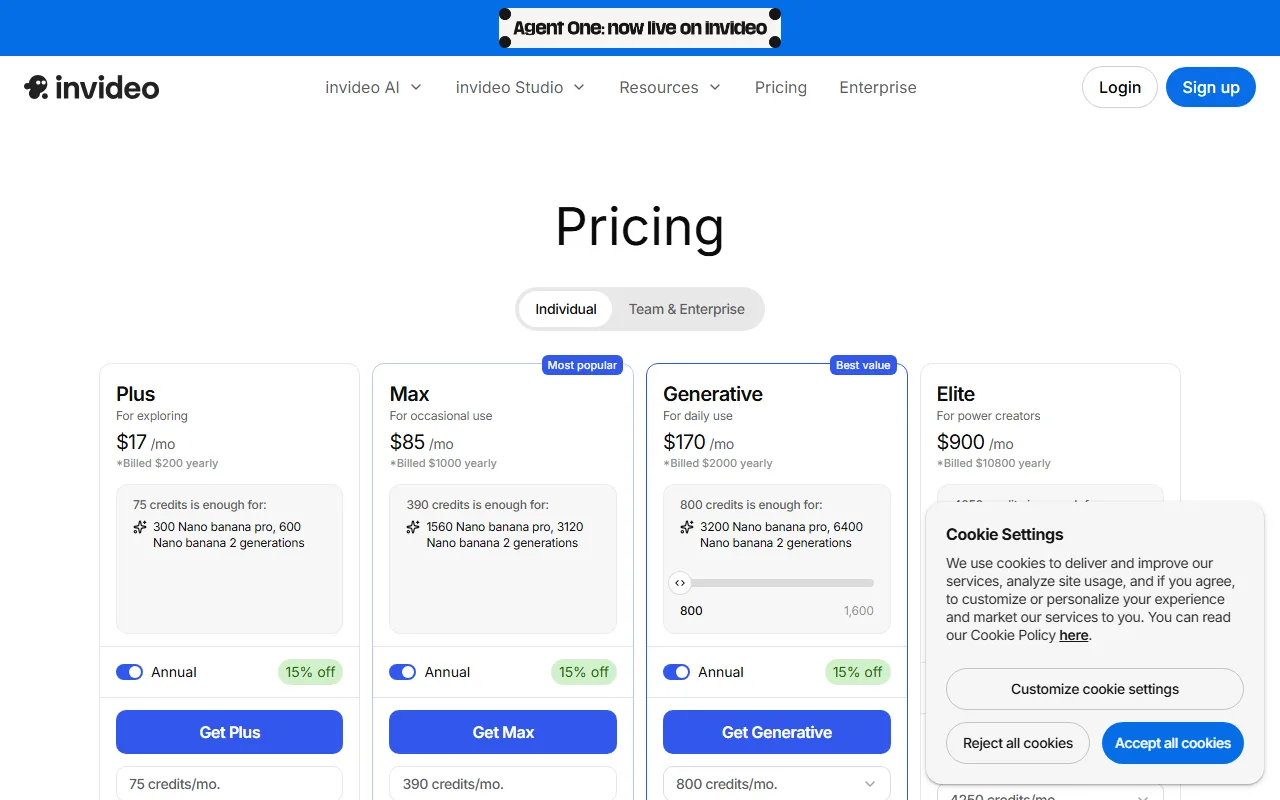 InVideo's 2026 pricing is credit based. Plus starts at $17 a month billed annually for 75 credits.
Put that against my test. My one attempt wanted about 14.6 credits. At that rate, Plus's 75 credits a month works out to roughly five of those short cinematic generations before you run dry. That is not a knock by itself, it is just the math you should do before subscribing: decide how many videos you actually make per month and check it against the credit allowance, not against the headline price.
Where Each One Falls Short
Neither tool is a clean win, so here is the candid version for both.
InVideo's weak spots. The free tier is effectively a demo. It let me plan a video and make a still, then stopped at the paywall, which is a frustrating place to hit a wall if you wanted proof before paying. The agent flow also adds steps: it wanted to generate a reference sheet first, which is thoughtful but burns credits and time on something that is not your final clip. And the credit model means your real cost depends on usage, which is harder to predict than a flat "X videos per month."
Sora's weak spots. The biggest one is fatal: it is being shut down, so there is no path to use it as a standalone product. Even before that, Sora gave you a raw clip, not a finished video, so you still needed to edit, add audio, and assemble. And running it was expensive enough that, by reported accounts, the economics are part of why it is closing. A brilliant model you cannot access is, for planning purposes, not an option.
Choose InVideo If, and What to Do If You Wanted Sora
Here is the decision routing, kept practical.
Choose InVideo if you want one place to go from a text prompt to a finished, narrated video without editing it yourself, and you are willing to pay for credits rather than expecting a free clip. It also fits if you make videos regularly enough to use a monthly credit allowance, or if you want an agent to draft the whole thing and you refine from there.
If you specifically wanted Sora, your options are: accept that the standalone product is gone and export any old Sora data before the cutoff dates; or move to a tool that gives you comparable text to video generation. InVideo is a reasonable landing spot because it focuses on the finished video rather than a raw clip, but if it is Sora's raw photoreal look you were after, judge any replacement on that specific quality before you commit. Test one real clip first, ideally past the free wall, so you are buying on results and not on the marketing.