 ChatGPT
 Perplexity
 Claude
 Gemini
 Grok
Grok
Vibe marketing is the practice of directing AI systems to produce and run marketing work, rather than executing each asset by hand. A marketer sets the audience, the offer, and the emotional tone, then AI agents generate the copy, visuals, video, and distribution, in fast, repeatable loops. The term extends vibe coding, which Andrej Karpathy named in February 2025 for building software by describing intent instead of writing every line. Vibe marketing applies the same shift to campaigns. Where vibe coding turns a description into working software, vibe marketing turns a positioning brief into a finished campaign, with a human curating for taste at every step rather than producing every asset.
The paradigm sits inside a small family of "vibe" terms spreading from the same root idea. Vibe coding covers software. Vibe scripting covers the specific act of turning a video idea into a production script. Vibe marketing is the umbrella for the marketing function as a whole, copy, visuals, video, and distribution together, directed by one person or a small team instead of a department of specialists.
What Vibe Marketing Actually Is
Vibe marketing replaces hands-on production with hands-on direction. Instead of writing every headline, designing every graphic, and cutting every clip, a marketer defines the direction (who the campaign is for, what feeling it should carry, what the brand never sounds like) and AI systems generate the drafts, variants, and assets against that direction. The marketer's judgment, not their typing speed, becomes the bottleneck and the asset.
It is worth separating vibe marketing from two things it gets confused with. It is not one-click template marketing, where a tool spits out a finished asset with no direction step. And it is not simply "using AI tools," the way a marketer who runs one prompt through a chatbot for a headline is not doing vibe marketing any more than a developer who autocompletes one function is vibe coding. The defining feature is the loop, direction feeding generation, generation feeding a test, the test feeding the next round of direction, repeated fast enough that a week's worth of campaign iteration compresses into a day.
How Vibe Marketing Works
The workflow has four repeatable beats, regardless of which tools sit underneath it.
Direction. The marketer writes a short brief, the audience, the offer, three or four adjectives for the vibe, and one sentence on what the brand never sounds like. This step cannot be automated away. Every failure mode in vibe marketing traces back to a weak or missing direction step, because generic AI output with no direction just produces generic content faster.
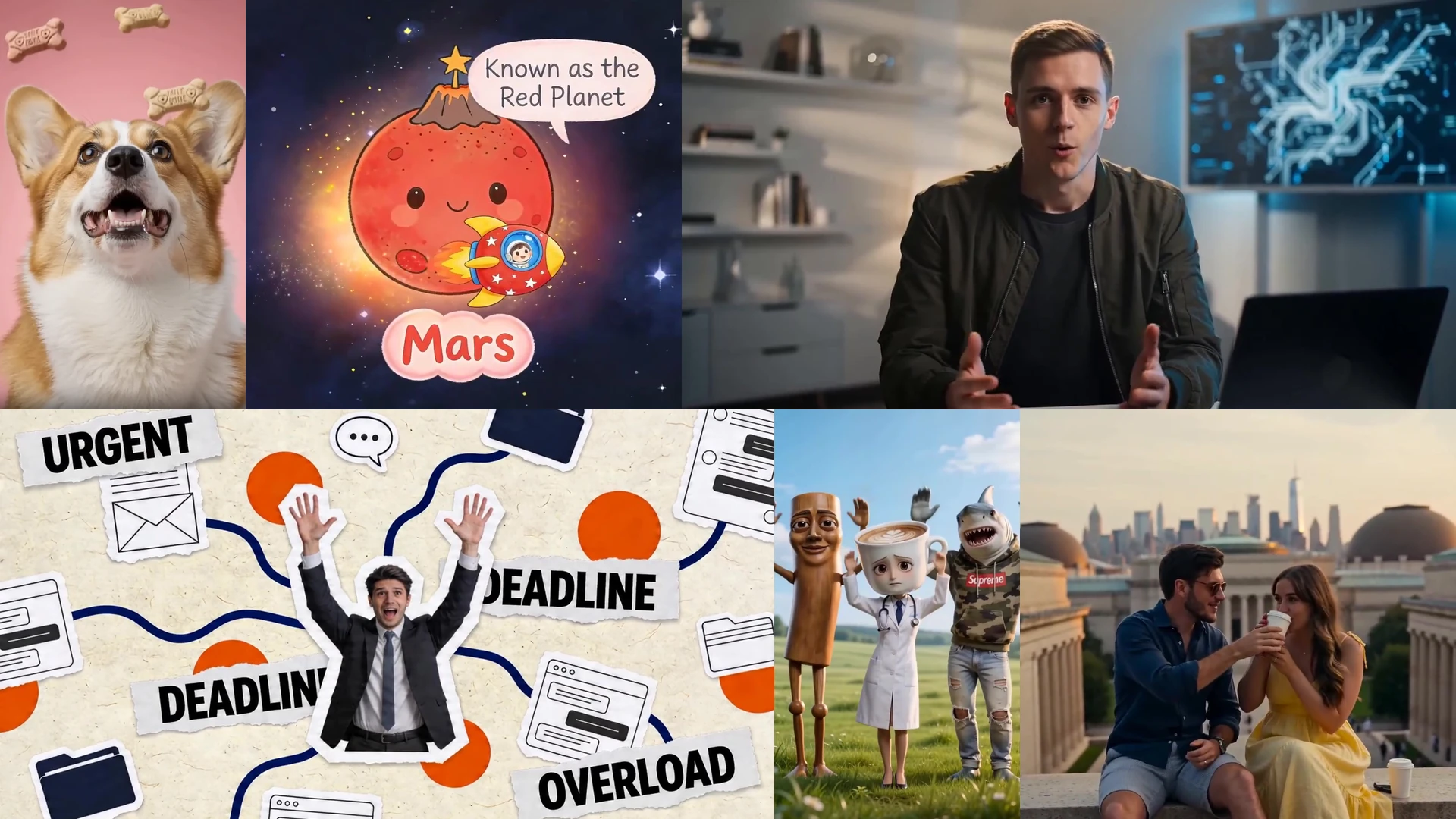
Generation. AI agents produce assets in volume against that direction, a batch of headline variants, matching visuals from an AI image generator for marketing, a short video, a landing page. The generation step is where most of the manual hours that used to fill a marketer's week disappear.
Test. The variants ship as small, cheap, live experiments rather than one big bet. A handful of hook lines might run as low-budget ad creative for a day before the team knows which angle is working.
Iterate. The marketer reads the results, tightens the direction based on what actually resonated, and runs the loop again. Each pass sharpens the brief, which sharpens the next batch of generated assets.
| Layer | Traditional marketing | Vibe marketing |
|---|---|---|
| Human role | Executes each asset by hand | Directs, curates, and approves |
| Team shape | A specialist per function | One generalist plus an AI stack |
| Cycle time | Weeks per campaign | Hours per loop |
| Testing approach | A few large bets | Many cheap variants run in parallel |
| Primary cost | Headcount and agency retainers | Software subscriptions and generation credits |
| Main risk | Slow, expensive misses | Generic output if the direction is weak |
Vibe Marketing vs Vibe Coding vs Vibe Creating
These three terms share a mechanism (describe intent, review output, redirect) but apply it to different outputs. Vibe coding produces software from a description. Vibe creating is the broader creative-production version of the same shift, most visible in image and video work. Vibe marketing is the campaign-level umbrella, it draws on vibe creating for its visual and video layers and adds the marketing-specific loop of direction, generation, test, and iterate against a business goal. A marketer doing vibe marketing is very likely also doing vibe creating for the video and image assets inside that campaign, the two overlap rather than compete.
Where Vibe Marketing Fits
The paradigm shows up differently depending on team size and industry, but a few shapes repeat.
Solo operators and small teams. A founder or a two-person marketing team runs always-on content across two or three channels, looping AI generation against a strong voice guide instead of hiring a full content team. This is the segment where the paradigm shift is most visible, because the alternative (hiring specialists for every function) simply is not on the table at that scale.
Performance and growth teams. Ad-creative testing moves from a handful of manually built variants per week to dozens of hook-and-visual combinations, with spend following whichever variant wins rather than a creative meeting deciding in advance.
B2B and SaaS. A product release note becomes a matched set, a launch email, a changelog post, a few social hooks, and a short explainer clip, generated from one direction doc and reviewed in a single sitting instead of routed through separate writers, designers, and video editors.
Trend-response marketing. A fast-moving loop is what lets a brand catch a rising cultural moment and ship an on-vibe reaction while it is still climbing, instead of routing the idea through a creative brief and an approval chain that outlasts the trend.
Adoption is no longer confined to startups experimenting with a new workflow. One tracking community reports, by its own count, thousands of practitioners across dozens of countries within the first year of the term circulating, and the same source reports close to half of Fortune 500 companies now running some form of AI-directed marketing workflow, a figure worth reading as self-reported rather than independently audited. One vendor guide reports cycle times compressing from roughly eight weeks to a few days for teams that adopt the loop fully, a claim worth treating as directional rather than a guaranteed result, since it comes from a company selling into this workflow.
Tools That Enable Vibe Marketing
The stack spans six functional layers. No single tool covers all six, and most vibe marketers assemble a small set rather than buying one platform.
| Layer | What it does | Example tools |
|---|---|---|
| Foundation / reasoning | Drafts copy, plans campaigns, orchestrates other tools | Claude, ChatGPT, Gemini |
| Visual generation | Produces statics, product imagery, and graphics | Midjourney, Krea |
| Video generation | Turns a description into a finished, edited video | Pexo, Higgsfield, Runway |
| Build tools | Turns a description into a landing page or micro-site | Cursor, Lovable, Replit |
| Automation | Chains steps together and pushes output to channels | n8n, Make, Zapier |
| Distribution and analytics | Sends the work out and reports on what happened | Klaviyo, HubSpot, Buffer |
The video layer is usually the hardest to loop, because traditional video production (scripts, filming, editing, revisions) resists the fast iteration the other layers get for free. Conversational AI video agents change that math. Pexo, for example, takes a plain-language brief and returns a finished, edited video with sound rather than a raw clip, which keeps the video layer inside a weekly loop the way a copy draft already is. It sits alongside avatar-led tools such as HeyGen and Synthesia (presenter-style video) and single-shot generators (one clip per generation, assembled by hand), each suited to a different piece of the video layer.
Getting Started With Vibe Marketing
A first loop does not require a platform migration. Five steps get a team running.
- Write a one-page direction doc, the audience, the offer, three adjectives for the vibe, and one sentence on what the brand never sounds like.
- Pick one channel and one goal for the first week, a short-form social post with a click-through target is a reasonable starting scope.
- Generate in volume against that direction, a batch of headline variants from a copy assistant and matching visuals from an image model.
- Add the video layer if the campaign needs it, describe one clip to a conversational video agent and review the shot plan before it renders.
- Ship the strongest few variants with a small budget, read the results, and feed what worked back into the direction doc before the next loop.
The skill that compounds is not prompting, it is writing a direction doc precise enough that AI-generated volume stays on-brand instead of drifting toward generic output.
Related Reading
- The Wikipedia entry on the vibe coding origin term
- Best AI Video Generator for Marketing
- Claude Code Marketing Video Playbook
Resources
| Tool | URL | What it does |
|---|---|---|
| Pexo | https://pexo.ai | Conversational AI video agent, plain-language brief to finished edited video |
| HeyGen | https://www.heygen.com | AI avatar and presenter-style video |
| Synthesia | https://www.synthesia.io | AI avatar video for training and explainer content |
| n8n | https://n8n.io | Workflow automation connecting AI tools and channels |
| Klaviyo | https://www.klaviyo.com | Email and SMS distribution with AI-assisted campaign tools |
| Midjourney | https://www.midjourney.com | AI image generation for visual assets |