
 ChatGPT
 Perplexity
 Claude
 Gemini
 Grok
Grok

AI-generated video is projected to account for 10% of all digital video in 2026. On TikTok, 59% of the first 500 videos served to a brand new account are AI-generated, against 21% on YouTube Shorts. Only 9.5% of people can reliably tell an AI-generated video from real footage, yet nearly 83% say they have watched one they suspected was synthetic.
Every figure below was checked against the organization that published it, not against another roundup. Sample sizes are stated. Where two sources disagree, both appear.
The Volume: How Much Video Is Actually AI-Made
The clearest measurement of AI video density comes from Kapwing's original research, published July 2026, which analysed the first 500 videos served to brand new accounts on both TikTok and YouTube Shorts, plus a category-level breakdown of TikTok.
- 59% of the first 500 TikTok videos served to a new account were AI-generated.
- 21% of the first 500 YouTube Shorts were AI-generated, with a further 33% falling into what Kapwing classes as "brainrot", meaning low-effort content whether or not a model made it.
- The category with the highest share of low-effort content on TikTok is Kids at 57.4%, followed by Science and Education at 35.0%, Health at 33.8% and History at 33.5%.
- Counting filters and voiceovers as well as fully synthetic clips, roughly 52% of all TikTok content now involves AI in some form.
- Across all platforms, AI-generated video is projected to reach 10% of all digital video in 2026.
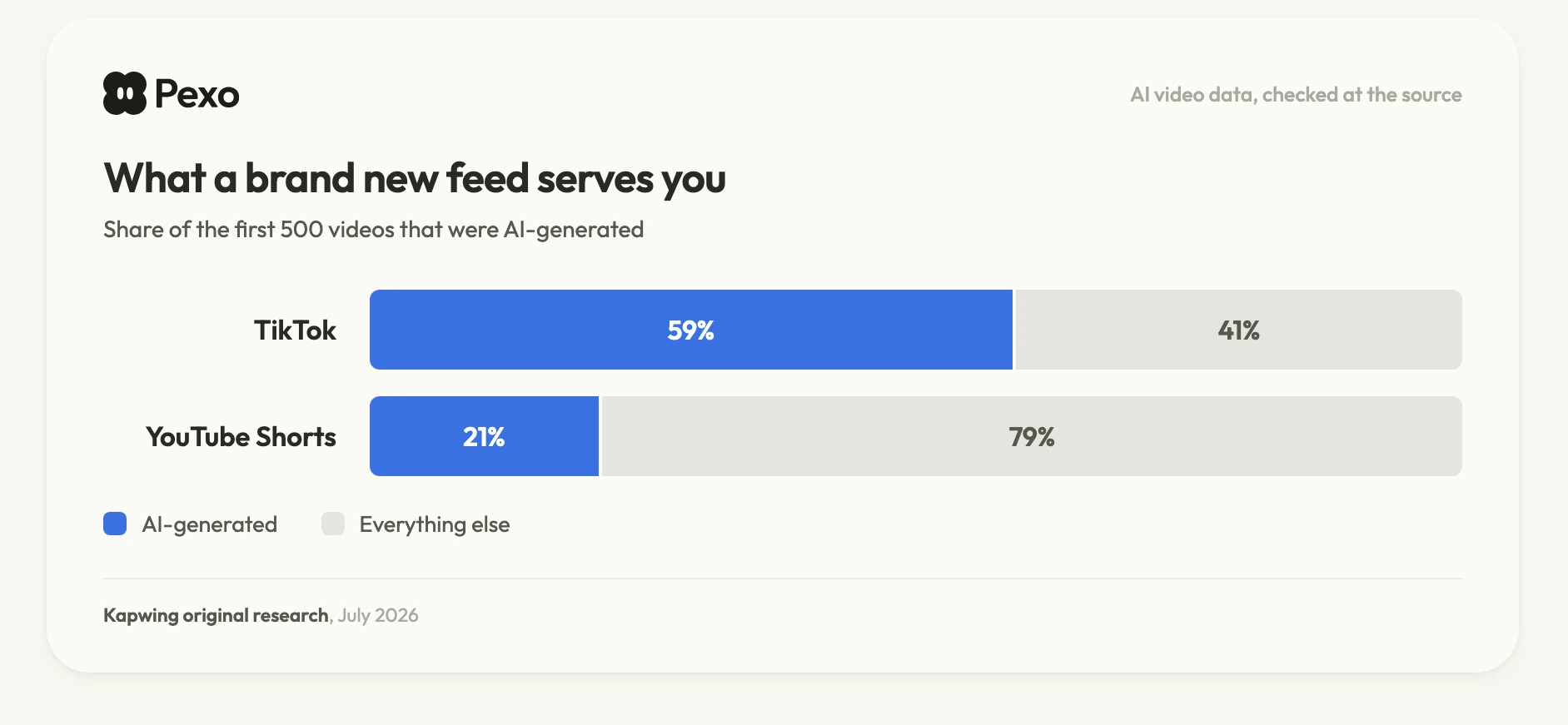
Read the method before you reuse these numbers. The 59% and 21% figures measure what a recommendation algorithm serves to a fresh account. That is not the share of everything uploaded, and the two can differ substantially. It is the right measure for "what will my video be competing against" and the wrong measure for "how much AI video exists".
The platform split matters if you are choosing where to publish. A cold TikTok feed is majority synthetic while Shorts sits closer to a fifth, which means the competitive baseline and the viewer's calibrated expectation are different on each. The practical constraints differ too, which is why the approach to AI video for TikTok and the approach to YouTube Shorts are not interchangeable.
The Makers: Who Is Producing AI Video and How Fast
Marketers
- 63% of video marketers have used AI tools to create or edit marketing video, up from 51% a year earlier (Wyzowl, 12th annual State of Video Marketing, 2026). That 12-point jump was the fastest-moving figure in the survey.
- 91% of businesses use video as a marketing tool, back to joint all-time highs after a slight dip in 2025 (Wyzowl, 2026).
- 92% plan to spend the same or more on video in 2026, and 41% have spent money on video ads this year, up from 36% (Wyzowl, 2026).
- 67% of marketers who do not currently use video say they plan to start in 2026 (Wyzowl, 2026).
A note on this source before you quote it. Wyzowl's 2026 edition is based on 266 unique respondents surveyed in late 2025. It is the longest-running survey in this category, now in its 12th year, which makes the year-over-year comparisons useful. It is not a large sample, and any single percentage carries a wide margin. Treat the direction as the signal and the decimal as noise.
Freelancers and independent creators
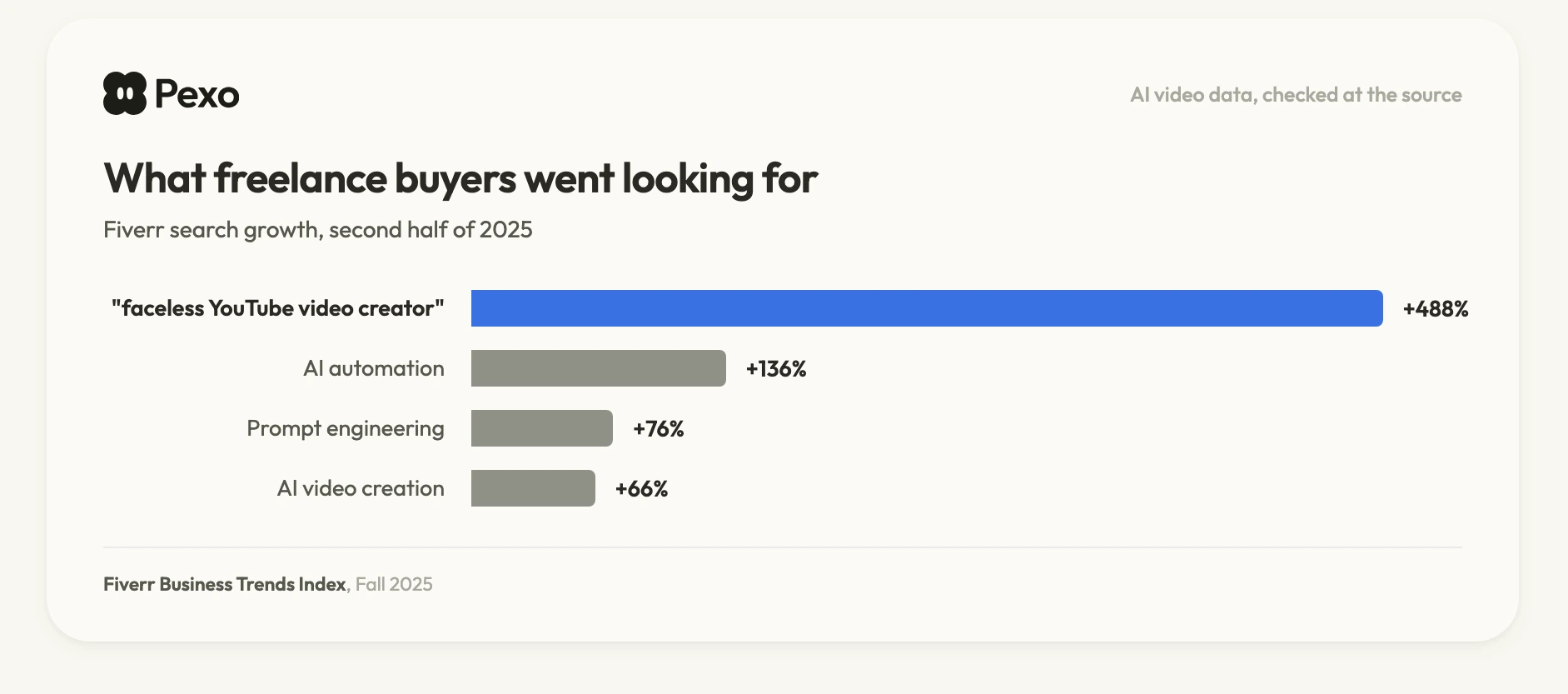
- Searches for AI video creation on Fiverr grew 66% in the second half of 2025 (Fiverr Business Trends Index). Fiverr still cited this as its latest index figure as of March 2026.
- Searches for "faceless YouTube video creator" rose 488% over the same period. AI automation rose 136% and prompt engineering rose 76% (Fiverr).
- In March 2026 Fiverr launched a dedicated AI Video Hub for independent AI video directors, whose client work already includes Google, Universal Music Group, Klarna, Hugo Boss and Yamaha. One duo on the roster made Snoop Dogg's first AI music video, which passed 20 million views in 48 hours.
The term "faceless" covers a wide range in practice, from fully synthetic presenters to faceless explainer formats where a written script runs over generated visuals with nobody on camera. The 488% figure bundles all of it.
The freelance data is the clearest signal that this moved past experimentation. Commissioning an independent AI director for a brand film is a budget decision, not a trial.
The Tools: What the Platforms Disclose About Their Scale
Demand is easier to measure than supply here, because most model providers publish nothing. Of the platforms people actually name, only a handful disclose usage or revenue at all.
- Kling, owned by Kuaishou, is the only major AI video platform with a publicly reported active user figure: roughly 12 million monthly active users, with annual recurring revenue around $240 million (SCMP). Sensor Tower data shared with Bloomberg put weekly active users at about 2.6 million.
- Synthesia raised $200 million in January 2026 at a $4 billion valuation, backed by the venture arms of Nvidia and Alphabet. Its CFO told CNBC that annual recurring revenue stands at $150 million and is expected to pass $200 million during 2026, across 55,000 business customers.
- HeyGen reports roughly $200 million in annual recurring revenue, up from $100 million a year earlier, with 15 million registered users and more than 100,000 paying customers (Getlatka).
- OpenAI shut down the Sora consumer app on 26 April 2026, with the API scheduled to sunset on 24 September. Within a week of the announcement, Sensor Tower recorded Kling's global weekly active users rising 4% week over week (Bloomberg).
- Among organisations already using generative media, 65% expect to see return on investment within 12 months (Artificial Analysis, State of Generative Media Survey 2025). The same survey found image generation far ahead of video in personal adoption at 89%, with video catching up, and cost the deciding factor when choosing a video generation API.
Two caveats on this section. The Artificial Analysis survey closed before Sora 2 and the OpenAI video API shipped, so it describes the market as it stood earlier. And revenue figures for privately held companies come from trackers rather than audited filings, except Synthesia's, which its own CFO confirmed on the record.
That an actively used consumer product can be withdrawn mid-cycle is the most useful fact in this section. Any roundup still listing Sora among the leading platforms in 2026 was redated rather than rechecked.
What Is Not Getting Easier (The Counterpoint Data)
Everything above points one direction: more people, more output, lower generation cost. Here is the countervailing set. As with the previous section, Wyzowl's barrier data covers video marketing generally, not AI video alone.
- The barriers reported by marketers who still do not use video are not what the tooling industry claims. In Wyzowl's 2026 data the top two are "we don't feel it's needed" at 24% and "too expensive" at 24%, followed by lack of time at 19%. Unclear ROI and not knowing where to start sit at 10% each. Lack of in-house skills does not appear in the list at all.
- The EU AI Act transparency rules take effect in August 2026, making disclosure a compliance question rather than a stylistic choice for anyone distributing in Europe.
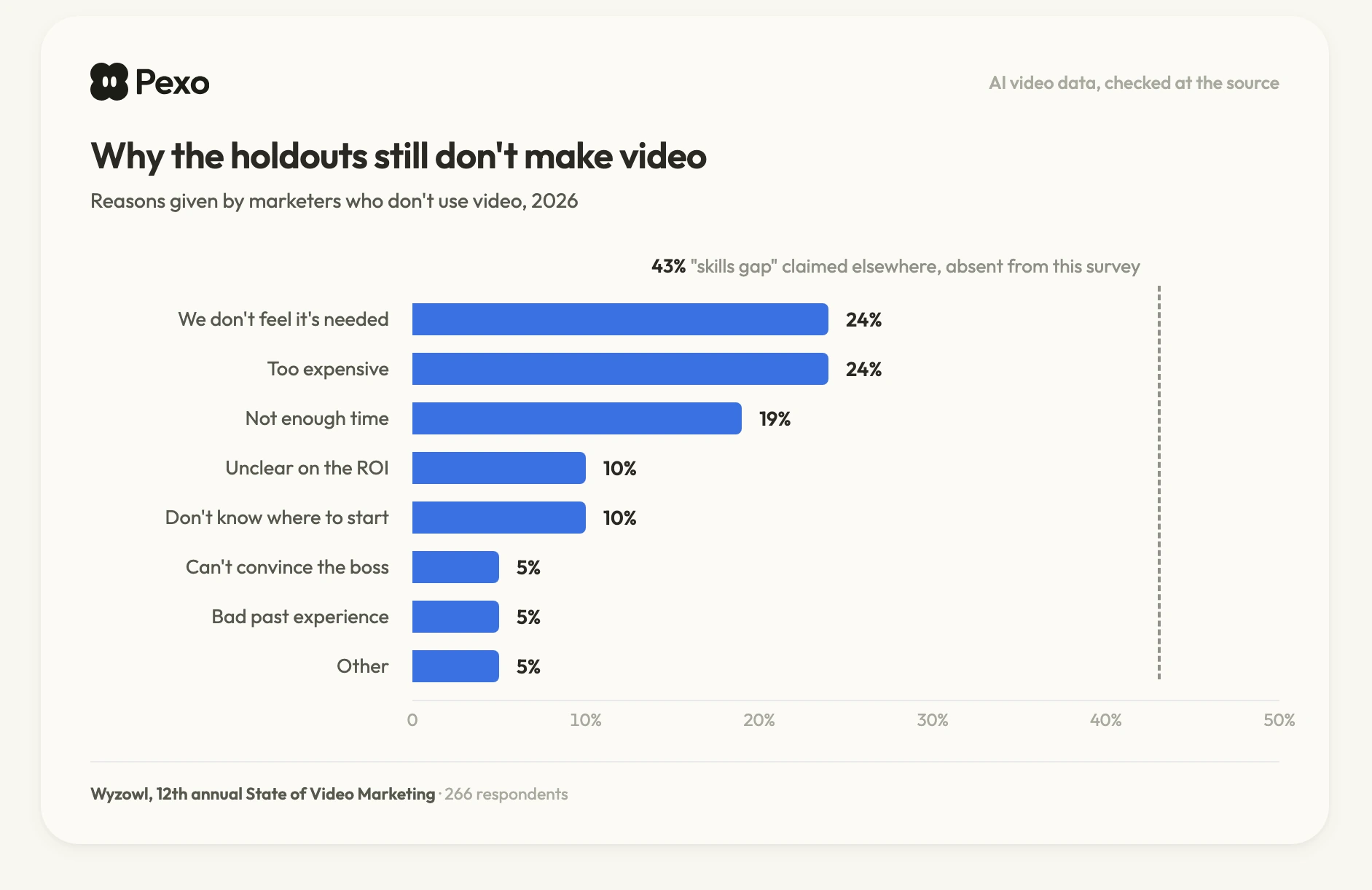
That first point is worth pausing on, because a different number circulates widely. A 43% "lack of in-house skills" barrier is quoted across many 2026 roundups and credited to Wyzowl. Checked against Wyzowl's published page in August 2026, the figure is not there, and neither is the 37% usually printed beside it. What Wyzowl does publish is a 37% for something else entirely: the share of video marketers who have not used AI tools. The likely path is a transcription slip that got copied forward rather than rechecked. It is a useful reminder to open the source page before quoting a percentage, including the ones on this page.
The practical read. In 2024, publishing AI video was itself a differentiator. In 2026 it is table stakes, a fresh feed is between a fifth and three fifths synthetic depending on the platform, almost no viewer can reliably tell, and a third of them will think less of your brand if you do not say so. The advantage has moved from access to tooling toward editorial judgment: knowing what to make, and being straight about how it was made.
The Audience: What Viewers Notice and What It Costs You
This is where the sources genuinely disagree, and the disagreement is the finding.
- Only 9.5% of people can reliably distinguish an AI-generated video from real footage (Kapwing, 2026).
- Yet nearly 83% of consumers say they have watched a video they suspected was AI-generated, citing robotic gestures (67%), unnatural voices (55%) and flat emotional tone (51%) as the giveaways (Animoto, State of Video 2026).
Those two figures are not contradictory, and the gap between them is worth understanding. Suspecting that something is synthetic is not the same as being able to tell reliably, and Animoto's respondents were screened for familiarity with AI tools, so they are more alert than the general public. Read the near-83% as "audiences are primed to look for it" and the 9.5% as "they are usually wrong when they guess".
On what that does to a brand:
- 36% of consumers say an AI-generated video would lower their opinion of the brand behind it (Animoto, 2026).
- But more than a third say they trust AI-generated content just as much as human-made video (Animoto, 2026). The audience is split, not uniformly hostile.
On disclosure, the platform position is more permissive than most people assume. TikTok integrated C2PA Content Credentials in January 2025, becoming the first major platform to detect and label AI content automatically through embedded metadata, and has since labelled more than 1.3 billion AI-generated videos. TikTok states that the label is "a disclosure mechanism, not a distribution signal": the flag is stored as metadata and is not directly weighted in For You Page ranking. Workflow AI is exempt, so AI-written captions and scripts do not trigger it.
Labelling your video as AI-assisted should not cost you reach. Given that 36% of consumers say undisclosed AI would lower their opinion of a brand, the disclosure is close to free and the alternative is not.
The Returns: What Changed in Video Economics
One scope note before the numbers. Wyzowl asks about video marketing as a whole, not AI video specifically, so the figures below describe the medium AI video is entering rather than AI video alone. They are included because the claim they settle, that AI made video cheap, is made about AI video.
82% of marketers say video delivers good ROI in 2026, down from an all-time high of 93% the previous year (Wyzowl, 2026).
That decline is not a sign video stopped working. It is the predictable result of the adoption curve above: when the barrier to production drops, every competitor raises output at once and the return on any single video gets diluted.
The cost story is where the gap between the industry's claims and its customers' experience is widest.
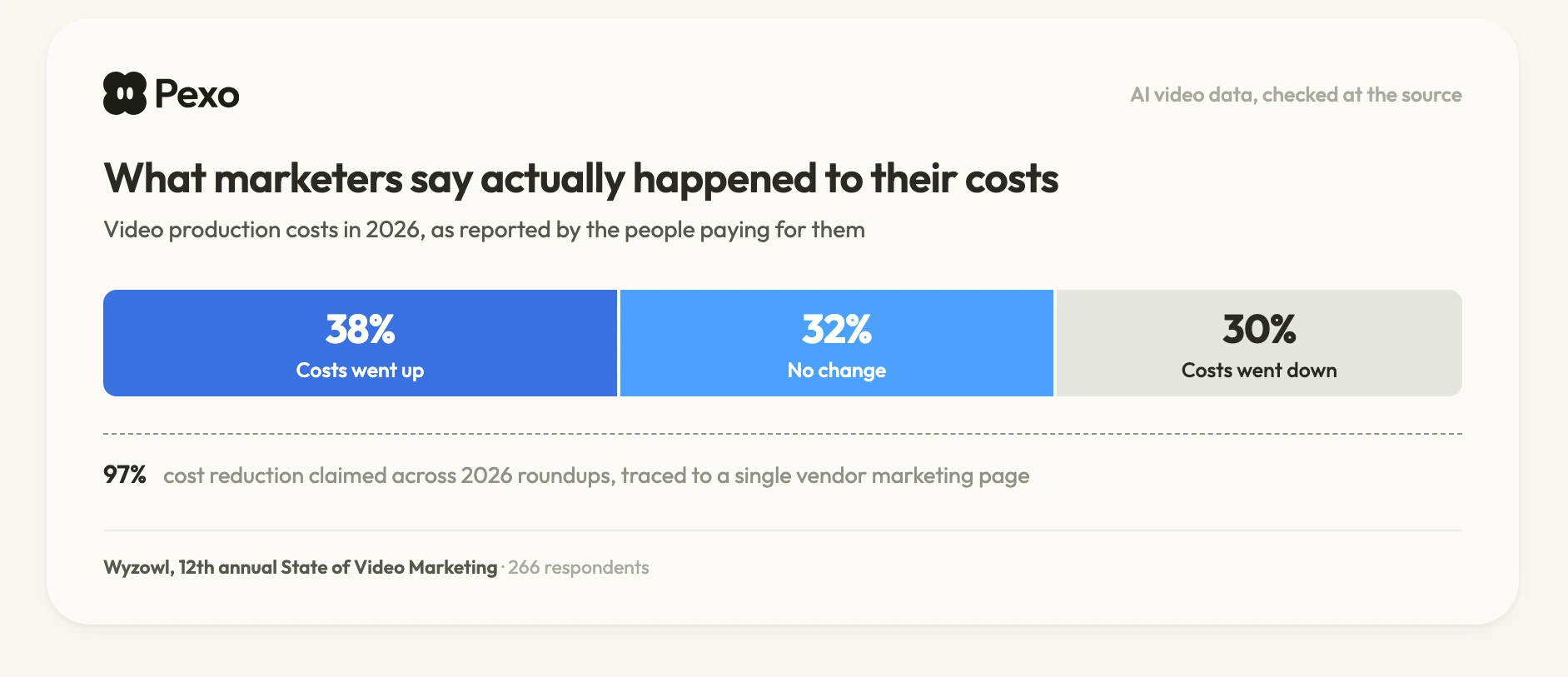
Wyzowl asked marketers directly what happened to their video production costs. 38% said costs went up, 32% reported no change, and only 30% said costs went down. Against that, a 97% cost reduction is claimed across most 2026 roundups, a figure that traces to one tool company's marketing page comparing its cheapest subscription against a full agency project.
Cheaper generation did not make video cheaper. It made video more common, and the surrounding costs, briefing, review, distribution, did not move.
Where That Number Goes Next
This piece opened with a share: 10% of all digital video in 2026, and 59% of a cold TikTok feed. The honest way to close is to say what moves that share next, using dated events rather than forecasts.
- 67% of marketers who do not currently use video say they plan to start in 2026 (Wyzowl, 2026). None of that output exists yet, and most of it will be made with the tools described above.
- Image generation still leads video in personal adoption at 89%, with video catching up (Artificial Analysis, Q3 2025). Video is the later, harder modality, which is why its share of total output is still in single digits while image work is mainstream.
- The EU AI Act transparency rules take effect in August 2026. Disclosure stops being a stylistic choice for anyone distributing in Europe, which will make the labelled share of AI video visibly larger without a single extra video being made.
- The Sora API sunsets on 24 September 2026. Capacity does not disappear, it relocates, and the platform figures above are a snapshot of where it was heading in April.
Put together, the direction is not in doubt and the destination is unmeasured. The share goes up. Nobody currently publishes a credible 2030 number for it, and this page would rather say that than invent one.
The more useful question is not how much video will be AI-made, but how much of it will be worth watching. On that, the numbers here are unanimous: generation stopped being the constraint, and judgment did not.
10 numbers that define AI video adoption in 2026
| Number | What it measures |
|---|---|
| 59% | AI-generated share of the first 500 TikTok videos served to a new account |
| 21% | Same measure on YouTube Shorts, plus 33% more classed as low-effort |
| 10% | AI-generated share of all digital video in 2026 |
| 9.5% | People who can reliably tell AI video from real footage |
| ~83% | Consumers who have watched a video they suspected was AI-generated |
| 36% | Consumers who say AI-generated video lowers their opinion of a brand |
| 63% | Video marketers using AI tools, up from 51% |
| 488% | Rise in "faceless YouTube creator" searches on Fiverr |
| 12M | Kling monthly active users, the only major platform to publish a figure |
| 38 / 32 / 30 | Marketers reporting video costs up, flat, and down |
Sources and method
Every figure on this page was checked against the publishing organisation directly. Where a source had released a newer edition than the one commonly quoted, the newer edition is used. Sample sizes and methods are stated so you can judge each number yourself.
A word on how thin this evidence base is. Almost nobody measures AI video specifically. Broad technology surveys measure AI adoption across all functions; broad media surveys measure video consumption regardless of how it was made. Neither answers "how much video is AI-generated". The organisations that do measure it are mostly companies that sell video tools, including two of the sources below. That is a real limitation, not a footnote, and any roundup presenting this category as well-measured is overstating it. Where a vendor source is the only measurement available, it is named as such and its method is given.
Four figures that circulate widely in other 2026 roundups are excluded or corrected.
The 43% skills barrier. Attributed to Wyzowl across multiple roundups. It does not appear in Wyzowl's published statistics, and neither does the 37% cited alongside it. Corrected above using Wyzowl's actual barrier data.
The 97% cost reduction. Traces to one tool company's marketing page comparing its cheapest subscription against a full agency project. Replaced above with Wyzowl's survey data.
The 38% faceless channel figure. Traces to a single vendor aggregator with no published methodology. Excluded.
General AI and general video statistics. Enterprise AI adoption figures and total video consumption figures are widely used to pad AI video roundups. They measure adjacent things and are excluded here.
| Data | Source | Period | Method |
|---|---|---|---|
| AI share of feeds, category density, detection, labelling | Kapwing original research (vendor) | Jul 2026 | First 500 videos served to new accounts, plus category breakdown |
| Marketer adoption, ROI, costs, barriers | Wyzowl, 12th annual State of Video Marketing | 2026 | Survey, n=266, late 2025 |
| Consumer trust and detection | Animoto State of Video 2026 (vendor), figures via its January 2026 announcement | Sep 2025 | Survey, over 450 US consumers and marketers at companies that made a video in the prior three months, screened for AI familiarity |
| Freelance demand, AI Video Hub | Fiverr Business Trends Index and company releases | Dec 2025, Mar 2026 | Platform search data |
| Kling users and revenue | SCMP; Bloomberg citing Sensor Tower | 2026 | Reported figures, parent company listed |
| Synthesia funding and ARR | CNBC | Jan 2026 | On-record CFO statement |
| HeyGen revenue and users | Getlatka | 2026 | Third-party revenue tracker |
| Generative media ROI and adoption | Artificial Analysis, State of Generative Media Survey | Q3 2025 | Survey, closed before Sora 2 shipped |