
 ChatGPT
 Perplexity
 Claude
 Gemini
 Grok
Grok


A faceless explainer video is a short video that teaches, demonstrates, or simplifies a concept without showing a visible host on screen, relying instead on animation, voiceover, text overlays, stock footage, or AI-generated visuals to carry the message.
The format has moved from a budget workaround to a deliberate creative choice. YouTube channels built entirely around faceless explainer content now generate thousands of dollars in monthly ad revenue. Educators, SaaS companies, and solo creators publish faceless videos daily because they can produce them faster, keep them on-brand, and scale without booking a studio or finding talent.
This guide breaks down the types of faceless explainer videos, why they are growing, and how to create one from scratch.
Why Faceless Explainer Videos Are Growing
The faceless video trend accelerated in 2024 and 2025, driven by two forces: platform economics and AI accessibility.
YouTube's algorithm does not penalize faceless content. Channels like Kurzgesagt, 3Blue1Brown, and dozens of niche finance and science channels have proven that faceless formats can outperform talking-head videos in watch time and subscriber growth. The "$10K/month faceless YouTube channel" narrative, while often exaggerated, reflects a real pattern. Creators who cannot or prefer not to appear on camera are finding sustainable audiences.
On the production side, AI video generation has collapsed the cost curve. What once required a motion graphics freelancer, a script, storyboards, and weeks of back-and-forth can now start with a single text description. A solo creator who previously needed a $3,000 budget and three weeks of turnaround can now describe a concept and have a finished explainer in a fraction of the time. The barrier to entry dropped from thousands of dollars to a conversation.
For businesses, the math is straightforward. A SaaS company that needs 20 explainer videos for different product features cannot afford to shoot 20 separate on-camera sessions. Faceless formats let them produce at scale while maintaining a consistent visual identity.
Types of Faceless Explainer Videos
Not all faceless explainer videos look the same. The format spans several distinct visual styles, each suited to different messages and audiences.
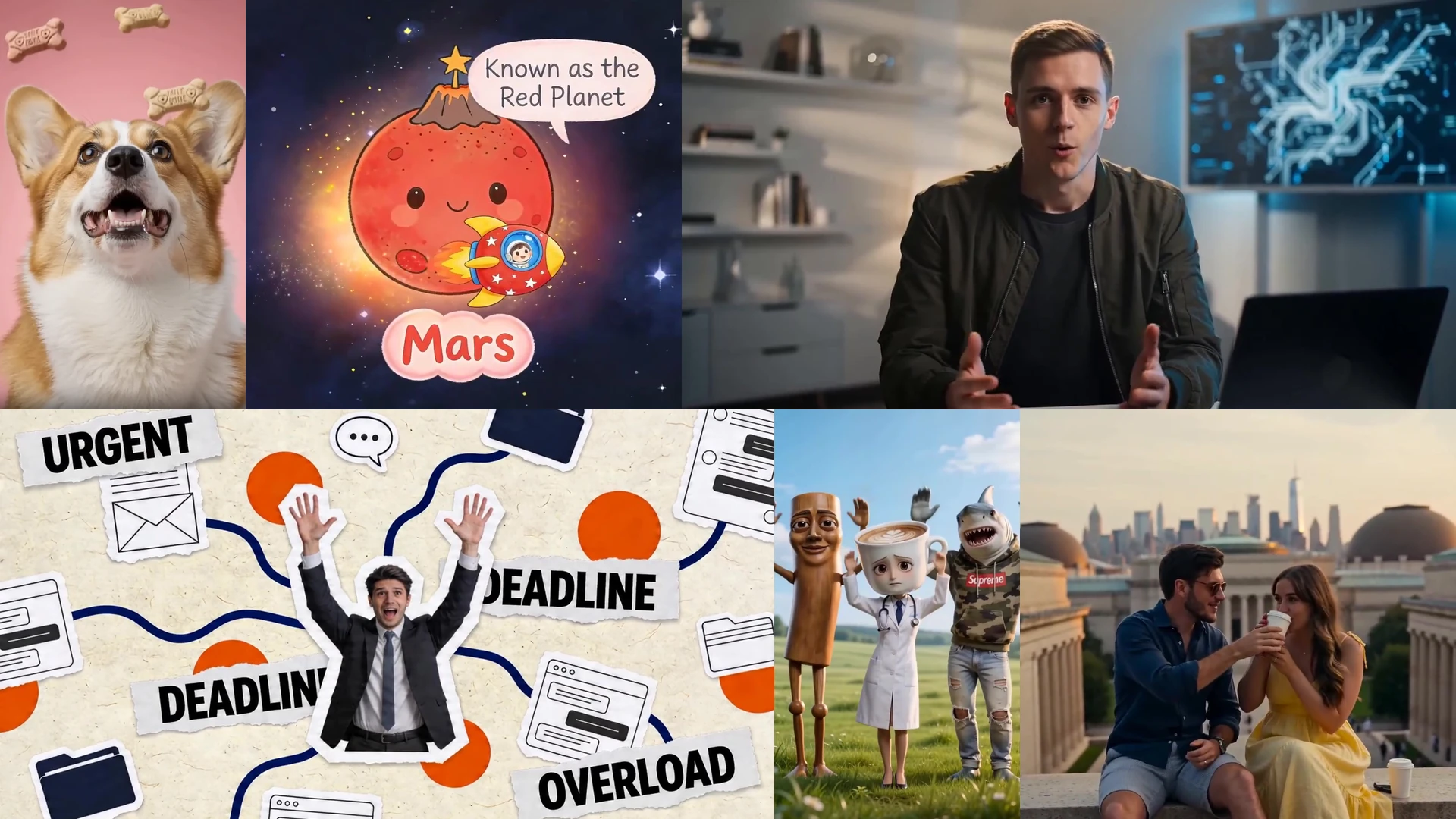
Animated explainer videos use 2D or 3D characters, scenes, and transitions to illustrate a concept. This is the most recognized style, popularized by companies like Dropbox and Slack for product onboarding. Explainer video animation works well for abstract ideas that need visual metaphors.
Kinetic typography puts the words themselves in motion. Text flies, scales, and transforms on screen in sync with a voiceover. This style works for motivational content, data-driven presentations, and any message where the language itself is the focal point.
Stock footage montage layers relevant video clips under a voiceover narration. Travel, real estate, and news recap channels rely on this approach. The strength is realism. The risk is looking generic if the footage choices are not deliberate.
AI-generated visuals are the newest category. Instead of sourcing pre-existing clips or commissioning custom animation, creators describe scenes in natural language and let AI models produce original visuals. This eliminates the licensing question entirely and allows for imagery that does not exist in any stock library.
Screencast and screen recording captures software interfaces, dashboards, or websites with voiceover narration layered on top. SaaS tutorials, app walkthroughs, and tech reviews use this format almost exclusively. It is the most literal form of "show, don't tell."
Benefits of Faceless Explainer Videos
Privacy and comfort. Many creators, educators, and business owners simply prefer not to appear on camera. A faceless format removes that barrier without reducing the quality of the content. The message carries itself.
Lower production cost. No camera, no lighting rig, no makeup, no location scouting. A faceless explainer video can be produced with a laptop, a script, and the right visual approach. For teams creating content at volume, this savings compounds quickly.
Scalability. A talking-head video is locked to the person who recorded it. A faceless video can be repurposed, translated, updated, and versioned without reshooting. Change the voiceover language, swap the visuals for a different market, and the same core message reaches a new audience.
Focus on content over personality. Some topics benefit from the absence of a presenter. Complex financial concepts, medical explanations, and technical tutorials often land better when the viewer's attention stays on the visuals and narration rather than the speaker's delivery.
How to Create a Faceless Explainer Video
Creating a faceless explainer video used to mean assembling a team: a scriptwriter, a voiceover artist, a motion designer, and an editor. AI has compressed that pipeline into a conversation.
Here is how to create one using Pexo, an AI video agent that handles the production end-to-end.
Step 1: Define Your Core Message
Before generating anything, clarify what the video needs to communicate. One video, one concept. Write a single sentence that captures the takeaway. "This video explains how compound interest works for first-time investors" is a usable starting point. "This video is about finance" is not.
Step 2: Describe What You Want
Open Pexo and describe your video in natural language. You do not need a polished script or storyboard. Something like "60-second explainer about how solar panels convert sunlight to electricity, animated style, clean and minimal" gives Pexo enough to work with. Pexo interprets your intent, suggests creative directions, and selects the right AI model behind the scenes, working with Seedance 2.0, Kling AI, and more.
Step 3: Review and Redirect
Pexo shows you a plan and preview before committing to full production. If the tone feels too corporate, say so. If you want a different color palette or pacing, describe the change. This is not a one-shot generation. It is a back-and-forth creative conversation where you direct and Pexo produces.
Step 4: Refine the Details
Adjust transitions, soundtrack, and pacing through conversation. Point at what you want changed and describe the adjustment. Pexo delivers a complete, polished video with transitions, audio, and visual flow, not just a raw clip.
Step 5: Export and Publish
Once the video matches your vision, export it in the format and aspect ratio you need, whether that is 16:9 for YouTube, 9:16 for TikTok and Reels, or square for LinkedIn. One conversation in, a ready-to-publish explainer video out.
Best Practices
Keep each video focused on a single idea. Faceless explainer videos lose their effectiveness when they try to cover too much ground. If the topic has five subtopics, make five videos.
Lead with the problem, not the solution. Viewers click away when they do not see relevance in the first few seconds. Open with the question or pain point your audience already has, then walk them through the answer.
Match your visual style to your audience. A kinetic typography video about cryptocurrency appeals to a different viewer than a soft-animated explainer about childhood nutrition. The style is part of the message.
Use voiceover pacing intentionally. Rushing through narration undermines comprehension. Leave breathing room between key points, and let the visuals carry meaning during pauses.
Maintain visual consistency across a series. If you are building a YouTube channel or a product tutorial library, use the same color palette, typography, and animation style. Consistency builds recognition.
When a Faceless Format Works (And When It Doesn't)
Faceless explainer videos excel when the content is the star. Tutorials, concept breakdowns, data visualizations, product demos, and educational series all benefit from removing the presenter and letting the visuals do the work.
The format struggles when personal trust is the primary conversion driver. A therapist explaining anxiety management, a fitness coach demonstrating exercises, or a founder pitching to investors will almost always perform better on camera. Viewers need to see and connect with the person behind the message in those contexts.
There is also a middle ground. Many creators use a faceless format for their core educational content while appearing on camera for channel introductions, Q&A sessions, and community updates. The two approaches are not mutually exclusive.
Ask yourself one question before choosing: does removing the presenter make this video better or worse? If the content is stronger without a face, go faceless. If the audience needs to see a person to trust the message, show up on camera. The format is a creative decision, not a compromise.
Conclusion
Faceless explainer videos have moved from a niche workaround to a mainstream production format. They are faster to produce, cheaper to scale, and effective at keeping viewer attention on the content itself. With AI video agents like Pexo making the production process as simple as describing what you want, the barrier to creating professional faceless explainer videos is lower than it has ever been.
Ready to create your first faceless explainer video? Start a conversation with Pexo and describe what you are imagining.