
 ChatGPT
 Perplexity
 Claude
 Gemini
 Grok
Grok


The CapCut free vs paid decision comes down to one fact: the free plan is more generous than most people expect. Here is the short version. If you mostly cut, trim, and arrange footage you already have, the free plan covers it at 1080p with no watermark on a normal export. You pay for three specific things: 4K and HDR export, the full AI toolkit (text-to-video, avatars, voice cloning), and watermark-free use of premium templates. The honest takeaway is that paying is a feature unlock, not a quality unlock. A free 1080p export and a paid 1080p export look identical.
CapCut Free vs Paid at a Glance
Before the detail, here is the whole decision in one table. Read the price row and the "max export" row first, because for most people those two lines settle it.
| Feature | Free | Standard | Pro |
|---|---|---|---|
| Price (web, 2026) | $0 | ~$9.99/mo | ~$19.99/mo or $179.99/yr |
| Max export | 1080p | 1080p | 4K and HDR |
| Watermark | Only on Pro templates and some AI clips | Removed | Removed |
| Manual editing toolkit | Full | Full | Full |
| AI toolkit | Basic (captions, simple voiceover) | Limited | Full (text-to-video, avatars, voice clone) |
| Monthly AI credits | None | None | About 200/mo |
| Cloud storage | None | None | 100 GB or more |
| Asset library | Free tier | Expanded | 12M+ royalty-free |
| Best for | Manual editors | Watermark-free mobile | 4K and AI-heavy work |
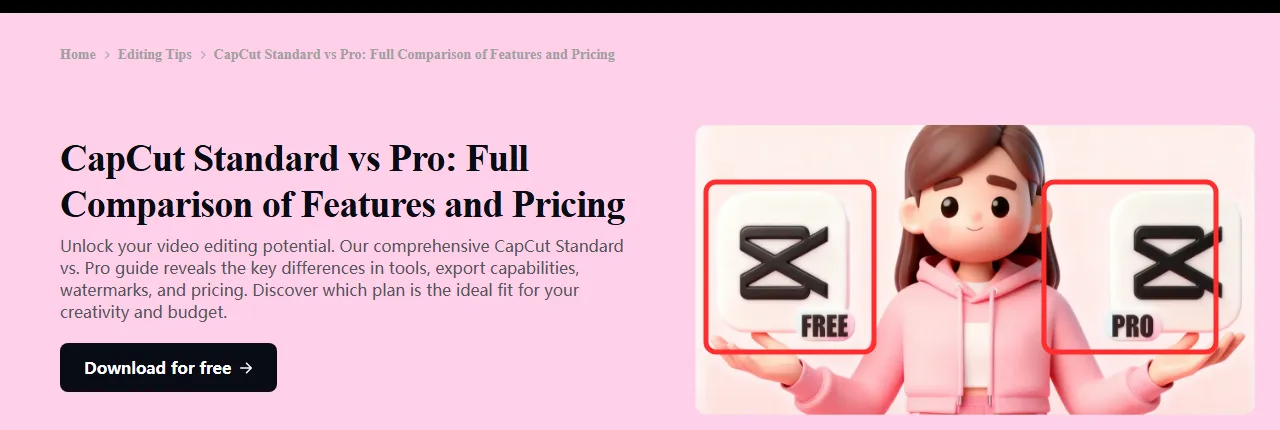 CapCut's own Standard vs Pro page frames the same free versus paid split, marked here in red.
How I Judged Each Tier
A quick note on method, since pricing pages are not always honest about what changes between tiers. I built this from CapCut's own pricing and Standard vs Pro pages, then cross-checked every number against several independent 2026 pricing breakdowns and one long-term hands-on review. Where sources disagreed, which was almost always about price, I treated the web checkout figure as the baseline and flagged the variance rather than pick one tidy number. Every price below is a web list rate as of June 2026.
What the Free Plan Actually Does
CapCut is a free video editor from ByteDance, the company behind TikTok, and it runs on phone, desktop, and in the browser. The important part is that the free plan is the real editor, not a time-limited trial. You get a multi-track timeline, keyframe animation, chroma key (green screen), speed ramping, filters, transitions, auto-captions, a basic AI voiceover, plus a large library of free music and sound effects. Exports go up to 1080p.
In practice the free tier handles roughly 90 percent of everyday manual editing. The watermark question trips a lot of people up, so to be precise: a plain manual export carries no watermark at all. A CapCut watermark only appears when you keep a Pro-locked template in your project, or when you export certain AI-generated clips. Edit your own clips, add your own text and music, and the 1080p file comes out clean. For short-form social posts, that is usually the entire job done on $0.
Two more things are worth knowing on the free plan. First, it is the same editor on every platform. The phone app, the desktop app, and the web version share the same timeline, so you can rough-cut on mobile and finish on desktop without re-importing. Second, the free plan ships with a limited commercial license, which means you can monetize what you make, with some restrictions on how certain premium template assets get used commercially.
What Standard and Pro Unlock
CapCut restructured its paid plans during 2025, and there are now two paid tiers above free.
Standard, sold mainly through the mobile app stores at around $9.99 a month, is the "remove the friction" tier. It strips watermarks everywhere and unlocks more premium templates, transitions, text styles, and effects. It does not add 4K export or the full AI suite, so it is still a 1080p plan.
Pro, at roughly $19.99 a month or $179.99 a year on the web, is the real upgrade. It adds 4K and HDR export, the complete AI toolkit (camera tracking, vocal isolation, speaker-ID captions, AI voice effects, text-to-video, avatar generation, voice cloning, and bulk background removal), 100 GB or more of cloud storage with cross-device sync, team collaboration, and access to the full library of 12 million-plus royalty-free assets.
One detail worth knowing before you upgrade for the AI: those headline features run on credits, not unlimited use. Pro includes about 200 AI credits a month. An avatar render costs 20 to 40 credits and a text-to-video clip costs 5 to 15, so heavy AI users can empty the monthly allowance in a week or two, then buy top-up packs that run from $4.99 to $19.99.
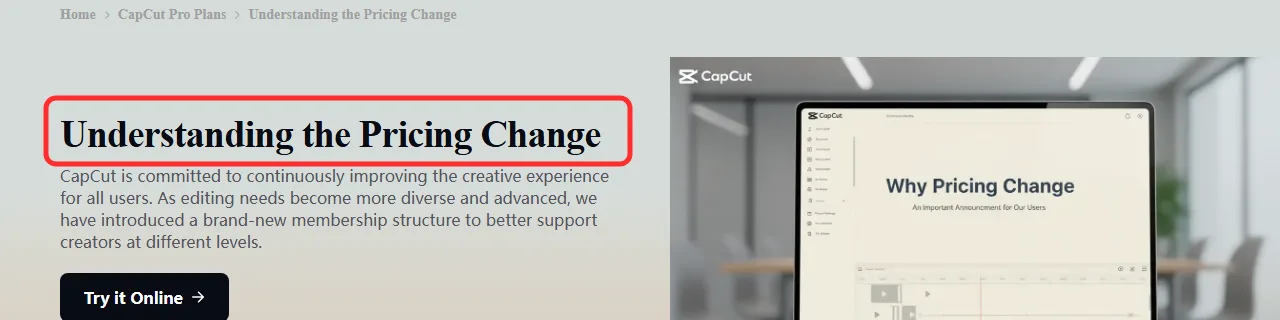 CapCut's 2026 pricing-change notice, where the Standard and Pro membership structure was introduced, boxed in red.
What It Costs in 2026, and Why Your Price May Differ
CapCut pricing is genuinely confusing. The web list price for Pro is about $19.99 a month or $179.99 a year, which works out to roughly $15 a month on the annual plan. If you want one figure to budget around, use that $15 a month for annual Pro bought on the web, then treat everything below as variance on top of it. Standard sits near $9.99 a month and is mostly an app-store product.
The number you actually see depends on where you buy. Subscribing through the Apple App Store or Google Play usually costs $1 to $3 a month more than buying directly at capcut.com, because the platform commission gets passed on to you. Regional pricing varies a lot too: users in markets such as Brazil, Turkey, India, and Southeast Asia pay significantly less, and seasonal promotions can drop the monthly web price toward $7.99. Then add credit top-ups if you lean on the AI tools, which is why several long-term Pro users report a real all-in spend of $15 to $25 a month.
Where Each Tier Falls Short
Both sides have honest limits, and a neutral comparison has to name them.
The free plan's ceiling is real: you are capped at 1080p, premium templates and most AI features sit behind a paywall, those locked templates stamp a watermark, and there is no cloud sync, so your projects live on one device. If your work needs 4K delivery or regular AI generation, free will frustrate you fast.
Pro has its own catch. The marquee AI features are metered by credits, not unlimited, so "I upgraded for unlimited AI" is a common and costly misunderstanding. CapCut is owned by ByteDance, which is a data and privacy consideration some teams take seriously. App-store pricing carries that commission premium. And it is worth remembering what Pro is not: even with the AI add-ons, CapCut is still a manual timeline editor. It does not turn a written script into a finished video on its own the way a dedicated AI generator does. You are still the one assembling the edit.
How to Choose: CapCut Free vs Paid
The decision is cleaner than the pricing page makes it look.
Choose Free if you mostly edit footage you already have, export at 1080p for social platforms, and do not need premium templates or heavy AI. This is the right answer for the majority of casual and even semi-regular editors.
Choose Standard if you work mainly on mobile, post often, and the watermark on premium templates is the one thing standing in your way.
Choose Pro if you publish in 4K or HDR, use the AI toolkit most weeks, or need cloud sync and the full asset library across a team. Just go in knowing the AI is credit-metered, and buy through the web rather than an app store to skip the commission.
Conclusion
For most people, the CapCut free vs paid answer is simple: Free is enough, Standard solves a watermark problem, and Pro is a targeted upgrade for 4K and AI rather than a general "better app." Match the tier to the job, not to the longest feature list.
One last framing, since editing is only ever a means to an end. If the reason you open CapCut is to assemble clips you have already shot, this comparison is your answer. But if you are starting from just an idea, a script, or a single product photo and you would rather skip the timeline entirely, that is a different workflow: an AI video partner like Pexo works from that kind of input and shapes it into a finished video through a back-and-forth conversation, with no timeline editing at all. You can see how that feels before you commit to any tier.