

 ChatGPT
 Perplexity
 Claude
 Gemini
 Grok
Grok

I spent a week pulling apart what actually separates a safety training video that workers remember from one they click through on autopilot, and the answer surprised me.
A safety training video is a short instructional video that shows employees how to recognize workplace hazards and follow correct safety procedures, using visuals, demonstrations, and realistic scenarios instead of text alone. It is used to standardize how a workforce learns to stay safe, often to meet regulatory requirements like those set by OSHA.
That single idea covers a forklift refresher in a warehouse, a bloodborne-pathogens module in a clinic, and a fall-protection clip on a construction site. Below, I break down where the format came from, how one actually gets made today, who it serves, and how to start.
TL;DR: Key Takeaways
- A safety training video teaches hazard recognition and correct procedures through visual demonstration, not text.
- Most run 2 to 4 minutes, the length OSHA itself uses for its public training library.
- Common topics: hazard identification, PPE use, emergency response, equipment operation, bloodborne pathogens.
- The format's strength is consistency: every worker, every shift, every site sees the same procedure.
- Production no longer requires a film crew. You can describe a scenario in plain language and have a finished video assembled for you.
What Is a Safety Training Video?
A safety training video is a purpose-built instructional clip that demonstrates how to perform a task safely or how to respond to a hazard. It pairs a visual of the situation (a spill, a ladder, a confined space) with the correct procedure, so the viewer sees both the risk and the response in context.
It is distinct from a generic explainer because it is tied to a specific safety outcome: fewer injuries, a documented training record, and compliance with a standard. Where a written safety manual tells you a rule, the video shows you the rule being followed, which is why retention is higher for procedures that are physical or spatial.
What it is not: it is not a substitute for hands-on practice (you still need a real fit test for a respirator), and it is not a one-time fix. Safety training is recurring by design, because hazards, equipment, and regulations all change.
Where the Format Came From and Why It Matters Now
Workplace safety film has roots going back decades, but the modern driver is regulatory. The Occupational Safety and Health Administration (OSHA), created under the Occupational Safety and Health Act of 1970), requires employers to train workers on the hazards they face. Video became the default delivery method because it scales across shifts, languages, and locations in a way that a live instructor cannot.
OSHA now publishes its own library of short training videos, most running 2 to 4 minutes, on topics from falls to respirators, available in English and Spanish. That public standard set an expectation: training content should be short, scenario-driven, and consistent.
What changed recently is production cost. For most of this history, a watchable safety video meant a crew, a script, and a location shoot, which is why so many companies recycled outdated tapes. The barrier to producing fresh, role-specific content has now dropped sharply, which is the part that matters in 2026.
How a Safety Training Video Works in Practice
A safety training video works by sequencing three things: the hazard shown clearly, the correct procedure demonstrated step by step, and a takeaway the viewer can recall on the floor. The craft is in keeping it short enough to hold attention (the 2-to-4-minute OSHA benchmark exists for a reason) while concrete enough to change behavior.
To see how achievable the production side now is, I tested it directly. Instead of booking a shoot, I opened Pexo and described a scenario the way I'd brief a colleague: a 30-second clip showing a warehouse worker checking a forklift before a shift, with on-screen callouts for the brake, horn, and load limit. I did not write a prompt or touch a timeline. I described what I wanted to see.
Pexo came back with a plan and a quick preview before committing to the full render, so I could redirect the pacing instead of waiting and praying. The first cut moved too fast on the checklist callouts, so I said exactly that, and the revision slowed those beats. Total time from idea to a shareable draft was a few minutes, not the days a traditional shoot would have taken.
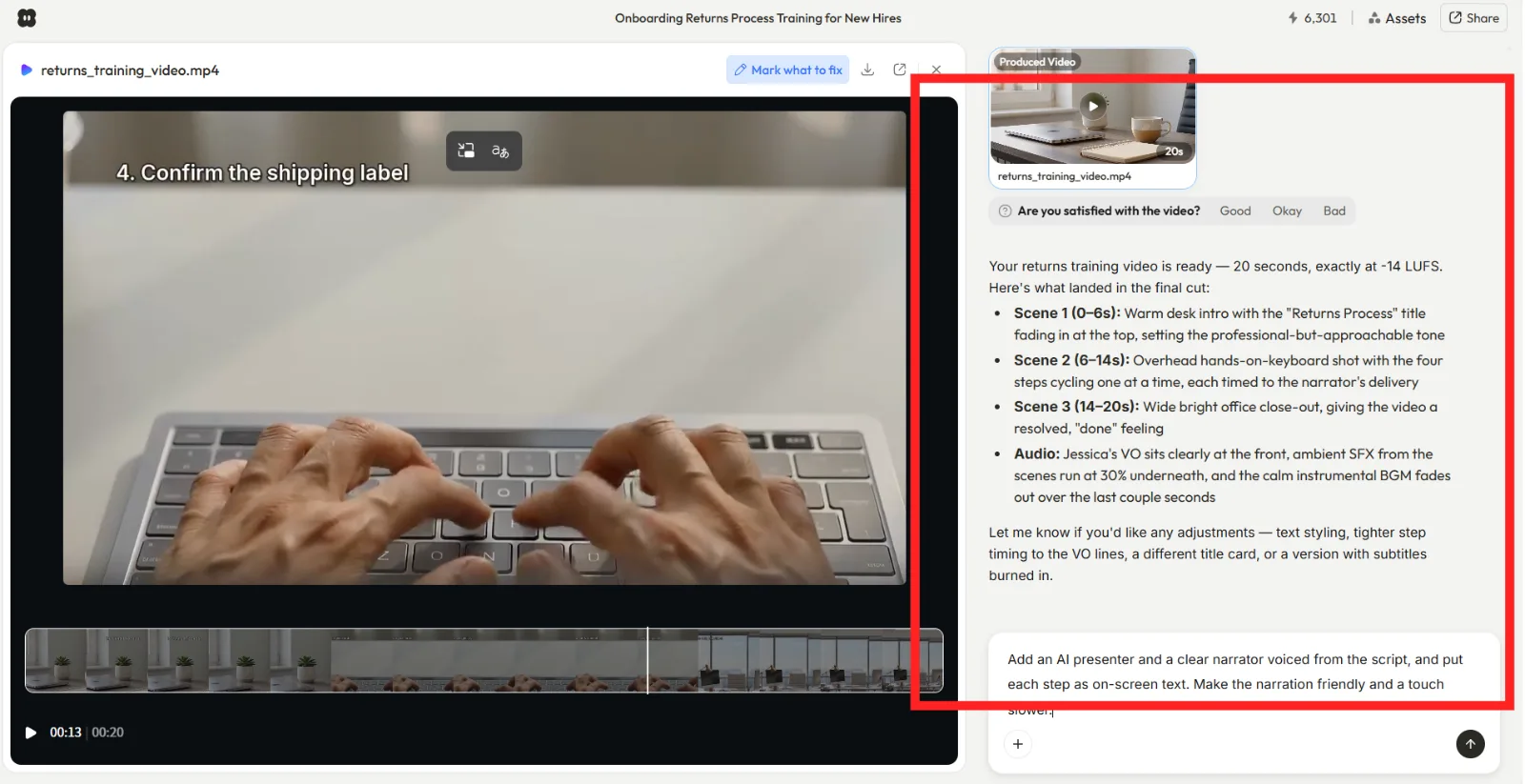
The point of the exercise is not the speed for its own sake. It is that role-specific safety content (your equipment, your site, your procedure) is now something a safety officer can produce in-house, instead of settling for a generic stock module that doesn't match the actual floor. Pexo works with the leading models behind the scenes (Seedance, Sora, Kling, and more) and routes to the right one, so the safety officer never has to think about which model fits a warehouse scene versus an office one.
How It Differs From Traditional Safety Training
The old way and the video way solve the same problem differently. The table below makes the contrast concrete.
| Dimension | Live session / printed manual | Safety training video |
|---|---|---|
| Consistency | Varies by instructor and shift | Identical every viewing |
| Scale | One room at a time | Unlimited, any location |
| Showing physical procedure | Hard in text, slow live | Native strength |
| Updating content | Reprint or reschedule | Re-edit the clip |
| Documentation | Manual sign-in sheets | Trackable completion |
Video does not replace everything. Hands-on verification and live Q&A still belong in any serious program. But for the demonstrate-and-standardize layer, video is the format that travels.
Who Safety Training Videos Are For
- Safety officers and EHS managers standardizing procedures across multiple sites or shifts, who need every worker to see the identical correct method.
- Operations and HR teams onboarding new hires fast, where day-one safety training is a legal and practical requirement.
- Small business owners without a dedicated training department, who previously had no affordable way to produce site-specific content.
- Multilingual and distributed workforces, where a single live trainer cannot cover every language or location, but a captioned, re-voiced clip can.
How to Start Making a Safety Training Video
- Pick one hazard or procedure. Narrow beats broad. "Forklift pre-shift inspection" trains better than "warehouse safety" in general.
- Write the scenario, not a script. Describe the situation, the risk, and the correct action in plain language: who, what, the three callouts that matter.
- Generate a draft. With Pexo, you describe that scenario in a conversation and get a finished draft back to review, no editing skills required. Other routes exist too, from hiring a production crew to using OSHA's free public clips for general topics, and each fits a different budget and specificity need.
- Review against the procedure. Check that the demonstrated steps match your actual written safety procedure exactly. A video that shows a slightly wrong method is worse than none.
- Caption, translate, and log. Add captions for accessibility, translate for your workforce, and record completion for your compliance file.
Conclusion
A safety training video earns its place by doing one thing well: showing every worker the same correct procedure, in context, in a few minutes. For years the bottleneck was production. That bottleneck is largely gone, which means the real question is no longer "can we afford to make one" but "which hazard do we cover first." If you want to turn a written procedure into a clip your team will actually watch, describe it to Pexo and start from the scenario in your head.