 ChatGPT
 Perplexity
 Claude
 Gemini
 Grok
Grok


You type 'a car chase' into Seedance 2.0, hoping for a blockbuster scene, but get a generic, lifeless clip instead. Sound familiar? The model's output quality hinges entirely on how you ask. A vague request yields a vague result, highlighting the massive gap between simple phrases and well-defined Seedance prompts. Understanding the proper AI video prompt structure is the key to unlocking truly cinematic visuals. In this guide, you'll get more than just a list; you'll receive 10 copy-paste-ready prompts and the powerful 6-part formula used to create them, transforming your AI video workflow forever.
Why Your Seedance 2.0 Prompts Keep Failing
If your results feel flat, you're likely making a few common mistakes. The difference between an amateur and a professional-looking AI video often comes down to a few key details that give the model the specific instructions it needs to render a compelling scene. Here are the most common reasons your prompts aren't delivering.
Too vague on subject: "a woman walking" gives the AI no anchor. Is she a 25-year-old in a neon-drenched cyberpunk city at night, or a 70-year-old on a sunny park bench? Without defined age, clothing, and setting, the model produces a generic character.
No camera instruction: Without a specific "slow dolly-in" or "low-angle tracking shot," the model defaults to a static, eye-level medium shot that feels flat and uninspired. Camera movement is essential for creating a sense of dynamism and emotion.
Missing style anchor: "Cinematic" alone isn't enough. To truly lock in the aesthetic, you need to add a specific film reference (e.g., "in the style of Blade Runner"), a color grade ("warm, golden hour tones"), or a lighting condition ("dramatic chiaroscuro lighting").
This table shows how a few specific changes can radically improve your output.
| Weak Prompt | Strong Prompt | What Changed |
| A man looks at the city | A grizzled detective, 40s, stands on a rain-slicked rooftop overlooking a futuristic city at night. Medium shot, slow push-in. Cyberpunk aesthetic, neon signs reflecting in puddles, high contrast. | Added a specific character, action, detailed scene, camera move, and style anchor. |
| A chef cooking | A young, energetic chef, tattoos on her arms, expertly flips a pancake in a bright, sunlit kitchen. Close-up on the pan, slow motion. Lifestyle commercial aesthetic, vibrant colors, clean lighting. | Defined the subject's look and energy, specified the action and camera details, and set a clear commercial style. |
| A monster in the forest | A shadowy, vaguely humanoid creature with glowing red eyes stalks through a misty, moonlit forest. Low-angle tracking shot from behind the creature. Horror film style, desaturated colors, film grain. No other people visible. | Created a specific monster, added atmosphere with scene details, used a horror-specific camera shot, and added a negative constraint. |
The 6-Part Formula That Actually Works (With Examples)
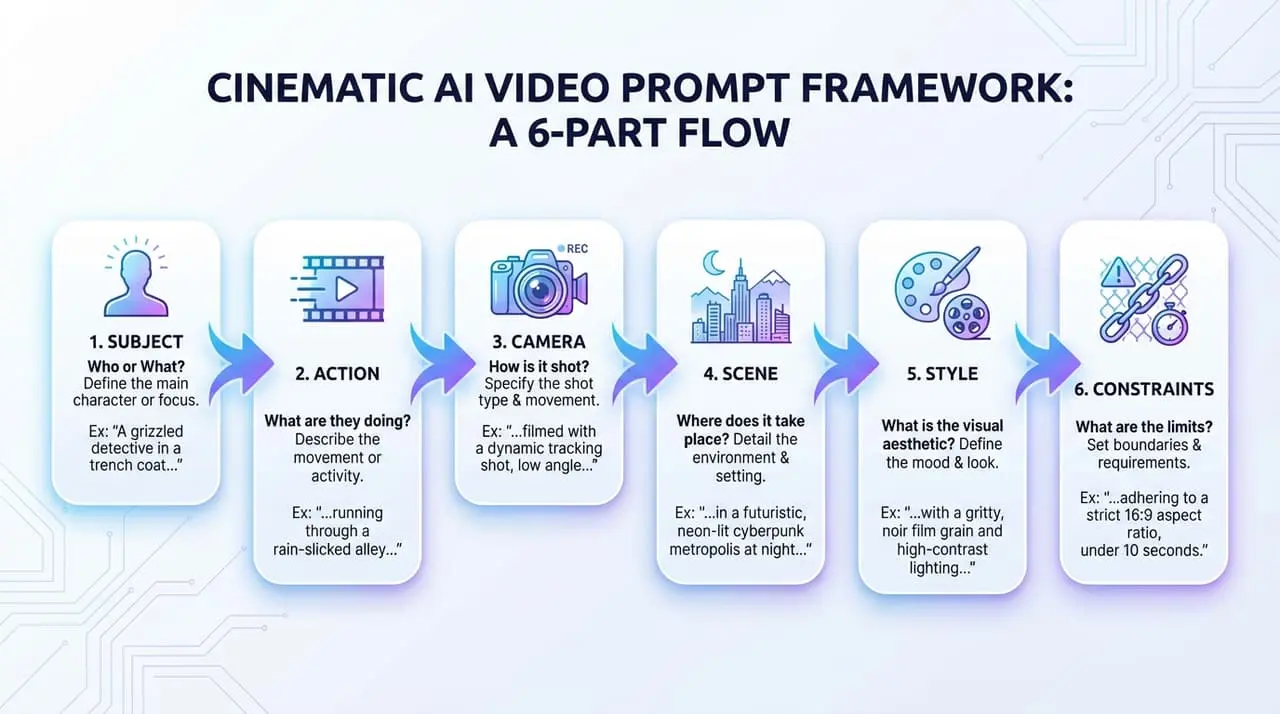
Top-tier AI video results don't happen by accident. They are built on a structured foundation that gives the model clear, unambiguous instructions. All three of the strong prompts above follow the same 6-part formula. By mastering this structure, you can take control of your generations and produce consistently better videos.
| Component | What It Controls | Example Phrase |
| Subject | Who or what is in the shot | A stoic astronaut, 30s, in a sleek white spacesuit... |
| Action | What the subject is doing | ...floats silently through a zero-gravity corridor... |
| Camera | Shot type and movement | ...Wide shot, slow tracking shot following the astronaut... |
| Scene | Setting, background, lighting | ...inside a minimalist space station, lens flare from a nearby star... |
| Style | Visual aesthetic and mood | ...Hard sci-fi aesthetic, clean lines, sterile lighting, 4K... |
| Constraints | What to exclude or limit | ...No motion blur, no text, duration 8 seconds. |
The One Component Everyone Skips (And Why It Kills Your Video)
The Constraints component is by far the most overlooked part of the formula, yet it is one of the most powerful for refining your output. It tells the AI what not to do, which helps eliminate randomness and unwanted elements. Adding constraints is like putting guardrails on your creativity, ensuring the final video aligns perfectly with your vision.
"No people in background"
"Daytime only, no artificial lighting"
"Duration: 10 seconds, no transitions"
"No subtitle overlays"
"Stable camera, no handheld shake"
Pro Tip: Adding even one constraint line reduces re-generation rate by more than half.
10 High-Performing Cinematic Prompts (Copy-Paste Ready)
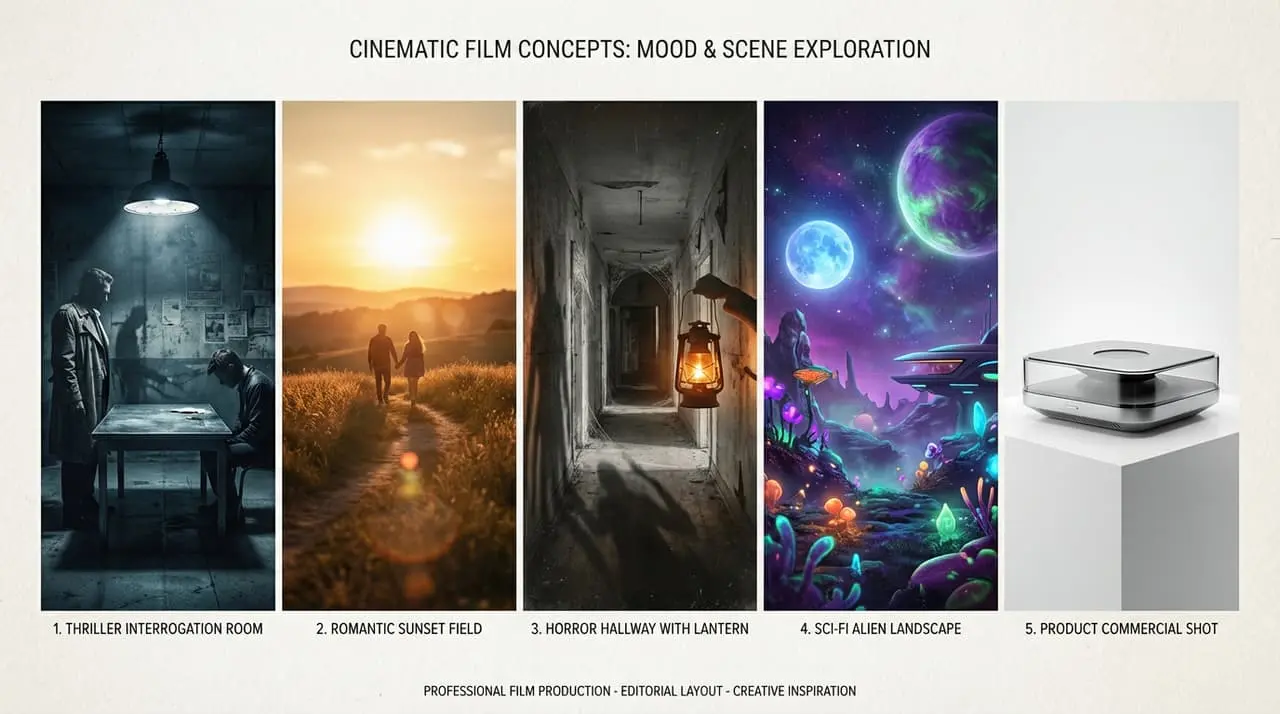
Now that you understand the formula, here are 10 ready-to-use prompts across different genres. Use them as-is or as a starting point for your own creations. Each one is designed for high-quality, cinematic output.
Narrative & Drama (Prompts 1-3)
[Thriller]
A nervous data analyst in his late 20s sits in a dark, minimalist interrogation room, illuminated by a single overhead lamp. He glances furtively at a two-way mirror. Extreme close-up on his eyes, which dart back and forth. Tense, suspenseful mood, desaturated color palette, in the style of a David Fincher film. No dialogue, no camera movement.
Best for: Creating a moment of high-stakes psychological tension.
Modify this: Change the subject to "a seasoned detective" to alter the power dynamic of the scene.
[Romance]
A couple in their early 30s, laughing, runs hand-in-hand through a field of wildflowers at sunset. Backlit by the golden hour sun, creating a warm, hazy glow. Medium tracking shot that keeps pace with them. Romantic, nostalgic aesthetic, soft focus, lens flare. Duration 7 seconds.
Best for: Evoking feelings of joy, freedom, and romantic nostalgia.
Modify this: Change the scene to "a rain-soaked city street at night" for a more dramatic, passionate feel.
[Horror]
A lone woman holding a flickering lantern walks slowly down a dusty, cobweb-filled Victorian hallway. The camera is positioned at the end of the hall, using a static wide shot. The only light comes from the lantern, casting long, dancing shadows. Gothic horror style, deep blacks, high contrast, film grain. No jump scares.
Best for: Building slow-burning atmospheric dread and suspense.
Commercial & Lifestyle (Prompts 4-7)
[Product Ad]
A sleek, matte black electric kettle sits on a polished marble countertop in a modern, minimalist kitchen. Steam gently wafts from its spout. Macro shot, slowly orbiting the kettle. Luxury product commercial style, clean, high-key lighting, 4K resolution. No people, no background clutter.
Best for: Creating a sophisticated product shot for a luxury brand.
Modify this: Add "a hand with a delicate gold ring reaches in to pick up the kettle" to introduce a human element.
[Cooking Show]
Overhead top-down shot of a chef's hands artfully arranging microgreens on a gourmet dish with tweezers. The dish is a vibrant seared tuna steak on a bed of black rice. Food documentary style, bright, natural lighting, extremely sharp focus. No camera movement.
Best for: A classic, appetizing shot for a high-end cooking tutorial or food blog.
[Fashion Editorial]
A tall, androgynous model with sharp cheekbones and a bold geometric haircut wears an avant-garde silver jacket. They walk towards the camera down a concrete brutalist walkway. Full-body shot, slow motion. High-fashion editorial style, slightly overexposed, cool color temperature. No other clothing visible.
Best for: A powerful, confident shot for a fashion film or brand campaign.
Modify this: Change the action to "stands still and looks directly into the camera" for a more confrontational and intimate feel.
[Street Photography]
An elderly man with a weathered face and a kind smile plays a saxophone on a bustling city street corner. Passersby are blurred with motion. Medium shot, handheld feel with a slight, natural sway. Authentic street photography style, black and white, high contrast. Capture the emotion of the moment.
Best for: A candid, soulful character portrait with an urban backdrop.
Action & Sci-Fi (Prompts 8-10)
[Sports]
A female rock climber, muscles taut, chalk on her hands, reaches for a difficult hold on a sheer cliff face. The camera is a drone shot, pulling back slowly to reveal the immense scale of the mountain. Epic sports documentary style, natural light, vast landscape. No ropes visible.
Best for: A dramatic and inspiring shot showcasing human strength and determination.
[Sci-Fi]
A lone explorer in a rugged, orange-tinted spacesuit plants a flag on the desolate, rocky surface of Mars. Two moons are visible in the deep purple sky. Ultra-wide shot to emphasize the alien landscape. Cinematic sci-fi style, in the style of "The Martian," 4K, hyper-realistic detail. Duration 10 seconds.
Best for: A classic "first contact" or exploration scene for a sci-fi narrative.
Modify this: Change the action to "watches a shimmering portal open in front of them" to introduce a fantasy or mystery element.
[Nature Documentary]
A majestic bald eagle soars in slow motion against a backdrop of snow-capped mountains and a clear blue sky. Telephoto lens, tracking shot that follows the eagle's flight path perfectly. Nature documentary style, crisp, clean lighting, incredibly sharp detail. No man-made objects in the frame.
Best for: A breathtaking and majestic wildlife shot.
When You're Tired of Writing Prompts — There's a Smarter Way
Mastering the 6-part formula is a game-changer, but let's be honest—it's still work. Crafting the perfect prompt requires a specific vocabulary and a trial-and-error process that can be time-consuming. For many creators, the goal is to bring an idea to life, not to become a prompt engineer.
It can take 30+ minutes to write and refine a quality 6-part prompt for a single, complex scene.
It often still requires multiple re-generations to get the framing, pacing, and style exactly right.
It requires learning cinematography vocabulary (dolly, tracking shot, telephoto) that most creators don't have.
One wrong component in the formula can misdirect the AI and ruin the entire output.
There's a different approach for those who want the creative control without the technical overhead. Tools like <u>Pexo AI</u> take a fundamentally different approach—instead of asking you to write a 6-part structured prompt, its AI agent interprets your creative intent from plain language, the same way you'd describe a video idea to a colleague.
| Approach | What You Need to Do | Time to Learn |
| Seedance Manual Prompting | Write 6-part structured prompts | Hours of practice |
| Pexo AI Agent | Describe your idea naturally | Zero learning curve |
With an AI agent like <u>Pexo</u>, you can simply say, "Show a detective on a rooftop at night, make it feel like Blade Runner," and the agent handles the complex prompt construction for you. It's a workflow built for creativity, not for code.
References
[1] Seedance Video Prompt Guide. <u>https://seedancevideo.com/prompt-guide/</u>