
 ChatGPT
 Perplexity
 Claude
 Gemini
 Grok
Grok


If you are weighing Sora vs Runway to pick an AI video generator, start with one fact that most older comparisons miss. OpenAI retired the Sora consumer app on April 26, 2026, and the Sora API is scheduled to shut down on September 24, 2026. So the honest 2026 answer is short. For nearly every creator, Runway is the practical pick today, because it is still here and still shipping. Sora 2 remains a remarkable model on a few fronts, but it is winding down. Below is a fair, dimension-by-dimension breakdown so you can see exactly where each one wins, and what to do if you would rather not bet your workflow on any single model.
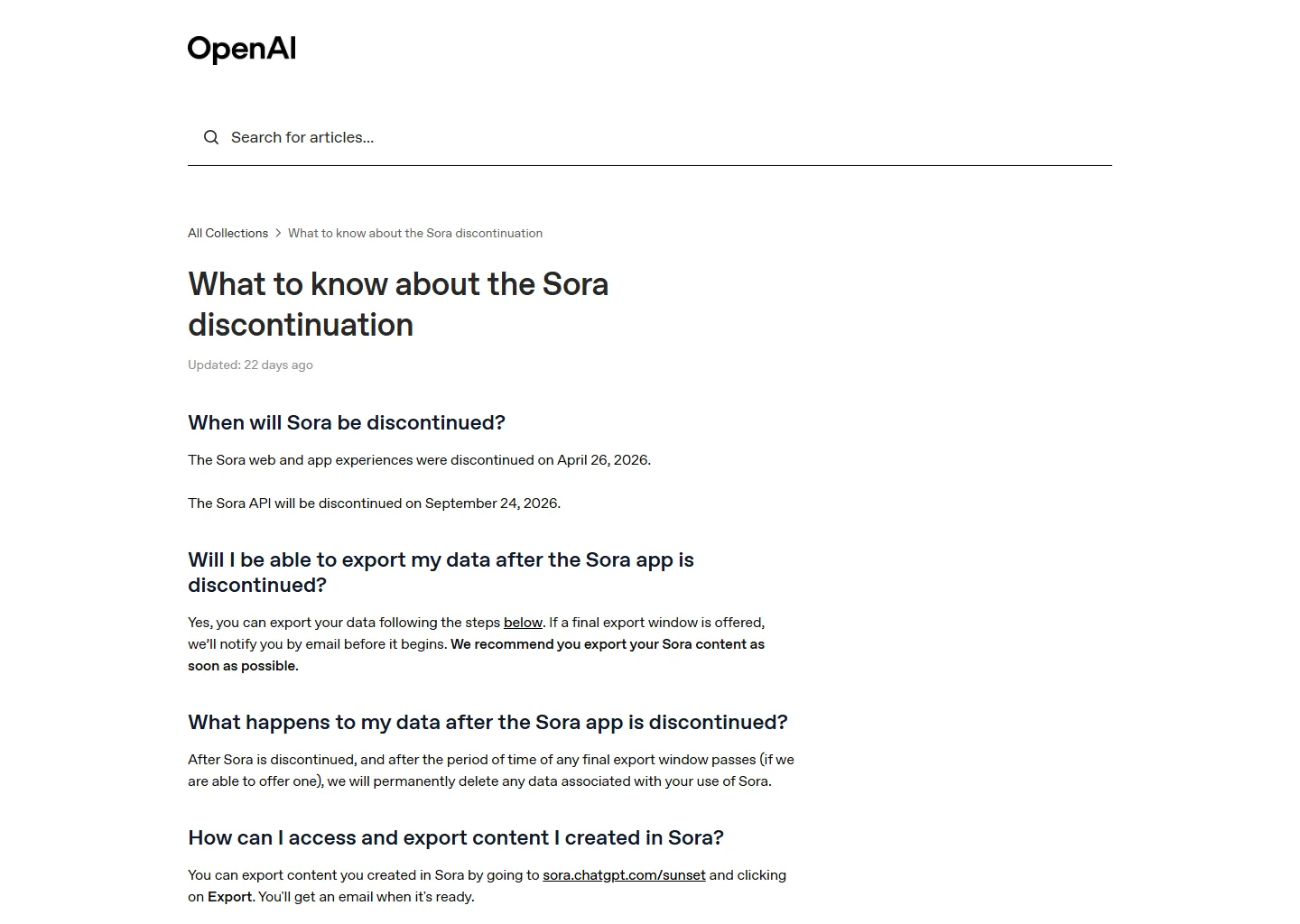 OpenAI's official notice confirms the staged Sora shutdown, the change that reshaped the Sora vs Runway decision in 2026.
Sora vs Runway: The Quick Verdict
For most people the decision is now simple. If you want a tool you can open today, keep using next year, and control shot by shot, choose Runway. If you are a developer who needs synchronized audio and physics-heavy realism in the next few months, Sora 2 is still worth using through its API while it lasts.
Here is the head-to-head at a glance.
| What you care about | Sora (Sora 2 / Sora 2 Pro) | Runway (Gen-4) |
|---|---|---|
| Status (as of June 2026) | Consumer app retired Apr 2026; API live until Sep 24, 2026 | Fully live and actively updated |
| Strongest at | Physics, world-model realism, native audio | Creative control, camera and motion direction |
| Who can access it | Developers only, through the API | Anyone, via web app and a free tier |
| Audio | Synchronized dialogue and sound effects, built in | Mostly visual, audio added separately |
| Pricing (as of June 2026) | Per-second API billing, around $0.10/sec at 720p, Pro tiers higher | Free tier, paid plans from roughly $12 to $15 per month |
| Bottom line | Strong model, short runway | The dependable choice for most creators |
What Changed in 2026: The Sora Shutdown
A year ago, "Sora vs Runway" was a straight fight between two flagship models. That framing broke in early 2026. OpenAI announced the wind-down on March 24, 2026, then closed the Sora web and mobile apps on April 26, 2026, roughly five weeks before this article. The official Sora discontinuation notice confirms the two-stage plan. The consumer experience is already gone, and the API follows on September 24, 2026, which is less than four months away as of June 2026.
Reporting from The Decoder framed it as a strategic shift away from consumer creative tools. Whatever the reason, the practical takeaway for you is the same. Any "Sora alternative 2026" search now points back to the same shortlist, and Runway sits at the top of it.
Sora vs Runway, Dimension by Dimension
Is Runway better than Sora? It depends on the job. The Sora vs Runway Gen-4 matchup splits by category, and neither one sweeps every dimension, so here is where each genuinely wins.
Output Quality and Realism
This one is close, and it splits by use case. Sora 2 Pro is built on a strong world model, so it handles physical cause and effect well. Drop a glass and the shards scatter in a believable way. Runway Gen-4 is excellent at temporal consistency and character continuity, holding a face and outfit steady across very different shots through its reference-image system. Call it a tie that leans on intent. Sora edges raw physical realism, while Runway edges usable consistency across a sequence.
Creative Control and Directing
Runway wins this clearly. Its Motion Brush lets you paint the exact region you want to move, and its camera controls give you director-grade moves like pan, dolly, and arc. Sora is more of a "describe it and accept what comes back" experience. Prompt adherence is strong, but you get less granular control over a specific shot. If you need a 24mm wide angle with a slow push in, Runway can execute that. Sora aims at the overall look instead.
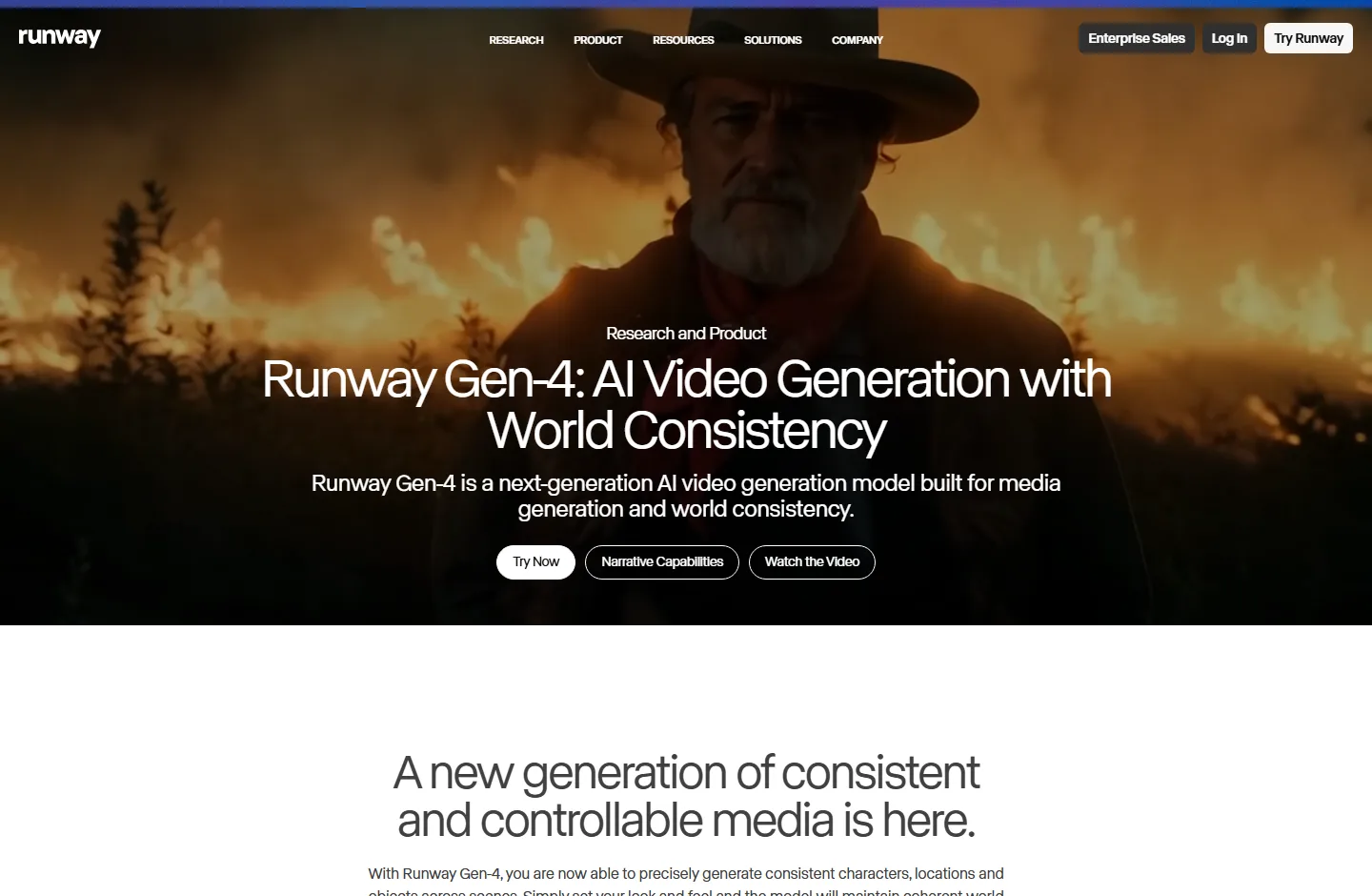 Runway Gen 4 is built around controllable, consistent generation, which is where it pulls ahead on creative direction.
Access and Ease of Use
This is where the shutdown decides things. Runway is a web app with a free tier, so a non-technical creator can sign up and make a clip in minutes. Sora no longer offers that path. Since the consumer app closed in April 2026, Sora is reachable only through its API, which means a developer has to wire it into something. For most marketers and creators, that effectively puts Sora out of reach. Runway wins on access by a wide margin right now.
Pricing
Runway vs Sora pricing works in two very different ways, so compare the shape, not just the sticker. Sora bills per second through the API, around $0.10 per second at 720p on the standard tier, with Sora 2 Pro costing more at higher resolutions. Runway uses subscriptions, with a free tier of one-time credits and paid plans starting in the low teens per month on the Runway pricing page. Verify both before you commit, since rates change. Neither is "cheaper" in the abstract. Predictable monthly budgets favor Runway, while pure API workloads can pencil out either way.
Speed
Both are fast enough for short clips, with a slight edge to Runway for iteration. Runway's Gen-4 Turbo mode is tuned for quick drafts, which matters when you are testing ten versions of an ad. Sora generation time varies by tier and resolution, and the Pro tier trades speed for fidelity. For rapid back-and-forth, Runway feels quicker. For a single hero shot where quality is everything, the difference stops mattering.
Audio and Sound
Sora wins here, and it is a real advantage. Sora 2 generates synchronized dialogue and sound effects in the same pass as the video, so a clip arrives with audio attached. Runway is primarily a visual model, so you typically add music, voiceover, or effects in a separate step. If a one-shot video and audio output saves you a whole stage of work, Sora led the field on that. The catch, of course, is that this strength is attached to a product that is shutting down.
Pros and Cons at a Glance
Before the verdict, here is the short version of what each tool gives you and what it costs you, so you can scan the trade-offs at a glance before reading the routing below.
Sora
- Pros: best-in-class physical realism, native synchronized audio, strong adherence to long and detailed prompts.
- Cons: consumer app already retired, API sunsetting in September 2026, and access is developer-only in the meantime.
Runway
- Pros: live and actively developed, granular shot control, an accessible web app with a free tier, and one subscription that now reaches several models including Veo, Kling, and Seedance.
- Cons: the credit system can get expensive at high volume, and the pro controls have a learning curve.
Choose Sora If, Choose Runway If
Different readers should walk away with different answers, so here is the routing.
Choose Sora (while it lasts) if:
- You are a developer who can use the API before the September 2026 cutoff.
- You need synchronized audio and video in a single generation.
- You are doing physics-heavy or world-simulation shots and can accept the wind-down.
Choose Runway if:
- You want a tool that will still be here next year.
- You need shot-level creative control over camera and motion.
- You are a non-developer who wants a web app and a free tier to start.
- You want access to several models under one subscription.
The one-line version: developers chasing native audio before the cutoff can still reach for Sora, but for almost everyone planning past this summer, Runway is the safer, more capable choice.
The Third Option: Don't Bet Everything on One Model
There is a lesson hiding inside this comparison. Sora was a frontier model with a Disney deal and enormous hype, and it is still being switched off. Models, and sometimes whole products, can disappear on someone else's timeline. If you build a workflow around one model, a shutdown like this forces you to rebuild it.
A multi-model approach hedges that risk, which is where a partner like Pexo fits. Pexo is an AI video partner, not a single model. It routes across leading models like Seedance, Kling, and more, and picks the right one for each shot, so you are not locked to any one engine. You just describe what you want in plain language, with no prompt syntax to learn, and Pexo works inside the tools you already use. When a model changes or retires, the workflow does not. You can generate a video from a single description and lean on the right model for each shot without managing any of it yourself. Pexo will not replace Runway's manual camera controls for a director who wants to place every move by hand, and that is a fair trade for not having to chase model changes.
 Pexo turns one plain description into a finished video and routes it across models for you, so a single model shutdown does not break your workflow.
Conclusion
The 2026 version of Sora vs Runway is not really a coin flip anymore. Sora 2 is still impressive at physics and native audio, but with the app gone and the API closing in September 2026, it is a short-term option for developers, not a foundation to build on. Runway is the practical winner for most creators, thanks to real creative control, open access, and a roadmap that is still moving. And if the Sora shutdown taught you anything, it is worth keeping your options open rather than tying your whole process to one model. You can try a video for free and see how a multi-model workflow feels before you commit to any single tool.