
 ChatGPT
 Perplexity
 Claude
 Gemini
 Grok
Grok


For three decades, Software-as-a-Service sold the same thing: tools a human operates. Salesforce, HubSpot, Figma, Notion, Adobe Premiere — every one of them is a surface a person sits in front of and drives toward a result. Agent-as-a-Service (AaaS) inverts that contract. Instead of renting a human a better tool, it sells the finished outcome an autonomous agent produces — Manus plans and executes a research brief, Devin ships a code change, Anthropic's Claude Managed Agents (public beta, April 2026) run a session to completion, and a video agent like Pexo returns a finished film. The shift is one line: SaaS sells tools humans operate; AaaS sells outcomes an agent delivers. The buyer stops operating the software and starts doing something narrower and more powerful — accepting or rejecting a result.
That reframe is currently trapped in vision essays. VC and analyst pieces on the "SaaS killer," "Service-as-Software," and "the end of software" tend to gesture at the transition without a usable framework, and they overshoot — declaring SaaS dead on a timeline reality will not honor. This article does the opposite. It gives you a concrete way to tell the two models apart, places AaaS against its look-alike terms (Service-as-Software, AI-as-a-Service), and argues the measured case: AaaS is not erasing SaaS this year. We are entering a hybrid period in which SaaS becomes the system of record and AaaS becomes the worker that acts across it. The deeper structural change is not the death of an industry — it is a pricing model moving from per-seat to per-outcome. For the architectural version of this same value/risk axis — how a Skill, an MCP server, and an AaaS endpoint differ as layers — see the pillar guide, MCP vs Agent Skills vs Agent-as-a-Service: what each layer actually sells.
SaaS: Software You Operate
Software-as-a-Service is, at its core, a delivery and business model: instead of buying a perpetual license and installing software on your own servers, you rent access to a centrally hosted application over the web, usually on a per-seat subscription. That delivery shift — from shrink-wrapped license to subscription — is what made SaaS a category. But the part that matters for this comparison is what sits at the end of the contract: a tool, and a human who operates it.
A CRM gives a salesperson fields to fill and pipelines to drag deals through. A business-intelligence dashboard gives an analyst charts to configure and filter. A design editor gives a designer a canvas and a toolbar. In every case the software supplies capability and surface; the human supplies the intent, the judgment, the clicks, and — critically — the responsibility for whether the output is any good. The vendor is on the hook for uptime and features. You are on the hook for the result.
This is why SaaS pricing settled on the seat. The value scales with the number of humans operating the tool, because the human is the one converting the tool into work. More operators, more seats, more revenue. Per-seat pricing is not an accident of billing convenience — it is the honest unit for a model where software enables and humans execute. Hold onto that, because it is exactly the assumption AaaS breaks.
Agent-as-a-Service: Outcomes You Accept
Agent-as-a-Service is a delivery model in which a complete, autonomous agent is sold as an endpoint: you hand it a goal, it plans the approach, gathers what it needs, uses its own tools, and returns a finished result — and the buyer's job collapses to accepting or rejecting that result. You are not operating software. You are dispatching a task to a worker that already knows how to do the whole job.
The contrast with SaaS is structural, not cosmetic. With SaaS, you open the application and do the work inside it. With AaaS, you never see the application. You state an outcome — "summarize this quarter's support tickets into a board memo," "fix the failing test and open a PR," "produce a 15-second product video" — and an agent runs the multi-step process opaquely, returning the deliverable. The clearest reference point is Manus, which describes its API in exactly these terms: a traditional model API is "call an endpoint, get a block of text," whereas Manus is dispatch-a-task, and it plans, gathers, uses tools, and delivers the complete result. Anthropic's Claude Managed Agents (public beta, April 2026) and Cognition's Devin expose the same shape from different starting points — one selling a managed agent runtime, the other a software engineer that ships work.
This is the value/risk axis the pillar article develops in full: a Skill sells a procedure (you still run it), an MCP server sells a capability (you still judge and stitch the output), and an AaaS endpoint sells a result (the seller absorbs planning, execution, and quality risk). The business-model shift from SaaS to AaaS is the same idea moved up to the level of how companies charge. SaaS sells the procedure-and-capability surface and leaves the outcome to you; AaaS sells the outcome and keeps the risk. For the layer-by-layer treatment — including why the interface (REST, CLI, npm, a Claude Code skill) is independent of the layer — read what each layer actually sells.
SaaS vs AaaS: A Side-by-Side
The two models differ on every axis that matters commercially. The table below is the compact version of the argument.
| Dimension | SaaS | Agent-as-a-Service |
|---|---|---|
| What you buy | A tool / surface to operate | A finished outcome |
| Who does the work | A human, inside the software | An autonomous agent, opaquely |
| Your role | Operator | Reviewer — accept or reject |
| Pricing unit | Per seat / per user | Per outcome / per action |
| Who owns output quality | You (the operator) | The seller (claims and absorbs it) |
| Transparency | Full — you see every step you take | Black box — you see the deliverable, not the process |
| Value scales with | Number of human operators | Number of completed outcomes |
| Examples | Salesforce, HubSpot, Figma, Notion, Adobe Premiere | Manus, Devin, Claude Managed Agents, Pexo |
Read down the "who does the work" and "your role" rows together and the shift becomes concrete. SaaS makes a human faster at a task; AaaS removes the human from the task and leaves them at the decision. That is a different relationship to the software, and — as the pricing section argues — a different thing to charge for.
One caution the table forces into the open: the "black box" row is a feature and a liability at once. Accepting an outcome you did not watch get produced demands trust the buyer cannot yet cheaply verify. That is part of why AaaS is early rather than finished, a point the hybrid section returns to.
Service-as-Software vs Agent-as-a-Service vs AIaaS
Three terms orbit this shift and get used interchangeably, which muddies every conversation. They operate at different levels and should be held apart cleanly.
| Term | What level it describes | One-line definition |
|---|---|---|
| Service-as-Software | Economics / business model | Software priced and sold as the outcome it produces, not the tool that enables it |
| Agent-as-a-Service (AaaS) | Delivery model | A complete autonomous agent sold as an endpoint that returns a finished result |
| AI-as-a-Service (AIaaS) | Infrastructure access | Renting access to models and AI compute (the capability layer) |
Service-as-Software is the economic framing — the reframe Thoughtworks and others describe, where the unit of sale moves from "tools that enable work" to "outcomes delivered," and pricing follows the outcome. It says what changes about the business model but nothing about how the work is delivered. Agent-as-a-Service is one concrete delivery model of Service-as-Software — the most prominent one, where an autonomous agent is the thing that produces the outcome. You can think of Service-as-Software as the economic thesis and AaaS as the implementation that makes it real.
AI-as-a-Service (AIaaS) is the odd one out and the most often conflated. It is the older term for renting access to models and AI infrastructure — the capability layer that capability-layer APIs occupy. Market figures citing a roughly $9.5B-to-$43B trajectory are typically measuring AIaaS, not AaaS; treating those numbers as proof of a mature agent-outcome market overstates how far along the AaaS layer actually is. Cleanly: Service-as-Software is the economics, AaaS is the delivery, AIaaS is the infrastructure access.
Will AaaS Replace SaaS?
The honest answer is no — not in the "SaaS is dead" sense the vision essays reach for, and not on any near horizon. What is happening is a restructuring, not an extinction, and the most useful way to see it is a division of labor: SaaS becomes the system of record; AaaS becomes the worker that acts across it.
Consider what enterprise SaaS actually holds that an agent cannot conjure: the permission model that decides who may touch what, the audit trail that records what changed and when, the compliance posture that satisfies regulators, and the durable store of truth — customers, transactions, documents — that the business runs on. None of that disappears because an agent can now execute work. If anything, an autonomous worker acting across your records makes the permission, audit, and compliance layers more important, not less. The plausible shape of the next few years is therefore hybrid: SaaS as the substrate of record and governance, agents executing tasks on top of and through it.
This reframes Gartner's widely cited projection — that around 40% of enterprise software will include agentic capabilities by 2026 — correctly. That figure is best read as ambition and roadmap, not realized outcome-based revenue. "Includes agentic capabilities" describes SaaS products bolting agents onto their existing surfaces far more than it describes a wholesale migration to outcome-priced AaaS. The substrate is absorbing agents; the substrate is not vanishing. A measured forecast: SaaS keeps the records and the rules, AaaS does more of the work, and the two coexist for a long time before anyone can sensibly call one the successor to the other.
The Pricing Shift: Per-Seat to Per-Outcome
If you strip away the rhetoric, the single most consequential structural change in the SaaS-to-AaaS transition is the pricing unit. SaaS is priced per seat because value scales with the number of humans operating the tool. AaaS trends toward per-outcome or per-action because value scales with the number of completed deliverables — and there may be no human seat to count at all.
This is not a billing detail; it is the economic core of the whole shift. Per-seat pricing assumes a human in the loop converting software into work. Remove that human and the seat stops being a meaningful unit — you cannot sell a seat to an agent, and you would not want to. The natural unit becomes the thing the agent actually produces: a resolved ticket, a merged pull request, a rendered video, a completed research brief. The table makes the contrast explicit.
| SaaS pricing | AaaS pricing | |
|---|---|---|
| Unit | Per seat / per user / per month | Per outcome / per action / per task |
| What scales revenue | More human operators | More completed outcomes |
| Buyer's question | "How many people need access?" | "How many outcomes do I need, at what quality?" |
| Cost predictability | High — flat per seat | Lower today — usage- and effort-driven |
| Alignment | Pays for access whether or not work gets done | Pays for work done (in principle) |
The alignment row is the appeal: outcome pricing promises you pay for results, not for logins that may go unused. But "in principle" carries weight, which leads directly to the caveat the next sections sharpen — today's AaaS providers mostly bill by effort (opaque credits, token-and-session fees) while promising outcomes, and failed runs are frequently still charged. Per-outcome is the direction of travel; clean per-outcome settlement is not yet the norm.
A Concrete Example: Video
Abstractions get real fast in a single vertical, and video is one of the cleanest. Watch the same goal — "make a 15-second product video with three shots and a soundtrack" — land in the two models.
The SaaS way: an editor you operate. You open a tool like Adobe Premiere or CapCut. The software hands you a timeline, a media bin, transition controls, an audio mixer, and a render button. Then you do the work: you source or generate each clip, drag them onto the timeline, trim and sequence them, choose and sync music, mix the levels, and export to the right aspect ratio. The editor is excellent at giving you tools and surface. It does none of the production. You are the operator, the value scales with your skill and hours, and you own whether the result is good. That is SaaS exactly.
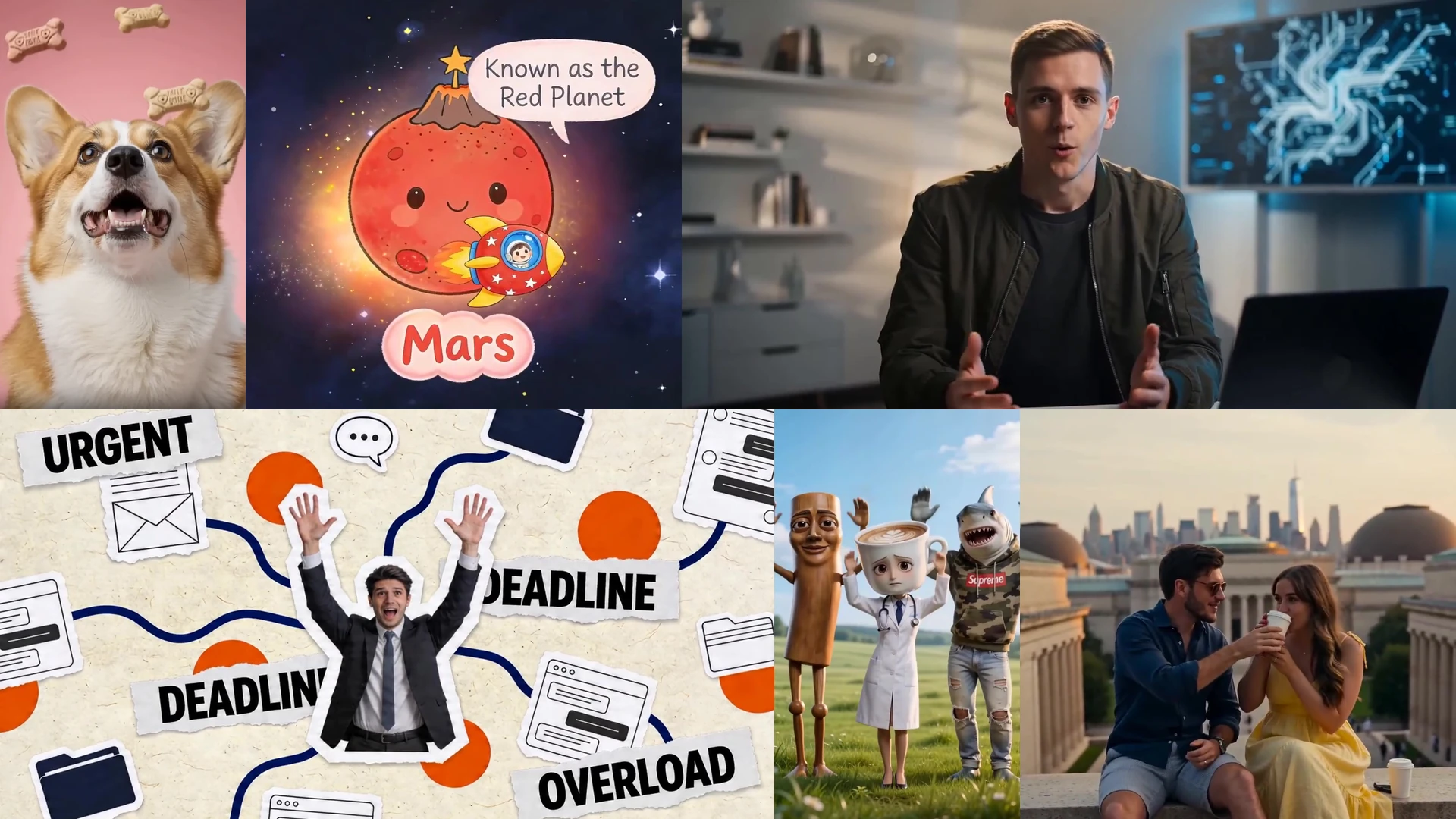
The AaaS way: a video agent you brief. You tell an AI video agent the goal in plain language, and it returns a finished film. Internally it writes a script, breaks the story into shots, routes each shot to the best-suited model across a pool of ten or more (Seedance 2.0, Kling 3.0, Veo 3.1, Sora 2, Runway Gen-4), generates them, adds transitions, composes and mixes a soundtrack, and masters the output — then delivers a finished 15-second video. You never touched a timeline or chose a model. You review the deliverable and accept or ask for a change.
Pexo is the video-vertical instance of AaaS: a conversational AI video agent that takes a goal and returns a finished video, auto-routing across 10+ models and owning the full pipeline from script to mastered export. It is to video what Manus is to general knowledge work — the same outcome-delivery shape, a different domain. And it makes the SaaS-vs-AaaS line tangible: a video editor sells you tools and leaves the production to you; Pexo sells you the finished production and keeps it. Comparing the two on "which has more timeline controls" misses the point entirely — one is a tool you operate, the other is an outcome you accept.
Agent-as-a-Service Is Still Early
The measured case cuts both ways: just as "SaaS is dead" overstates the disruption, treating AaaS as a finished, drop-in replacement overstates its maturity. The category is pre-paradigmatic. The boring, reliable infrastructure that made SaaS dependable — and that is now making MCP dependable — does not exist for AaaS yet:
- No shared protocol. Manus, Devin, Claude Managed Agents, and the rest expose private REST APIs. There is no agreed standard for how a buyer's agent dispatches a job to a seller's agent. Google's A2A protocol has backers but is not yet the connective tissue across the major labs.
- No discovery layer. MCP has registries; AaaS has no "agent yellow pages." A buyer's agent finds a provider through web search today — which is why answer-engine visibility, being the source an AI assistant cites, is currently the real distribution channel for an AaaS product.
- No reputation or settlement standard. A calling agent cannot cheaply verify the quality of a returned deliverable, and pricing is improvised — opaque per-vendor credit systems where cost accrues by effort while value is promised by outcome, and failed runs are often still billed.
This is the shape of an early category, not a flaw to hide. It is also why the transition is a multi-year restructuring rather than a finished migration. SaaS spent twenty years becoming dependable plumbing. AaaS is at the start of that road — the market structure is visible, the standards are not built yet, and the per-outcome pricing the model points toward is still mostly aspiration dressed as effort-based billing.
Related Reading
- MCP vs Agent Skills vs Agent-as-a-Service: what each layer actually sells — the architectural version of this value/risk axis
- MCP vs Agent Skills: When to Use Each, and the Layer Above Both
- What Is Agent-as-a-Service (AaaS)? The Complete Guide
- Agent-as-a-Service for Video: How AI Video Agents Deliver Finished Work
Resources
| Resource | URL | Description |
|---|---|---|
| Thoughtworks: Service-as-Software | thoughtworks.com | The economic framing — software sold as the outcome it produces |
| Manus API | open.manus.im/docs/v2 | A general agent sold as an endpoint — the clearest AaaS reference |
| Anthropic | anthropic.com | Claude Managed Agents — an agent runtime sold as a managed endpoint |
| Pexo | pexo.ai | The video-vertical Agent-as-a-Service — goal in, finished film out |
| Pexo Skills (GitHub) | github.com/pexoai/pexo-skills | Open-source agent skills for content creation |