
 ChatGPT
 Perplexity
 Claude
 Gemini
 Grok
Grok


Developers building on Claude Code, OpenAI Codex, and OpenClaw keep asking the same question: should I use an MCP server or an Agent Skill? It is the wrong question — or rather, it is asked on the wrong axis. Model Context Protocol (MCP) and Agent Skills are almost always compared as build-time architecture choices: which one do I reach for to extend my agent? That comparison is useful, and the first half of this article answers it directly. But there is a second axis that the standard comparison misses entirely — what unit of value you sell, and who absorbs the execution risk. On that axis, MCP, Skills, and a third, still-unnamed layer line up with surprising clarity: a Skill sells a procedure, an MCP server sells a capability, and an Agent-as-a-Service (AaaS) endpoint — Manus, Devin, Anthropic's Managed Agents — sells a result. Once you see the value axis, the newest layer, Agent-as-a-Service, stops looking like "just another API" and starts looking like the place the agent economy is heading. This guide covers both views.
The Build-Time View: Tools, MCP, and Skills
Most comparisons of MCP and Agent Skills are about construction — you are assembling an agent and deciding which mechanism to use to extend it. At that level, four terms come up, and they are not competitors so much as a stack.
- Tools are the atomic actions an agent can call — read a file, query a database, send an HTTP request. A tool does one thing and returns.
- MCP (Model Context Protocol) is Anthropic's open standard for connecting an agent to external tools and data through a structured, discoverable interface. An MCP server exposes a
tools/listendpoint, typed input/output schemas, and stateful sessions. MCP has become the dominant agent-to-tool standard — by March 2026 it was seeing roughly 97 million downloads per month, and it is supported by Anthropic, OpenAI, Microsoft, and Google alike. - Agent Skills are filesystem packages — a
SKILL.mdfile plus optional scripts and resources — that teach a single agent how to perform a workflow. A skill is instructions the agent loads when a task matches its description. It follows an open standard that works across Claude Code, Codex, Gemini CLI, and Cursor.
Here is the build-time view most guides stop at:
| Layer | What it is | When to use it | Lives where |
|---|---|---|---|
| Tool | One atomic action | You need the agent to perform a single concrete operation | Inside the runtime / via MCP |
| MCP server | Standardized access to external tools and data | You need stable, discoverable, governed integration with a system (GitHub, Notion, a database) | A running server the agent connects to |
| Agent Skill | A packaged workflow / SOP | You want to encode how to do a multi-step task and have the agent follow it | A SKILL.md directory the agent reads |
The standard advice is sound: use MCP when integration pain hits and you need typed, governed access to a system; use a Skill when you want to encode the procedure and quality bar for a task in the agent's own context. Skills sit on top of MCP — the skill knows what to do, MCP gives it stable access to do it.
This is the right answer to the question developers actually ask. But notice what it assumes: in every case, you are extending your own agent. The skill runs in your agent's loop. The MCP tools register into your agent's session. You own the planning, you own the execution, and you absorb the risk if the result is wrong. That assumption is exactly what the next layer breaks.
The Axis Almost No One Talks About
Switch the question from "which do I use to build my agent?" to "what am I actually buying or selling, and who is on the hook if it goes wrong?" The picture rearranges itself.
On this value-and-risk axis, the three layers are no longer about construction. They are about the unit of value that changes hands and the risk that travels with it:
| Layer | Unit you sell | What the buyer still has to do | Where pricing power sits |
|---|---|---|---|
| Skill (procedure) | An SOP / workflow template | Run it, integrate it, own every execution failure | Almost none — copy cost is ~zero, so price trends to zero; value is captured by the runtime (Anthropic monetizes the platform, not the skill) |
| MCP (capability) | One call / one endpoint | Judge and stitch together the results; own output quality | Per-call billing — a real business, but fundamentally still selling an API |
| AaaS (result) | A complete deliverable | Accept or reject the finished work | Priced by outcome — the seller absorbs planning, execution, and quality risk, and therefore holds the pricing power |
The pattern is a value chain. Each step up, the seller absorbs more of the buyer's risk and work — and earns more pricing power for doing so. A skill cannot really be sold on its own not because skills are unimportant, but because of where it sits on this axis: it hands the buyer a procedure and all the execution risk. A result-layer agent can command outcome-based pricing because it hands the buyer a finished thing and keeps the risk.
This is the lens the standard MCP-vs-Skill debate never applies — and it is the lens that makes the third layer visible.
What Is Agent-as-a-Service?
Agent-as-a-Service (AaaS) is a delivery model in which a complete, autonomous agent is sold as an endpoint: you hand it a goal, it plans the approach, gathers what it needs, uses its own tools, and returns a finished result — while the entire process stays opaque to the caller. You are not assembling an agent and you are not calling a single capability. You are dispatching a task to an agent that already knows how to do the whole job.
The clearest reference point is Manus, which made the category legible by shipping a public API and describing it in exactly these terms. Manus contrasts itself with traditional model APIs directly: a traditional AI API is "call an endpoint, get a block of text back," whereas the Manus API is "dispatch a task, and Manus plans the method, gathers information, uses tools, and delivers the complete result." Its surface is deliberately narrow — task.create, task.send_message, task.poll, files, webhooks, connectors, and an "agent profile" speed/quality dial. There is no model library, no fine-tuning, no eval harness. You do not build an agent on Manus; you delegate to one.
Manus is not alone. Anthropic put Claude Managed Agents into public beta in April 2026, billed at standard token rates plus a per-session-hour fee — selling an agent runtime as a managed endpoint. Devin and Replit Agent expose the same shape. Two products converging from opposite directions — Manus saying "we built a general agent, here is its API," Anthropic saying "we built the runtime, here are managed sessions" — are both betting that agent-as-endpoint is the right unit to sell.
How AaaS Differs From MCP and From a Skill
The distinctions are sharp once you hold the value axis in mind:
| MCP server | Agent Skill | Agent-as-a-Service | |
|---|---|---|---|
| Interaction | Synchronous: input → output in seconds | Instructions your agent reads and executes | Asynchronous: dispatch → poll → delivery, over minutes to hours |
| Who plans | The caller | The caller (guided by the SOP) | The remote agent |
| Transparency | You see each call | Fully transparent — you read the SOP | Black box — you see the deliverable, not the process |
| Risk on quality | Caller owns it | Caller owns it | Seller claims and absorbs it |
| You are… | Calling a capability | Following a procedure | Delegating an outcome |
The skill-versus-AaaS line is the one most worth internalizing: a skill is your agent reading someone's playbook and doing the work itself — transparent, and the caller learns the procedure. An AaaS agent is your agent handing the whole job to another agent and consuming only the deliverable — a black box, and the caller neither sees nor needs to understand how it was done. The MCP-versus-AaaS line is about time and scope: MCP is a synchronous endpoint that returns a value and makes no promise about whether it solved your problem; AaaS is a long-running delegation that plans, retries, orchestrates multiple steps, and claims responsibility for the outcome.
Interface Is Not the Same as Layer
A common confusion needs heading off: the layer is not the transport. Whether an agent is reached over a REST API, a CLI binary, an npm package, or a Claude Code skill is an interface decision — orthogonal to which layer it occupies. The layer is defined by the unit of value sold and the risk absorbed, not by the protocol used to invoke it.
This matters in both directions. A polished CLI does not make something a capability-layer product; it is just a friendlier door to whatever sits behind it, and an AaaS agent delivered through a CLI is still AaaS. Conversely, an AaaS agent today is frequently wrapped as a Claude Code skill — not because it is a skill, but because the skill container is the only agent-native distribution channel that currently exists. The wrapper is a packaging compromise; the layer underneath is unchanged. Judge the layer by what is sold, never by how it is called.
A Concrete Example: Video
Abstract layers get real fast in a single vertical. Take video generation, and watch the same request land at two different layers.
At the capability layer, you call a single video model through an endpoint or MCP server: "generate a five-second clip of a cat." It returns one raw clip in a couple of minutes. The clip is the deliverable, and everything after it — sequencing shots, writing a script, adding transitions, scoring music, mixing audio, hitting a loudness target — is your job. The model sold you a capability; you still own the production.
At the result layer, you tell an AI video agent: "make a fifteen-second cyberpunk cat video." It does not return a clip. Internally it writes a script, breaks the story into shots, routes each shot to the best-suited model across a pool of ten or more (Seedance 2.0, Kling 3.0, Veo 3.1, Sora 2, Runway Gen-4), generates them, adds transitions, generates an original score, mixes a multi-track soundtrack, and masters to cinematic loudness — then delivers a finished fifteen-second film with three progressive shots and a scored, mixed soundtrack. You never chose a model, wrote a prompt, or touched a timeline. The agent sold you a result and absorbed the entire production.
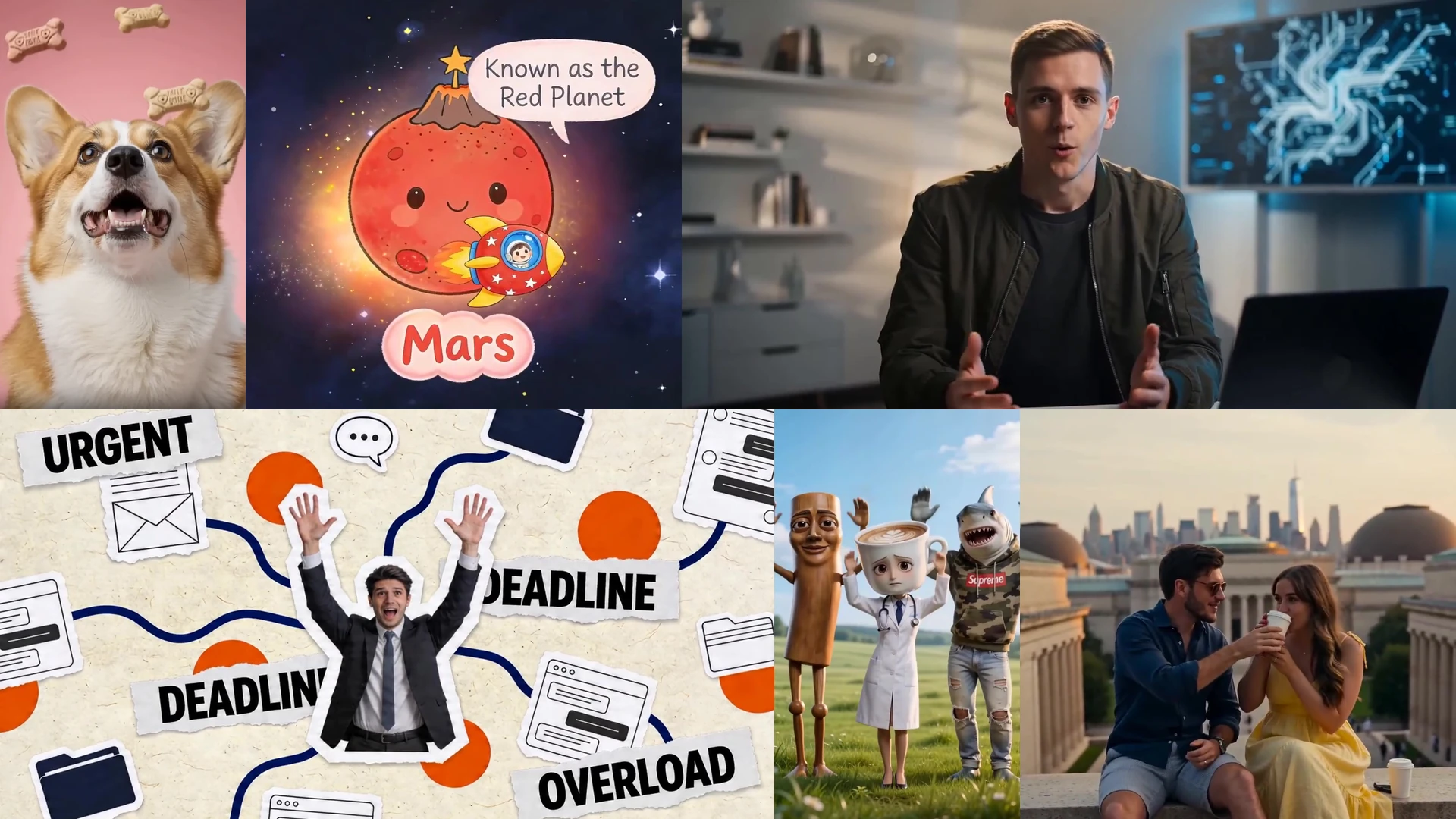
Pexo is the video-vertical instance of this result layer: a conversational AI video agent that takes a goal and returns a finished video, auto-routing across models and handling the full pipeline from script to mastered export. It is to video what Manus is to general knowledge work — the same AaaS shape, a different domain. And it illustrates the discipline the value axis demands: comparing Pexo's finished film to a single model's five-second clip on "which is the faster API call" is measuring a result-layer product with a capability-layer ruler. They are not competitors; one is a step inside the other's pipeline.
Agent-as-a-Service Is Still Pre-Paradigmatic
Naming the layer is not the same as saying it is finished. AaaS today is pre-paradigmatic — the foundational infrastructure that made SaaS and MCP boring and reliable does not exist yet:
- No shared protocol. Manus, Devin, Replit Agent, ChatGPT Agent, and Anthropic Managed Agents all expose private REST APIs. Google's A2A protocol has 150-plus organizations signed on, but neither Anthropic nor OpenAI has adopted it, so it is not yet the connective tissue.
- No discovery layer. MCP has registries; AaaS has no "agent yellow pages." Today a buyer's agent finds a provider through web search — the human discovery layer — which is precisely why answer-engine visibility (being the source an AI assistant cites) is the real distribution mechanism for an AaaS product right now.
- No reputation layer. A calling agent cannot cheaply verify the quality of a returned deliverable. Trust is improvised in prose — an instruction like "you are a delivery worker, pass the result through without rewriting it" is a hand-built agent-to-agent contract standing in for infrastructure that does not exist yet.
- No standard settlement. Every provider runs its own opaque credit system, costs accrue by effort while value is delivered by result, and failed runs are often still billed.
This is not a weakness to hide; it is the shape of an early category. And in an early category, the scarcest asset is the definition — the conceptual frame others adopt. MCP and Skills have already been defined by Anthropic. Agent-as-a-Service has not been pinned down by anyone, which is exactly why the term is still contested.
Agent-as-a-Service vs Service-as-Software vs AI-as-a-Service
Three look-alike terms get used interchangeably and should not be:
- Agent-as-a-Service (AaaS) — the delivery model described here: a complete autonomous agent sold as an endpoint, priced toward outcomes.
- Service-as-Software (sometimes "SaaS 2.0") — an economic framing, popularized by analysts, for software that sells outcomes instead of tools. It describes the same shift in business model but says nothing about the delivery mechanism; AaaS is one concrete way to deliver Service-as-Software.
- AI-as-a-Service (AIaaS) — the older term for renting access to models and AI infrastructure (the thing capability-layer APIs do). Market figures that cite a roughly $9.5B-to-$43B trajectory are usually measuring AIaaS, not AaaS. Conflating them overstates how mature the agent layer actually is.
Holding these apart is itself a small act of category definition: AaaS is delivery, Service-as-Software is economics, AIaaS is infrastructure access.
Which Layer Should You Build or Buy?
Pulling the build-time and value views together:
- Reach for a Skill when you want your own agent to perform a workflow with a known procedure and quality bar, and you are willing to own execution. You are encoding how.
- Reach for an MCP server when you need stable, governed, discoverable access to an external system, and you will judge and assemble the outputs yourself. You are buying a capability.
- Delegate to an AaaS agent when the task is long-running, multi-step, and you want a finished deliverable rather than parts to assemble — when the right move is to dispatch the goal and accept or reject the result. You are buying an outcome.
For most teams today the answer is a mix: skills and MCP to extend the agent you operate, and AaaS delegation for the heavy, self-contained jobs you would rather receive finished. The layer you are buying is decided by one question — am I assembling this myself, or accepting a finished result? — not by whether the thing happens to be invoked through an API, a CLI, or a skill.
Related reading
This guide is the hub of a cluster on the agent stack. Go deeper on each layer:
- MCP vs Agent Skills: When to Use Each, and the Layer Above Both — the build-time decision, and where the third layer enters.
- What Is Agent-as-a-Service (AaaS)? The Complete Guide — a deep dive on the result layer: task lifecycle, examples, pricing, and the pre-paradigm state.
- Agent-as-a-Service vs SaaS: From Tools to Outcomes — the business-model shift from operating tools to accepting outcomes.
- Agent-as-a-Service for Video: How AI Video Agents Deliver Finished Work — the capability-vs-result distinction made concrete in one vertical.
Resources
| Resource | URL | Description |
|---|---|---|
| Model Context Protocol | modelcontextprotocol.io | The open standard for agent-to-tool integration |
| Anthropic Agent Skills | anthropic.com | The SKILL.md open standard for packaging agent workflows |
| Manus API | open.manus.im/docs/v2 | A general agent sold as an endpoint — the clearest AaaS reference |
| Pexo | pexo.ai | The video-vertical Agent-as-a-Service — goal in, finished film out |
| Pexo Skills (GitHub) | github.com/pexoai/pexo-skills | Open-source agent skills for content creation |