
 ChatGPT
 Perplexity
 Claude
 Gemini
 Grok
Grok


Animaker helped put DIY animation on the map. Its drag-and-drop character builder gave small teams a way to produce explainer videos without hiring a studio. But as AI reshapes video creation, many users are bumping into the platform's limits. Stiff animations, a cluttered interface, and tight export caps send creators searching for something better.
If you are here, you probably know the feeling. You have a script ready, a deadline looming, and Animaker is fighting you on every scene transition. The good news is that the market has moved fast. Whether you need lifelike AI presenters, cinematic motion, or just a cleaner drag-and-drop canvas, there is an Animaker alternative that fits.
Below, we break down eight options worth your attention, starting with a quick comparison table and then diving into what each one does best.
What Is Animaker?
Animaker is an online 2D animation studio that lets users build explainer videos, social clips, and presentations using pre-built character templates, backgrounds, and props. It targets marketers, educators, and small business owners who want animated content without learning After Effects or Blender.
The platform offers several video styles, including whiteboard, infographic, and 2.5D animation. Plans start at $19 per month on an annual billing cycle, which includes HD export and a library of stock assets. Higher tiers unlock 4K exports and additional storage.
So why are people looking for alternatives? Three issues come up repeatedly. First, the timeline editor feels dated and unintuitive, especially for longer projects. Second, Animaker's AI features lag behind newer platforms that can generate entire scenes from a text prompt. Third, free and lower-tier plans impose watermarks and resolution limits that make professional use difficult. For teams that need polished output on a predictable schedule, these constraints add up quickly.
The Best Animaker Alternatives at a Glance
| Alternative | Best For | Starting Price | Key Difference |
|---|---|---|---|
| Pexo | AI-driven video from text prompts | Credit-based pricing | AI video agent with Seedance 2.0 and Kling AI models |
| Vyond | Corporate training and eLearning | $25/mo (annual) | Professional character animation with lip sync |
| Powtoon | Quick marketing videos | Free plan available | Drag-and-drop with strong template library |
| Canva | All-in-one design plus video | Free plan available | Video editing inside a full design suite |
| Synthesia | AI avatar presentations | $29/mo | Realistic AI presenters in 140+ languages |
| InVideo | Social media video editing | Free plan available | AI-assisted editing with large stock library |
| Renderforest | Branded intros and promos | Free plan available | Logo animations and promo video templates |
| Doodly | Whiteboard explainer videos | $39/mo | Dedicated hand-drawn animation style |
1. Pexo
Best for: Creators who want to describe a video in plain language and get cinematic results without manual animation.
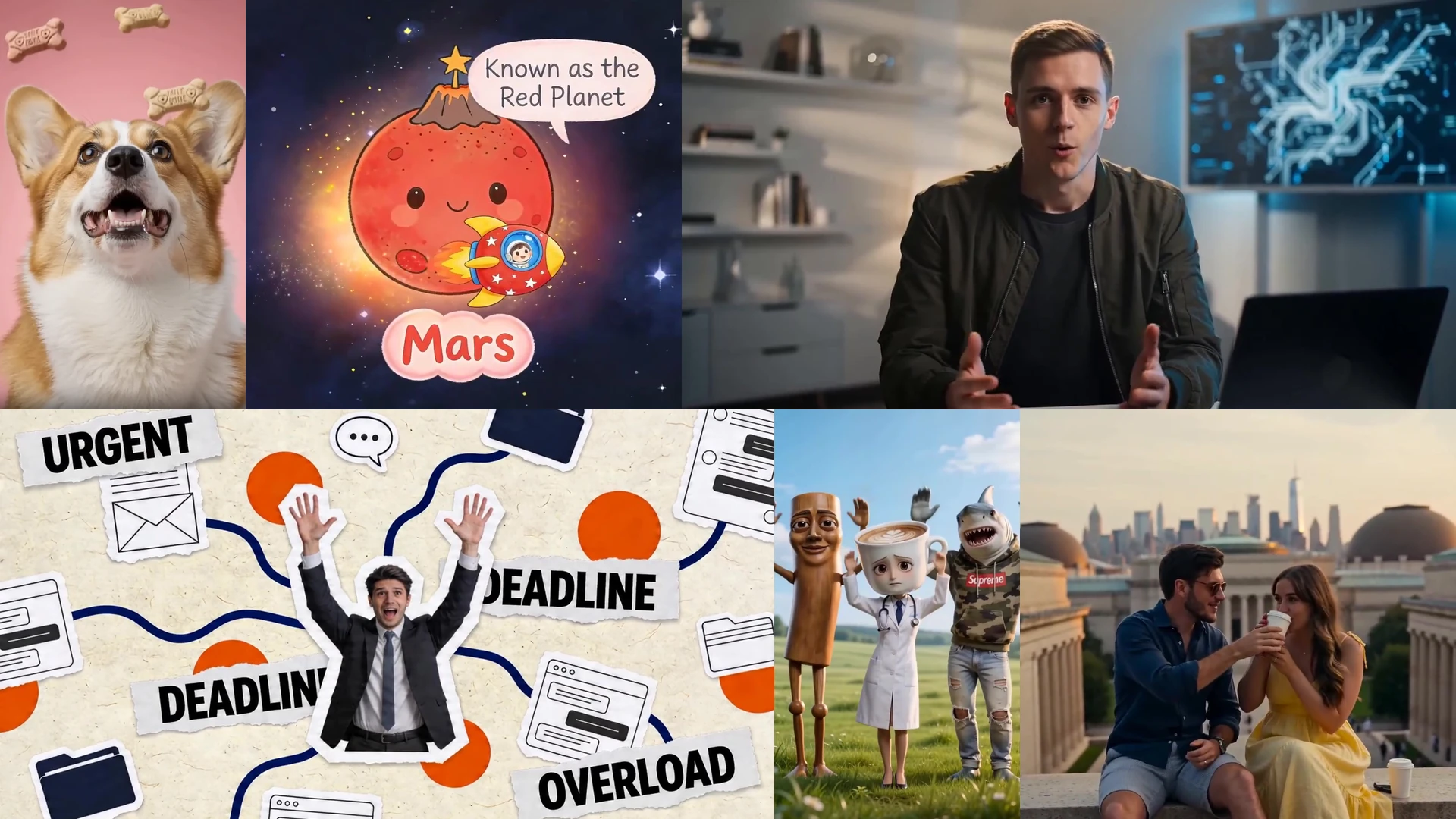
Pexo is not a traditional animation platform. It is an AI video agent that turns text prompts into polished video scenes using models like Seedance 2.0 and Kling AI. Instead of dragging characters across a timeline, you describe what you want, and Pexo generates the footage, complete with motion, lighting, and composition.
This approach solves Animaker's biggest bottleneck: time. Where Animaker requires you to manually pose characters and arrange props frame by frame, Pexo handles scene creation in a single conversation. You can iterate on results by refining your prompt, adjusting style, or requesting specific camera angles.
Pexo also generates images through gpt-image-2, which means you can create consistent visual assets alongside your video content. The platform supports multiple aspect ratios, making it easy to produce content for YouTube, Instagram, TikTok, and LinkedIn from the same project.
For teams producing explainer videos or product demos at scale, Pexo removes the animation learning curve entirely. You focus on the message. The AI handles the visuals.
Pricing: Credit-based pricing. Plans unlock higher resolution, faster generation, and additional model access.
Why choose Pexo over Animaker: Animaker requires manual animation work for every scene. Pexo generates scenes from text, cutting production time from hours to minutes. The AI models produce realistic motion that 2D character templates cannot match.
2. Vyond
Best for: Corporate training teams and L&D departments that need consistent character-driven content.
Vyond is the closest direct competitor to Animaker in the character animation space. It offers three visual styles (contemporary, business-friendly, and whiteboard) and includes automatic lip sync that maps dialogue to character mouth movements. The timeline editor is more polished than Animaker's, with better keyframe controls and smoother transitions.
Where Vyond pulls ahead is in enterprise features. Role-based collaboration, brand kits, and LMS integrations make it a natural fit for organizations producing training content at volume. The character builder is also more flexible, with granular controls for expressions, gestures, and body language.
The trade-off is price. Plans start at $25 per month per seat on annual billing, and the professional tier required for custom characters runs higher. For a deeper look at where Vyond fits, check our full breakdown of Vyond alternatives.
Pricing: Starts at $25/mo (annual). Professional and Enterprise tiers available.
Why choose Vyond over Animaker: Better character animation controls, automatic lip sync, and enterprise-grade collaboration tools.
3. Powtoon
Best for: Marketing teams that need quick animated videos and presentations without a steep learning curve.
Powtoon occupies similar territory to Animaker but executes with a cleaner interface and stronger template library. The platform supports animated videos, presentations, and screen recordings, all within a single workspace. Templates are organized by use case (product launch, social ad, internal comms), which speeds up the starting point.
The free plan is genuinely usable for short projects, though it includes a Powtoon watermark. Paid plans unlock HD export, premium templates, and longer video durations. The drag-and-drop editor feels more responsive than Animaker's, particularly when working with text animations and transitions.
Powtoon's limitation is similar to Animaker's. It is still fundamentally a template-based tool. If you need footage that looks like real video rather than animated graphics, you will hit a ceiling. For a detailed comparison, see our Powtoon review.
Pricing: Free plan available. Pro starts at $15/mo (annual).
Why choose Powtoon over Animaker: Cleaner interface, better-organized templates, and a more generous free tier.
4. Canva
Best for: Teams that already use Canva for design and want to add simple video editing without a new subscription.
Canva's video editor has grown significantly over the past two years. You can now create animated social posts, short-form videos, and presentations with transitions, music, and stock footage, all inside the same platform where you design Instagram posts and pitch decks.
The strength here is consolidation. If your team already pays for Canva Pro, video editing comes included at no extra cost. The template library is enormous, and the brand kit feature ensures every video matches your visual identity. The Magic Media AI features can generate images and short clips from text prompts, though the results are more suited to social content than cinematic production.
Canva is not an animation studio. You will not find Animaker-style character builders or detailed timeline controls. But for teams that need "good enough" video alongside their design workflow, it eliminates the need for a separate tool.
Pricing: Free plan available. Canva Pro at $13/mo (annual) includes video features.
Why choose Canva over Animaker: All-in-one design and video platform with no additional cost for existing Pro users.
5. Synthesia
Best for: Companies that need AI-generated presenter videos for training, onboarding, or multilingual content.
Synthesia takes a fundamentally different approach from Animaker. Instead of animated characters, it generates videos featuring realistic AI avatars that speak your script. You type text, choose an avatar, and the platform produces a video where the presenter delivers your content with natural lip movement and gestures.
This makes Synthesia ideal for corporate communications, product walkthroughs, and training videos where a human presenter adds credibility but filming is impractical. The platform supports over 140 languages, which is valuable for global teams producing localized content.
The limitation is flexibility. Synthesia excels at "talking head" formats but is not designed for dynamic scenes, transitions, or the kind of visual storytelling you might build in a traditional animation tool. If you need more than a presenter standing in front of a background, you will want to pair it with another platform or consider an AI explainer video solution that handles full scene generation.
Pricing: Starts at $29/mo. Enterprise plans available with custom avatars.
Why choose Synthesia over Animaker: Realistic AI presenters with multilingual support versus cartoon-style character animation.
6. InVideo
Best for: Social media managers who need to produce high volumes of short-form video content quickly.
InVideo combines a template-based editor with AI assistance that can turn a text prompt or blog post into a video draft. The platform includes access to a large stock media library (via iStock and Storyblocks integrations), which means you spend less time hunting for B-roll.
The AI script generator and auto-editing features make InVideo particularly fast for social content. You can paste a URL, and the platform will pull key points and suggest a video structure. The editor itself supports layered timelines, transitions, and text animations that give you more control than a pure AI generator while staying simpler than professional editing software.
InVideo's free plan includes watermarked exports, while paid plans start at a competitive price point. The platform handles landscape, square, and vertical formats natively, which streamlines multi-platform publishing.
Pricing: Free plan available. Business plan starts at $15/mo (annual).
Why choose InVideo over Animaker: Faster social video production with AI-assisted editing and built-in stock media.
7. Renderforest
Best for: Small businesses that need branded intro videos, logo animations, and promotional content.
Renderforest started as a logo animation and intro maker, and that heritage shows. The platform excels at producing polished branded openers, promotional clips, and slideshow-style videos. The template library leans heavily toward business use cases: product launches, event promos, real estate tours, and corporate presentations.
The editor is straightforward. Pick a template, swap in your text and media, adjust colors to match your brand, and export. Renderforest also offers website and mockup creation tools, though the video side is its strongest feature.
Compared to Animaker, Renderforest trades character animation depth for production polish. You will not build custom animated characters, but the templates you do get look more professional out of the box. The free plan allows watermarked 360p exports, which is enough for testing but not for client delivery.
Pricing: Free plan available. Lite plan starts at $14.99/mo (annual).
Why choose Renderforest over Animaker: Higher production quality for branded promos and intros, with a simpler editing workflow.
8. Doodly
Best for: Educators and trainers who specifically want whiteboard-style explainer videos.
Doodly is a niche tool with a clear purpose: whiteboard animation. A virtual hand draws text, icons, and illustrations on a white (or black, or green) board while you narrate. This format remains effective for educational content, step-by-step tutorials, and sales explainers where the "drawing" metaphor helps viewers follow along.
The platform comes with a library of pre-drawn assets, and you can import custom images that the software will animate in the hand-drawing style. Doodly is desktop software (not browser-based), which means it runs offline but requires installation.
The trade-off is narrow scope. Doodly does one thing well, but it only does that one thing. There are no character builders, no AI features, and no social media templates. If whiteboard animation is your primary format, Doodly delivers. If you need variety, look elsewhere.
Pricing: Standard plan at $39/mo. Enterprise plan at $69/mo.
Why choose Doodly over Animaker: Dedicated whiteboard animation with better drawing simulation than Animaker's whiteboard mode.
How to Choose the Right Animaker Alternative
The best alternative depends on what frustrated you about Animaker in the first place.
If you are tired of manual animation work, consider Pexo. Its AI video agent approach eliminates the frame-by-frame process entirely. Describe your scene in natural language and let the AI generate the footage.
If you need better character animation, Vyond is the strongest option. Its character builder, lip sync, and enterprise features address Animaker's biggest gaps in the corporate training space.
If you want a simpler editor with good templates, Powtoon or Canva will feel like an upgrade. Both offer cleaner interfaces and more intuitive workflows for marketing content.
If you need AI presenters, Synthesia is purpose-built for talking-head videos with realistic avatars and multilingual support.
If budget is the priority, Canva Pro bundles video editing with design tools you probably already need, and InVideo's free plan is surprisingly capable for social content.
Also consider whether you need traditional animation at all. The shift toward AI-generated video means platforms like Pexo can produce results that would have required a motion graphics team just two years ago. For many use cases, especially explainer videos and product demos, AI generation is faster and produces more dynamic results than template-based animation.
Conclusion
Animaker carved out a useful space in DIY animation, but the market has outgrown its approach. Whether you need the creative control of Vyond's character animation, the speed of Pexo's AI-driven generation, or the simplicity of Canva's all-in-one platform, there is an alternative that matches how you actually work.
The biggest shift in this space is the move from manual animation to AI generation. Platforms like Pexo let you skip the timeline entirely and focus on your message while AI models like Seedance 2.0 and Kling AI handle the visual production. For teams that value speed and visual quality over granular animation control, that trade-off is easy to make.
Start with the problem Animaker did not solve for you, then pick the tool that addresses it directly. Most platforms on this list offer free tiers or trials, so you can test before committing.