

 ChatGPT
 Perplexity
 Claude
 Gemini
 Grok



Your next content request may be unnecessary. Pexo can help revise a confusing image, prepare a clearer spoken explanation or develop a better video opening, but first identify what is failing. An HVAC social media audit should tell the business which existing messages to keep, correct, retire or replace.
This audit uses five checks that a small contractor can apply without an elaborate analytics project. It distinguishes a communication defect from a distribution or customer-service problem. The example is illustrative, with no claimed performance data from a real contractor. Use your own posts, inquiry records and service facts.
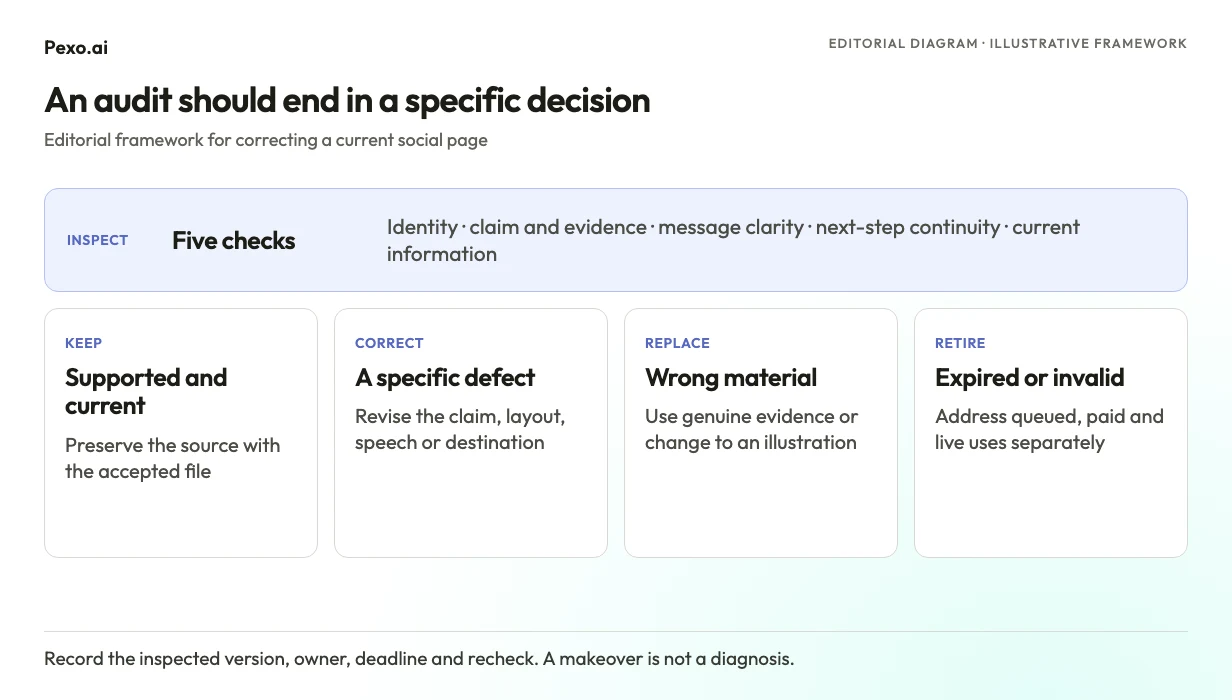 The audit connects an observed defect to an owner and a decision, rather than asking for a general visual makeover.
Audit the journey a local homeowner actually takes
Start with the visible journey: profile, recent post, destination and contact response. A viewer may arrive after hearing your name from a neighbor. Can they tell where you work and what service the post describes? Does the next step lead somewhere relevant? If they ask a question, who answers? Screenshot or record the exact version you inspect so the team can discuss the same evidence. A report saying “our content needs improvement” gives Pexo little useful direction. A report saying “the video mentions a promotion that the booking page does not explain” identifies a repairable mismatch.
For a bounded first pass, inspect every active promotion plus the introduction, four recent posts and two older posts still generating questions. This is an example work limit, not a statistical sample. Record the platform, item locator, version and inspection date. This audit primarily checks accuracy, clarity and the contact journey. A later performance pass can examine local audience fit, distribution, suitable inquiries and response coverage using the data available. You do not need private customer messages in a creative application; an anonymized description of the defect is sufficient.
Use five checks for an HVAC social media audit
Score each check as clear, incomplete or misleading. Do not average a misleading claim into an acceptable overall score. Some defects need correction regardless of how attractive the remaining content looks. This table gives the reviewer a concrete question and a corresponding next action.
| Check | Inspect | Corrective action |
|---|---|---|
| Business identity | Can a visitor identify the company, service area and relevant service? | Correct the profile or introduction before making another generic awareness post. |
| Claim and evidence | Does the source support every material claim in the image, narration and caption? | Remove unsupported wording; replace invented proof with genuine material or an obvious illustration. |
| Message clarity | Can a phone viewer explain the post's point after one viewing? | Simplify the visual hierarchy or narration, then review the actual revised asset. |
| Next-step continuity | Do the destination and office response match the post? | Fix the handoff, not just the graphic. |
| Current information | Are terms, dates, status and availability still correct? | Update or retire every affected version and assign a refresh owner. |
Apply the evidence check especially carefully to generated material. Pexo's image-generation workflow can create a useful illustration, but an illustration cannot prove that your crew completed a particular installation. Keep real job photographs and authorized customer comments attached to their context. The FTC's advertising guidance is a relevant primary reference for reviewing claims and endorsements. The audit should ask what a reasonable viewer would take from the whole post. A technically accurate caption does not necessarily correct a visual that implies a fictional customer result or an unavailable offer.
Turn the findings into four decisions
Mark each item keep, correct, retire or replace. Keep means the message remains useful and accurate. Correct means the purpose is sound but a specific defect can be repaired. Retire means the message no longer belongs in circulation, perhaps because the offer expired. Replace means the asset cannot do its job without a different approach or source. This is more actionable than ranking every post from best to worst. It also stops the team from regenerating content that already works. Record the reason, owner and affected versions. A correction affecting spoken words should identify the narration, not just the caption.
Here is an illustrative audit record a coordinator could use. It describes communication conditions rather than invented campaign results.
| Item | Finding | Decision and owner |
|---|---|---|
| Company introduction | Service area is absent | Correct; owner approves the area, coordinator revises the image with Pexo. |
| Maintenance explanation | Diagram is readable, but narration calls a request a confirmed booking | Correct; dispatcher supplies exact process, coordinator revises the speech. |
| Customer quote card | Original feedback and permission are available; wording is unchanged | Keep; preserve the evidence with the accepted file. |
| Seasonal promotion | Deadline has passed, including in the video audio | Retire; publisher identifies all active placements. |
| Installation showcase | Generated image has no genuine job source | Replace; use a real authorized job photograph or change the topic to a clearly labeled illustration. |
Brief Pexo on the defect rather than asking for a makeover
For the maintenance example, a usable request is specific: “The current narration implies that sending a form confirms a visit. Our actual process is request, office confirmation, then appointment. Preserve those three stages. Develop a clearer illustrated sequence and an audio read using the approved wording.” Review the proposed direction before requesting a full video. Pexo's text-to-speech workflow can prepare the spoken version, which should be checked against the source. If the visual already communicates the process, keep it. A revision does not need to replace every part of the packet to justify the effort.
Use a working record that survives the revision. These are hypothetical entries; the locator is the actual asset or placement reference your team supplies.
| Locator and inspected version | Evidence and decision | Owner, deadline and recheck |
|---|---|---|
| Promotion P-04, video v2, inspected Monday | Spoken deadline expired; retire in all active placements | Publisher acts today; recheck scheduled, paid and live organic uses separately |
| Booking B-02, card v3, inspected Monday | Card says “confirmed” but office confirms manually; correct image and destination | Coordinator revises with office-approved wording by Wednesday; recheck phone-size card and form confirmation; record result as open, passed or failed |
When motion is required, Pexo's text-to-video workflow can develop the revised sequence. Acceptance means checking the finished asset against the recorded defect, rather than assuming the instruction itself resolved it.
Check whether the correction solved the right problem
After a correction, revisit the original finding. The profile should show the approved service area. The narration should distinguish a request from a confirmed appointment. The retired promotion should no longer be used in active distribution under your control. These are verifiable outcomes even when a small business lacks enough volume for a meaningful performance experiment. Keep those checks separate from whether the post later receives attention. A clearer asset may still reach few local people. That is a distribution question, not proof that the correction was unnecessary. Likewise, a popular post can still contain an inaccurate claim that needs repair.
Conclusion
Use customer-response patterns to decide what to inspect next. If callers continue to misunderstand the booking process, compare the destination page and office wording with the revised asset. If inquiries are suitable but unanswered, assign response coverage before commissioning more creative. The Pexo social-media workflow can support a replacement packet when the audit establishes a real content need. A useful HVAC social media audit ends with fewer unresolved decisions, not a longer shopping list of assets. Keep what works, correct what can be fixed, retire stale promises and replace anything whose evidence or purpose cannot hold up.