

 ChatGPT
 Perplexity
 Claude
 Gemini
 Grok



A crew can complete valuable work every day and still have almost nothing usable for its next video. Pexo helps with the production of images, narration and video, but the obstacle may begin earlier: nobody has a clear brief, permission to use the material or time to approve the result. The reasons HVAC and plumbing teams underuse professional video services often need to be diagnosed as workflow problems before more production is purchased.
The explanations below are practical possibilities to check in your own business, not findings from an industry survey. The aim is to identify the missing responsibility and choose the right mix of real filming, creative support and internal coordination.
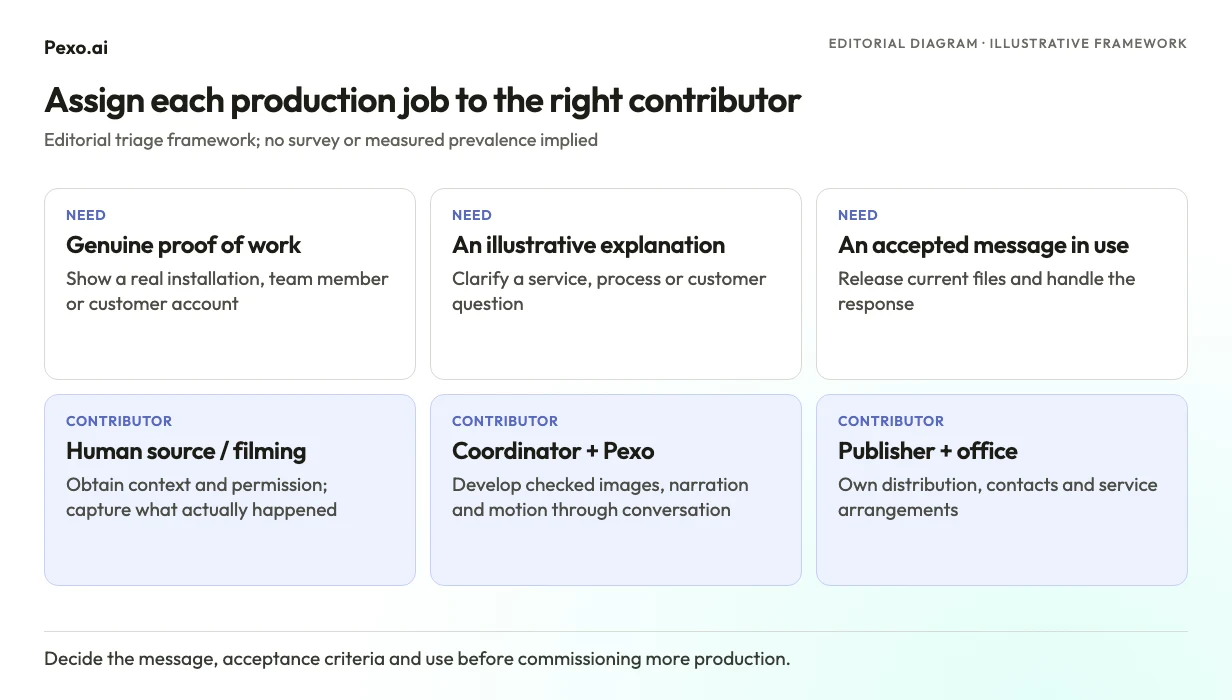 Different contributors solve different bottlenecks: generating an illustration does not document a real job, and delivering files does not publish them.
Find out whether the team needs footage or a finished message
“We need more video” can describe several different problems. A business may need genuine footage of its crew and completed work. It may need someone to turn approved facts into an educational explanation. It may already have attractive material but lack a publisher and response process. Those jobs require different help. A professional filmmaker can capture an interview or the details of an actual installation. Pexo can help develop original illustrative material, narration and a complete video around an approved idea. An internal coordinator connects those outputs to a clear business purpose and accepted version. Do not buy one responsibility while expecting it to silently cover the others.
Start by identifying the next useful message. Perhaps customers misunderstand what happens after submitting a service request. That explanation may need a clean visual sequence rather than a day of filming. Perhaps homeowners want to see the people entering their homes. That calls for genuine team material, not generated employee portraits. “No operating. Just directing” is a useful Pexo distinction when production complexity is the obstacle: the service owner describes the intended communication and reviews the creative direction. It does not remove the need for real evidence where the message claims to document real people or work. Deciding which kind of source the message needs prevents both unnecessary filming and inappropriate synthetic substitutes.
Check the barriers to using professional video services
Use the following diagnostic with the people who would actually supply and approve the content. Ask for an example of where work stalled, rather than inviting general complaints that video takes too long. The appropriate remedy should address that specific blockage.
| Possible barrier | What it looks like | A useful response |
|---|---|---|
| Missing source context | Photos arrive without explaining the job | Ask the technician for a short factual handoff alongside the source. |
| Filming disrupts service | A crew is expected to perform for a camera during a full schedule | Plan a limited capture assignment around the real work and obtain permission. |
| No clear message | The request is “something professional” | Specify the audience, question, next action and accepted facts before production. |
| Approval belongs to nobody | A finished draft waits in a chat | Name the factual reviewer, commercial approver and decision deadline. |
| Deliverables do not fit use | A long film exists, but the office needs a short service explanation | Define the actual placements and message before commissioning the package. |
| Distribution is missing | Accepted files remain unused | Assign publication and response responsibilities separately from production. |
Add two further checks before commissioning work: can the owner name a commercial purpose worth funding, and are the people involved willing and authorized to participate? A reluctant customer is not a production inconvenience to be solved with a synthetic testimonial. If four barriers apply, begin with the earliest unresolved dependency: purpose and budget, permission and source, production, approval, then distribution. Do not buy more production while purpose or publication ownership remains unresolved. Pexo's image generation can support appropriate illustrations, not documentary evidence. The FTC's advertising guidance is relevant to claim review.
Match each part of the job to the right contributor
A hybrid production plan is often more precise than an all-or-nothing choice between a filmmaker and AI. The field team supplies real service knowledge. A filmmaker records the people, interviews or physical details that need genuine capture. Pexo helps develop explanatory graphics, spoken drafts, music and video around the approved idea. The coordinator manages source versions and the review packet. This division should be visible in the assignment. Otherwise a provider may deliver exactly the film it was commissioned to make while the business still lacks the graphic, narration text or shorter explanation it intended to use.
Two fictional scenarios show why the purchase differs. An HVAC company wants to explain its maintenance visit. The service manager supplies scope; a limited real capture assignment shows the actual team and equipment, with permission and no interruption to unsafe or time-critical work. Pexo develops the explanatory graphic and narration. A plumbing company wants to explain what happens after a customer reports a leak. It should not stage a damaging leak or offer a generic repair diagnosis. The office supplies its actual contact process; a clear illustration explains the request and confirmation sequence. If either business lacks a publication owner, finish that assignment before buying another video. Capture records reality; editing assembles existing material; creative production develops explanatory assets; ongoing management owns release and follow-up. Buy the missing job.
Write the brief in terms of acceptance, not aspiration
A brief saying “make us look like the leading local contractor” invites a discussion about style while leaving the job undefined. A better brief says what the viewer should understand and what the source can establish. For the appointment example, the acceptance conditions might be: the three stages appear in the correct order; sending a request is not described as a confirmed appointment; the contact route is current; the company is identifiable; the message is readable on a phone. These conditions let the dispatcher and owner review the result without becoming video-production specialists. They also help a filmmaker or coordinator decide what source material is actually needed.
In Pexo, describe those conditions alongside the intended mood and presentation. A supporting soundtrack can be developed through music generation, but its purpose is to support the explanation, not obscure unclear words. Review the spoken audio before approving the full piece. “The booking step sounds like an automatic confirmation; use the approved wording and leave a pause before the next stage” is actionable feedback. “Make it more polished” is not an acceptance criterion. Keep the final narration text and accepted visual references with the file. If a later service-process change affects the message, the team can identify what needs revision instead of commissioning another entire project because nobody remembers what the original contained.
Run a small production cycle before expanding the service
Use one clearly defined message to test the handoff. Record how long it waits for source material, production, review and publication. Those are workflow observations, not evidence of marketing return, but they reveal whether the new arrangement addresses the original barrier. If approval still takes weeks, increasing the number of videos will multiply unfinished work. If accepted material is published but attracts unsuitable questions, inspect the message and destination. If the office finds the explanation useful in customer conversations, preserve that use even if the public post receives modest attention. A piece of content can have a practical role beyond accumulating views.
Conclusion
The next purchase should follow the finding. Commission genuine filming when the missing value is authentic people or work. Improve coordination when decisions stall. Use Pexo's text-to-video workflow when a sound idea and approved source need creative development into a finished explanation. The reasons HVAC and plumbing teams underuse professional video services are easier to address when the business can name the unfinished job. Start with one message, assign its evidence and decisions, and expand only after that production cycle produces material somebody actually uses.