 ChatGPT
 Perplexity
 Claude
 Gemini
 Grok



An HVAC company can afford TV advertising when the complete campaign cost, the contribution from genuinely additional work and the capacity to serve that work support the decision. Pexo can help develop creative concepts and supporting images, narration and video, but a less expensive production workflow does not make a weak media purchase profitable.
The useful question is not whether television is reserved for large contractors. It is whether this particular campaign can be tested without putting the business under financial or operational strain. The numbers below are hypothetical planning examples, not market rates, expected results or a recommendation for your company.
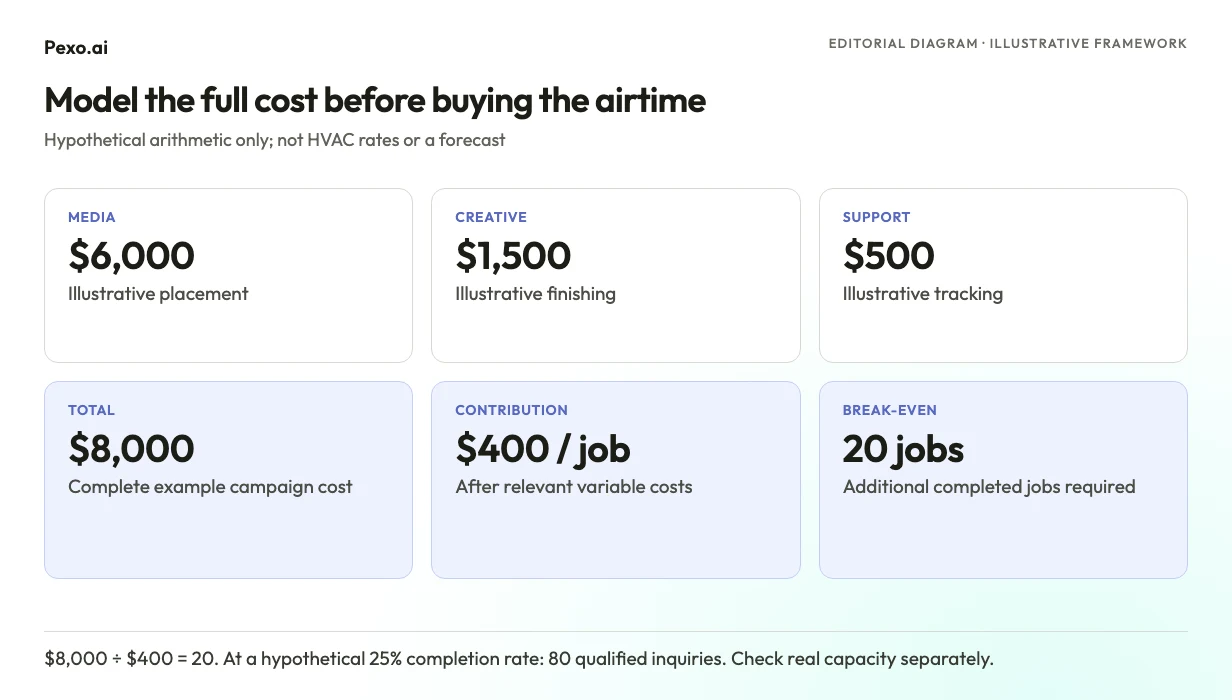 Hypothetical example: $8,000 of campaign cost ÷ $400 contribution per additional completed job = 20 jobs; it is not an industry benchmark or promised outcome.
Count the complete cost before deciding whether TV is affordable
Ask the outlet or provider for a written proposal that separates media placement from production and associated work. The placement may involve broadcast, cable or streaming inventory, and those are not interchangeable packages. Clarify where the ads appear, the intended geography, the campaign period and how delivery is reported. Then identify the work outside the quoted media: creative development, required finishing, alternate versions, tracking arrangements, destination changes and staff time handling inquiries. A low headline placement price can be misleading if the business cannot produce an accepted ad or understand what happened after it ran.
Keep cash timing visible. An apparently affordable total can still create a problem if payment precedes the work and receipts the campaign might generate. Decide what the business can risk on a test without assuming new sales arrive immediately. Your accountant or financial adviser can help assess that decision using your actual records. Pexo may support preproduction: develop a storyboard direction, an illustrative graphic, a draft narration or a sample creative treatment. Confirm the outlet's technical and rights requirements before treating any output as a broadcast-ready master. The relevant limitation is concrete: a finished-looking web video is not evidence that a broadcaster will accept the file, sound mix, disclosures or usage rights.
Use contribution margin to answer “can an HVAC company afford TV advertising?”
Revenue alone does not pay for a campaign. Estimate the amount left from an additional completed job after the costs that vary with that job. Use the type of work the campaign promotes, rather than the average invoice across unrelated services. The SBA break-even calculator uses fixed costs divided by price minus variable costs to find break-even units. For a simplified campaign test, the analogous calculation is total campaign cost divided by contribution per additional completed job. Treat it as a planning model, not a forecast. It does not by itself account for tax, financing, attribution uncertainty or every business expense.
The following example makes the assumptions explicit. Replace every amount with figures your team can support, then test less favorable scenarios before committing.
| Hypothetical input | Illustrative amount | What to verify |
|---|---|---|
| Media placement | $6,000 | Written inventory, geography and delivery terms |
| Creative and finishing | $1,500 | Scope, revisions, outlet acceptance and rights |
| Tracking and campaign support | $500 | Included services and any recurring cost |
| Total campaign cost | $8,000 | Complete test cost, not just media |
| Contribution per additional completed job | $400 | Based on the promoted service and actual variable costs |
| Completed jobs to cover campaign cost | 20 | $8,000 divided by $400 |
If one in four qualified inquiries becomes an additional completed job in this hypothetical scenario, covering the cost requires 80 qualified inquiries: $8,000 ÷ ($400 × 0.25). This is not an HVAC benchmark. At $250 contribution per job, the campaign needs 32 completed jobs; at $800, it needs 10. Round a fractional required-job result up to the next whole job. A logged response is not automatically incremental: some customers would have booked anyway. If realistic additional completion capacity is below 20 jobs in the assessment window, the $8,000/$400 scenario cannot cover its campaign cost through those jobs. Cash at risk remains a separate decision from accounting break-even.
Make the service and capacity assumptions inspectable
Choose the promoted service before commissioning the ad. A replacement-estimate campaign, a maintenance offer and a general brand message may produce very different inquiry patterns. Check whether the office can qualify the expected questions and whether the field schedule can absorb the work. In the example, 20 additional completed jobs are not useful if the company has capacity for only six and must turn away the rest. Model the realistic appointment and completion period, including whether the campaign may influence demand beyond its paid run. Avoid assuming that every inquiry converts quickly or that every job has the contribution used in the first calculation.
Define the observation method and its limits. A dedicated contact route can help identify some responses, while an inquiry log can record where customers say they heard of the company. Neither guarantees perfect attribution. People may encounter a referral, a search result and an ad before calling. Ask the provider how it distinguishes delivered impressions, responses and completed work. Agree on a review point and the conditions for pausing, revising or continuing the test. If the calculation only works with an optimistic close rate, high contribution and full capacity, the uncertainty is part of the decision. It should not be hidden beneath a promising creative concept or a large audience estimate.
Use Pexo to develop the creative before committing to finishing
A concept should make the service, company and next action understandable. Begin with a plain-language brief in Pexo that fixes the approved offer and source evidence while allowing different creative approaches. Develop an illustrative frame or campaign visual through Pexo's image-generation workflow. If the piece shows your crew or completed work, use real authorized material for those claims. A generated technician or customer should not be presented as documentary evidence. The FTC's advertising guidance is a relevant reference for the person checking the ad's claims and endorsements.
Then prepare the spoken idea with Pexo's text-to-speech workflow, checking offer wording and the contact instruction. A supporting track can be explored through Pexo's music-generation workflow when appropriate, with usage requirements checked for the intended placement. At this concept stage, the owner can assess whether the story represents the business and describe changes before paying for final finishing. Ask the outlet or production specialist what further work the accepted concept needs. Pexo's role here is creative development and asset production, not a guarantee of broadcaster acceptance or campaign performance. That distinction keeps a useful production saving from being confused with proof that the media investment will work.
Decide what a defensible test looks like
A test should have a complete cost, a realistic contribution range, capacity assumptions, an observation method and a decision rule. In the hypothetical example, the owner could decide not to buy the package if the business cannot accommodate the break-even work even under a reasonable scenario. Another owner might choose a smaller or differently structured test, provided the outlet offers one and the total economics remain clear. Compare alternatives on their complete responsibilities and evidence, not only their headline media cost. A social campaign, direct outreach and television may serve different objectives and observation windows.
Conclusion
Bring an approved creative brief to Pexo's video-production workflow once you know what the campaign must communicate. Keep the financial decision separate from enthusiasm for the draft. An HVAC company can afford TV advertising when it can fund a controlled test, serve the potential work and evaluate the result without relying on invented certainty. Run the numbers first, develop the concept second, and confirm the final placement and production requirements before spending on the full campaign.