

 ChatGPT
 Perplexity
 Claude
 Gemini
 Grok



Air-conditioning content should follow local conditions and available service capacity, not a national calendar template. Pexo can help prepare the graphics, narration and video for those moments without turning every weather change into a production scramble. Social media marketing for air conditioning works best when the message fits what customers are experiencing and what the business can actually deliver.
Use your local cooling conditions and service availability. A cold-climate contractor, a Southern Hemisphere business and a year-round cooling market should not inherit the same seasonal dates. The example below is a planning model, not a live forecast or a claim about your city.
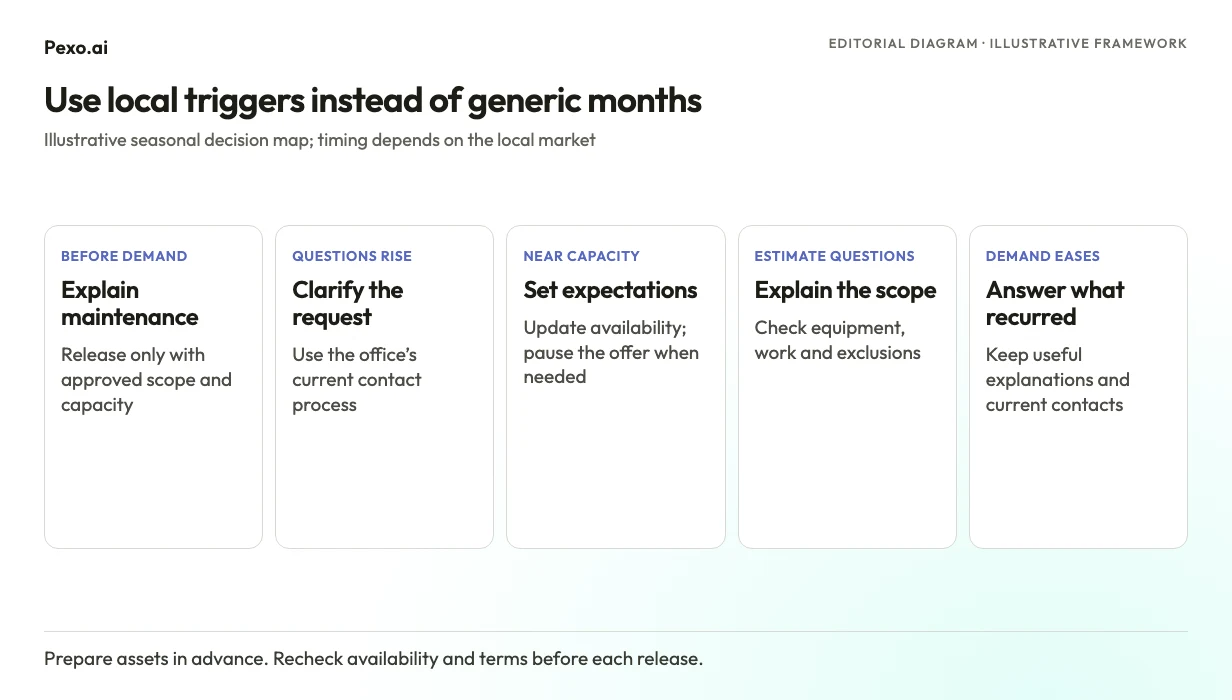 Illustrative seasonal map: local demand, recurring questions and appointment capacity determine when a message should run.
Map social media marketing for air conditioning to local triggers
Use operational triggers rather than assigning the same message to every month. A pre-season period may suit an explanation of your maintenance process. The first sustained local heat may make booking instructions more useful. Peak demand may call for clear availability information rather than a broad promotion. A quieter period may be a chance to explain replacement planning or answer questions your office collected during the busy weeks. Confirm the trigger with local knowledge and your actual schedule. An attractive post saying “book before the rush” is not helpful if the business already has a long wait or does not offer the service shown.
Define triggers your office can actually observe. For an illustrative local rule, the dispatcher might review remaining maintenance capacity each Monday and switch from appointment promotion to availability information when the owner's agreed capacity threshold is reached. The owner supplies that threshold from the schedule; it is not a universal number. Record the decision date and reviewer. Repeated office questions can select the next educational topic, while current authoritative local information supports any weather-specific statement. Pexo can prepare a reusable visual direction before the exact release date is known, but it should not invent a forecast or urgency.
Use a trigger table instead of twelve generic monthly posts
The following table shows a sample structure. Replace the conditions and services with those your business can verify. Each row specifies a communication job, which helps the team avoid producing several assets that all repeat the same sales message.
| Local trigger | Useful message | Material to prepare with Pexo | Release condition |
|---|---|---|---|
| Cooling demand has not yet peaked | Explain your actual maintenance appointment | Illustrated service-scope card and a short narration | Service scope and booking capacity approved |
| Customers begin asking how to request service | Explain the contact route and information to prepare | Simple booking graphic and narrated sequence | Office confirms its current process |
| Schedule is close to capacity | Set accurate expectations | Clear availability card with a refresh date | Dispatcher approves wording and owner monitors changes |
| Repeated questions about replacement | Explain what information an estimate includes | Educational visual, approved spoken explanation | Technical and commercial review complete |
| Cooling season eases locally | Answer a question collected during busy weeks | Evergreen explanation or process video | Topic remains relevant to the local audience |
Use Pexo's image-generation workflow to explore the explanatory graphics while the source is fresh. A clean visual can distinguish maintenance, repair and estimate requests without suggesting a diagnosis. Keep commercial details editable in the source record so a date or availability update does not require rediscovering the brief. For any maintenance statement, consult the equipment instructions and appropriate primary guidance, such as ENERGY STAR's maintenance checklist. Do not convert general guidance into a universal replacement interval, a savings promise or a do-it-yourself procedure your technical reviewer would not endorse.
Use a seasonal plan with messages ready to adapt
This fictional seasonal plan gives the coordinator messages to adapt. It describes local operating conditions, not calendar months or universal temperature thresholds.
| Stage and audience | Sample caption | Minimum format; release and pause rule |
|---|---|---|
| Before local cooling demand rises; existing customers | “Planning your next maintenance visit? Read what our service includes and contact the office to request an appointment. We will confirm availability.” | Image; release when approved capacity exists, pause when the office's threshold is reached. |
| Recurring estimate questions; prospective local homeowners | “Comparing replacement estimates? Ask what equipment, installation work and exclusions each proposal includes before comparing totals.” | Text and illustrative graphic; release after technical review, revise if service scope changes. |
| Schedule is full; anyone requesting service | “Please contact our office for current appointment information. A message or form submission is a request, not a confirmed visit.” | Current information card; office reviews against actual arrangements. |
| Demand eases locally; existing and prospective customers | “A question worth saving for your next visit: what is included in the recommended work, and what options should we discuss?” | Simple feed post or longer explanation if questions warrant it; keep current contact details. |
Choose the audience and minimum format before opening a production request. A straightforward feed card may be enough; a longer explanation belongs where customers can choose to watch or read it.
For the estimate post, a Pexo brief could read: “Develop an illustrative three-panel card labeled equipment, installation work and exclusions. Use the approved wording, avoid prices and do not depict a real customer's estimate.” If a spoken explanation would help, prepare it through text-to-speech and check every technical term. Music generation is optional when a video genuinely needs a soundtrack. Keep speech clear and do not expand a useful image into several deliverables merely because production is available. Judge the actual asset against its job: a homeowner should know what question to ask or how to request the service.
Adapt the message when capacity changes
The same business may need different communication before and during a busy period. Before demand rises, an educational campaign can explain a planned service. When the schedule fills, the immediate task may be to communicate realistic response arrangements. Leave somebody responsible for switching the message. An asset approved last week may be unsuitable today even when its technical explanation is still correct. Keep time-sensitive wording connected to an expiry or review condition in your content record. This is more reliable than assuming that pausing an ad removes every old post, saved video and shared image from view.
For a hypothetical change, imagine the office can no longer accommodate the appointment window described in a video. The coordinator should identify every related image, narration and final frame, withdraw or update the distribution where possible, and develop a corrected packet with Pexo. The change should not be treated as a cosmetic caption edit if the old promise is spoken in the video. Check the destination page and the office's response wording too. Advertising claims need to remain truthful as circumstances change; the FTC's small-business advertising guidance is a useful reference for the reviewer. Creative consistency matters, but current service reality takes precedence over keeping an old campaign visually intact.
Learn which cooling-season message deserves another run
Evaluate the content according to its job. A booking-process explanation may be useful if callers arrive with the right information. A maintenance campaign should be evaluated against suitable inquiries and work the business can accept. A broad local-awareness piece may need a longer observation period, but that does not justify treating every impression as a sale. Keep campaign costs, exposure, inquiries and completed work distinct. Ask the office why requests were unsuitable and whether the message contributed to the confusion. That feedback tells you whether to change the creative, the destination or the operational process.
Conclusion
Before the next season, review the trigger map rather than simply reusing last year's dates. Confirm services, terms, visual evidence and contact arrangements. Keep the useful explanation and refresh the information that changed. The Pexo social-media workflow can support the revised image, audio and video package from that updated brief. Effective social media marketing for air conditioning follows local needs, honest availability and a clear next step. Preparing the reusable creative work in advance leaves the team more time to make those decisions when the weather and workload change.