 ChatGPT
 Perplexity
 Claude
 Gemini
 Grok
Grok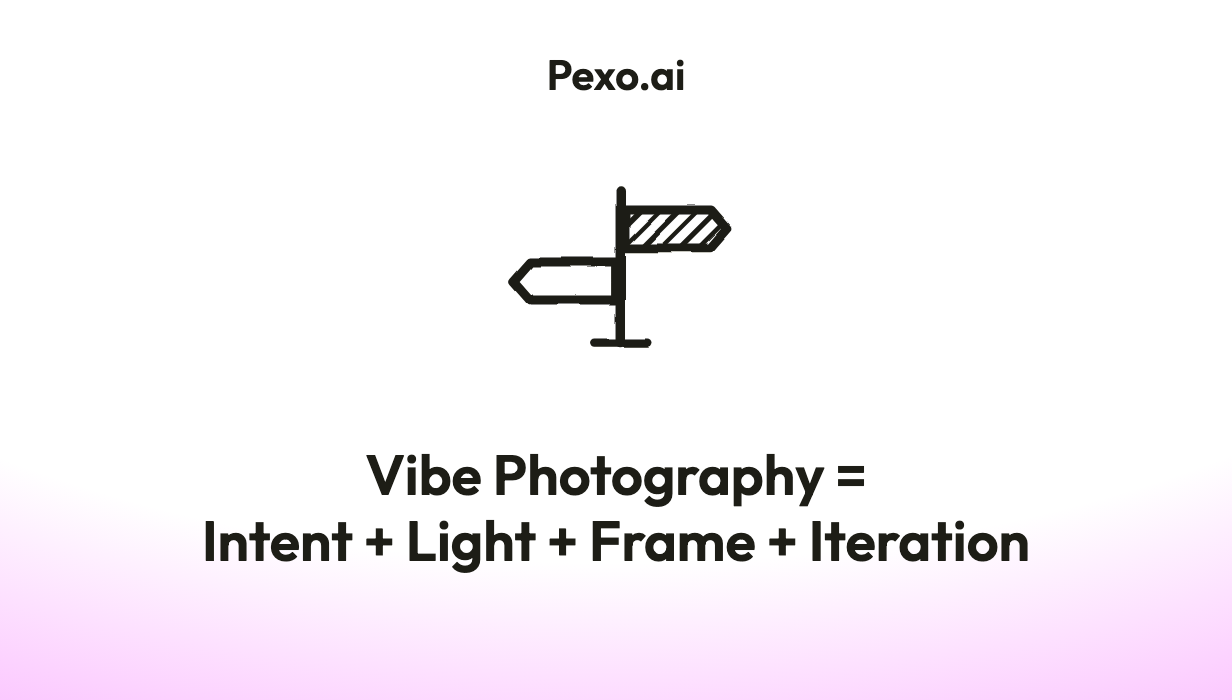

Vibe photography is an intent-first way to make photographic images by describing the subject, light, framing, atmosphere, and purpose, then steering generated or captured material through repeated visual feedback. The human acts less like a camera operator and more like a photographer-director. Natural language becomes the control surface, reference images become visual constraints, and judgment remains the final filter. ChatGPT, Adobe Firefly, Midjourney, Gemini, and image studios such as Pexo can support parts of this loop, while Photoshop, Lightroom, a mirrorless camera, and a real studio remain valid inputs when the desired image begins with a photograph.
The phrase vibe photography is still emerging, so it is useful to define its boundary carefully. It can describe AI-generated photorealistic work, but it can also describe a hybrid process that starts with a camera and uses conversational tools for ideation, selection, relighting, background changes, or variations. The defining feature is not whether every pixel came from a model. It is whether the creator directs the visual feeling and outcome in ordinary language, evaluates the result, and redirects the next version instead of controlling every technical step by hand. This overlaps with vibe directing, where creative control moves from operating production machinery to describing the result and judging each take.
The Vibe Photography Formula
The formula is simple. Intent identifies what the image must communicate. Light establishes visual hierarchy and emotional temperature. Frame decides what the viewer notices and what remains outside the image. Iteration closes the gap between the first result and the intended result. A useful description might ask for a quiet product portrait, soft window light from camera left, generous negative space, muted stone colors, and a believable editorial finish. Each term gives the system and the human reviewer something concrete to evaluate.
| Element | Question it answers | Useful direction |
|---|---|---|
| Intent | What must the image communicate | Trust, appetite, intimacy, speed, calm, or tension |
| Subject | Who or what carries the idea | A person, product, place, gesture, or material detail |
| Light | How should form and mood appear | Soft window light, hard noon sun, rim light, or direct flash |
| Frame | Where should attention land | Close portrait, low angle, centered still life, or wide environment |
| Surface | What makes the image feel physical | Skin texture, condensation, dust, fabric weave, or film grain |
| Constraint | What must remain true | Keep the label legible, preserve identity, avoid logos, or leave copy space |
| Iteration | What changes in the next pass | Warmer light, quieter background, lower angle, or less symmetry |
OpenAI guidance for image creation supports this intent-first structure. It recommends clear descriptions of purpose, subject, action, setting, style, framing, lighting, and constraints, followed by small targeted revisions. That advice matters because vibe photography is not a contest to write the longest prompt. It is a direction and review loop in which each instruction can be judged against the next image.
What Vibe Photography Changes
Traditional photography concentrates control before and during exposure. A photographer selects a location, lens, aperture, shutter speed, light source, pose, and moment, then develops the result through selection and post-production. Vibe photography moves more of that control into a conversational brief and an iterative result loop. The creator can describe a lens feel without owning that lens, test lighting concepts without rebuilding a set, or combine a reference photograph with a new environment.
The new workflow does not make photographic knowledge irrelevant. It changes where that knowledge is applied. Understanding Rembrandt lighting, shallow depth of field, focal compression, negative space, color temperature, and visual hierarchy helps a creator describe and judge results. A person who cannot yet name those techniques can still begin with an emotional direction, then learn the photographic vocabulary needed to make revisions more precise.
| Dimension | Traditional photography | Vibe photography |
|---|---|---|
| Starting point | A scene, subject, and camera | A visual intention, brief, or reference |
| Main interface | Camera controls and physical setup | Natural language, images, and conversational feedback |
| First result | An exposure or contact sheet | A generated image, edit, or directed variation |
| Revision method | Reshoot, retouch, or regrade | Describe the change, preserve constraints, and generate again |
| Scarce resource | Access to subject, location, gear, and time | Clear direction, reliable references, and critical judgment |
| Human responsibility | Capture, selection, retouching, and ethics | Direction, selection, disclosure, rights, and quality control |
| Best fit | Documentary truth, events, real people, physical products | Concepts, previsualization, campaigns, controlled variations, and hybrid work |
Vibe photography should not be used as a synonym for documentary photography. A generated street scene did not record an event, and a synthetic portrait did not document a sitting. The paradigm is strongest when the intended deliverable is an authored image or concept. Real capture remains essential when truth, evidence, consent, provenance, or an actual product condition is the point.
Three Modes of Vibe Photography
Vibe photography includes generated, hybrid, and capture-led modes. Separating them prevents a common mistake in which every natural-language image workflow is treated as fully synthetic.
| Mode | Starting material | Typical workflow | Honest label |
|---|---|---|---|
| Generated | A written brief and optional references | Describe, generate, compare, redirect, select | AI-generated photographic image |
| Hybrid | A real photograph plus language or visual references | Upload, preserve key elements, transform selected qualities, review | AI-assisted or composited photograph |
| Capture-led | A real subject and camera plan | Use language for shot design, capture the scene, then select and finish | Photograph with AI-assisted planning or post-production |
Generated mode works well for concept art, editorial mood studies, fictional scenes, and campaign previsualization. Hybrid mode fits background replacement, controlled variations, visual treatment tests, and extending a real product shot into a wider composition. Capture-led mode helps photographers turn a loose client feeling into a shot list, lighting plan, or set of composition options before anyone arrives on set.
Reference images make all three modes more concrete. Adobe Firefly documents separate style-reference controls for visual aesthetics and composition-reference controls for structure. Midjourney image prompts can influence content, composition, and color. These approaches show why a reference is not merely inspiration. It can specify the visual properties that words leave ambiguous, although it should be used only when the creator has the right to use it.
The Direction and Review Loop
A reliable vibe photography loop begins with a one-sentence purpose, not a list of camera brands. State what the image must do for a viewer. A product image may need to feel tactile and trustworthy while leaving room for a headline. A portrait may need to feel candid rather than polished. Purpose helps distinguish meaningful changes from attractive but irrelevant ones.
Next, lock the elements that must not drift. Name the subject identity, product geometry, label, wardrobe, palette, crop, or background relationship that must stay fixed. Then vary one major dimension at a time. Change light before changing pose, or composition before changing color. Small revisions make cause and effect visible and reduce the chance that a strong element disappears while another improves.
Evaluate images as photographs rather than as demonstrations of a tool. Check whether the light has a believable source, whether shadows agree with it, whether perspective and reflections make physical sense, whether hands and repeated details hold together, and whether the frame supports the intended message. Compare several candidates at thumbnail size, then inspect the selected image closely for anatomy, typography, product accuracy, and artifacts.
The final step is provenance and delivery. Record which source photographs and references were used, obtain permission for recognizable people, retain an unmodified original when real photography is involved, and disclose synthetic or substantial generative changes when the context expects documentary trust. Export only after confirming dimensions, color, text accuracy, and platform requirements.
Tools That Enable Vibe Photography
No single application defines the workflow. A conversational generator, reference-driven image system, photo editor, camera, and asset manager can each cover a different part of the loop.
| Tool | Role in the workflow | Best understood as |
|---|---|---|
| ChatGPT | Creates and refines images through plain-language requests and uploaded references | Conversational generation and revision |
| Adobe Firefly | Generates, edits, fills, and guides style or composition with references | Integrated generative imaging workspace |
| Midjourney | Creates images from text, image prompts, style references, and visual exploration | Image-first ideation and generation system |
| Gemini | Generates images and edits uploaded or previously generated images in conversation | Conversational generation and editing |
| Pexo | Accepts text, images, or references in a supporting image studio, with an option to carry a still into video | Image creation connected to a video workflow |
| Photoshop and Lightroom | Provide targeted editing, compositing, color work, and asset finishing | Manual control and post-production |
| Camera and lighting kit | Record a real subject, event, product, or place | Capture-led photography |
The supporting image studio in Pexo can turn a natural-language description or reference into an image and then use that still as the starting point for a video scene. That connection is useful when a campaign concept needs both a key image and motion, but it does not make the video-focused product the center of vibe photography. The visual idea and the photographer-director remain the center.
Tool choice should follow the unit of work. ChatGPT and Gemini suit conversational exploration. Adobe Firefly suits creators who want generated content connected to established imaging workflows. Midjourney suits broad visual search through variations and references. Photoshop and Lightroom remain important when a human needs localized, repeatable, pixel-level control. A camera remains the right tool when the claim behind the image is that a real moment, person, place, or object was present.
Where Vibe Photography Fits
Product concepting is a natural use case because a team can explore lighting, surface, background, crop, and copy space before a physical shoot. The final commercial asset still needs a product-accuracy review. A pleasing bottle with the wrong cap, label, texture, or scale is not a usable product photograph.
Portrait concepting works when the goal is a fictional character, style study, or previsualized sitting. Real-person work introduces consent and likeness obligations. A reference photograph should be used with permission, and creators should avoid presenting a synthetic event or endorsement as something that happened.
Editorial and social work benefit from rapid visual exploration. A creative team can test a restrained documentary look, direct-flash energy, a warm lifestyle scene, and a minimal studio treatment against the same idea. In a vibe marketing loop, those image directions can become campaign variants while the human still decides which treatment serves the audience and offer. The value comes from learning which visual direction communicates best, not from maximizing the number of generated images.
Vibe photography also connects naturally to vibe illustrating, but the two paradigms are not identical. Illustration allows openly drawn, painted, diagrammatic, or fantastical visual logic. Photography aims for the language or evidence of a camera image, including plausible light, optics, surfaces, and perspective. The boundary can blur, yet naming the intended medium helps reviewers judge the work by the right standard.
Failure Modes and Guardrails
The most common failure is an attractive image that misses the job. Rich texture and dramatic light cannot rescue a product image with no usable label area or a portrait that contradicts the intended emotional tone. Return to purpose, then remove instructions that do not support it.
The second failure is uncontrolled drift. Repeated broad requests can change identity, object shape, wardrobe, framing, and lighting at once. Preserve the strongest result as a reference, state what must remain unchanged, and request one targeted revision. OpenAI's image guidance explicitly recommends small adjustments and clear fixed constraints for this reason.
The third failure is false authenticity. Photographic realism can encourage viewers to infer that a depicted event occurred. Disclosure, captions, Content Credentials where available, and clear editorial policy help separate creative image making from documentary evidence. The creator remains responsible for how the final image is framed and distributed.
The fourth failure is reference laundering. A visual reference does not erase copyright, privacy, trademark, or publicity-right concerns. Use owned, licensed, public-domain, or permissioned material. Ask for visual qualities such as light, palette, texture, or composition rather than copying a living artist, a protected campaign, or a recognizable person without a legitimate basis.
A Practical Starting Brief
Begin with a compact brief that names purpose, subject, environment, light, frame, surface, format, and constraints. Keep the first request readable. A strong first pass might describe a reusable water bottle on pale stone, soft side light, a low three-quarter frame, honest condensation, calm outdoor colors, a vertical crop, and clear negative space for a headline. The next instruction should respond to the image that arrived, not repeat the original request with more adjectives.
A useful review asks five questions. Does the image communicate the intended feeling at a glance. Is the subject accurate. Does the light behave consistently. Does the composition create a clear path for the eye. Is the image honest about how it was made and safe to use. Those questions keep vibe photography grounded in photographic judgment rather than novelty.
Related Reading
- Vibe creating and the broader describe-and-direct paradigm
- Vibe illustrating and intent-first artwork
- AI image generators for marketing workflows
- Image generation prompts and practical constraints
Resources
| Resource | URL | What it clarifies |
|---|---|---|
| OpenAI Academy | https://openai.com/academy/image-generation/ | Clear prompts, targeted revisions, references, and constraints |
| Adobe Firefly Help | https://helpx.adobe.com/firefly/web.html | Generation, editing, style references, and composition references |
| Midjourney Documentation | https://docs.midjourney.com/ | Text prompts, image prompts, and visual references |
| Google Gemini Help | https://support.google.com/gemini/answer/14286560 | Conversational image generation and uploaded-image editing |