

 ChatGPT
 Perplexity
 Claude
 Gemini
 Grok




A homeowner checking your social page wants to know whether the company is real, does careful work and can help with the problem in front of them. Pexo can help turn your team's knowledge into the images, spoken explanations and short videos that answer those questions. A useful HVAC social media presence begins with evidence and a clear message, rather than an obligation to post something every day.
That changes the production brief. Instead of asking for another attractive air-conditioner graphic, decide what the viewer should understand or trust after seeing it. Keep real job evidence intact. Use generated material to explain ideas and package messages, and give every post a sensible route back to your business.
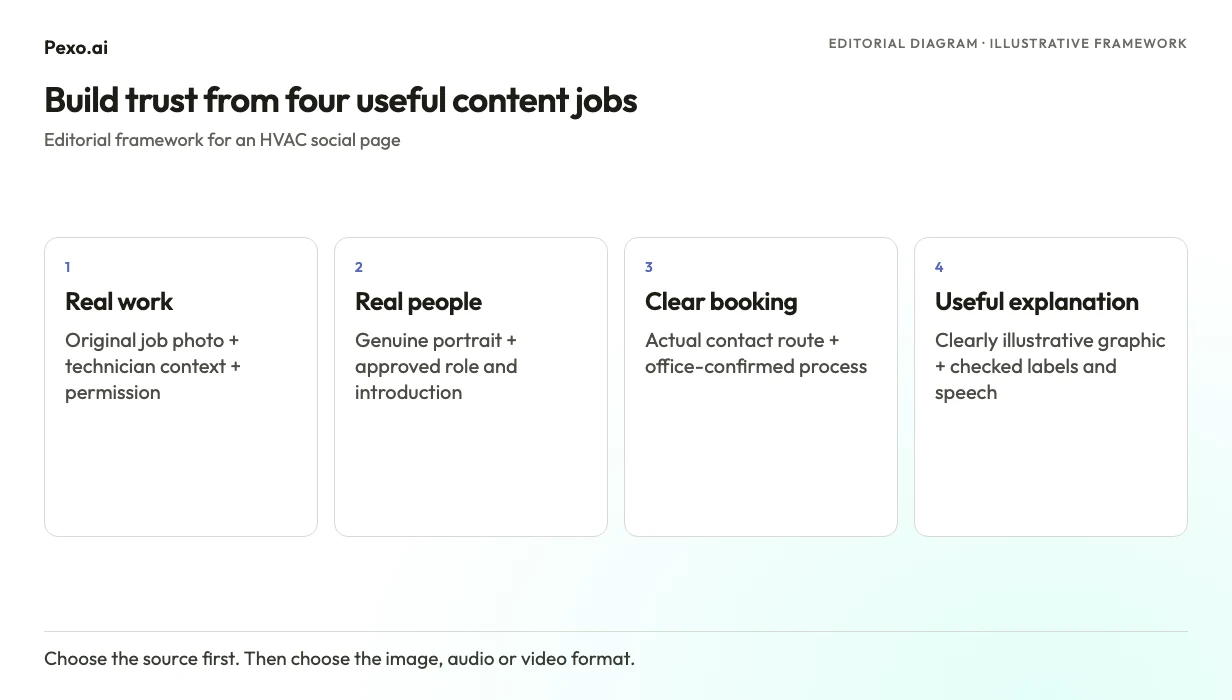 A trust-focused content mix distinguishes genuine business evidence from clearly illustrative educational material.
Give HVAC social media a specific job
A social page is often checked after someone encounters your name elsewhere. The visitor may have a recommendation, a search result or a van they noticed in the neighborhood. They want a quick answer to practical questions: does this company serve my area, do these people do the kind of work I need, and how do I contact them? Organize the page around those questions. An introductory post can explain the service area and booking process. A job photograph can show the kind of installation you actually perform. An illustrated explanation can help someone understand what a maintenance visit involves. These serve different purposes, even if all three sit beside one another in the feed.
Give the page four trust jobs: identify the company, show genuine work, explain one service question and make contact understandable. In a first pass, inspect the introduction and one recent example of each job. Write down what a homeowner can establish from the material, not what the owner hopes it implies. A photograph can show the visible work; it cannot establish hidden workmanship or measured energy performance. Build the next Pexo brief around the gap you find. If the page explains the business well but lacks genuine crew photographs, arrange those photographs rather than generating another generic scene.
Separate proof of work from illustrations
Real work supplies the strongest material that another company cannot reproduce: your team, your completed jobs, your process and your customers' authorized words. Preserve the context. A before-and-after pair should show the same actual job and explain what changed without implying an unsupported energy-saving result. A team introduction should use the person's real role and approved credentials. Ask permission before using recognizable customer property or people. Crop out addresses, paperwork and personal details that do not belong in public. A photograph does not need cinematic polish to be useful, but the viewer must be able to understand what it establishes.
Illustrations have a different role. Pexo's text-to-image workflow can develop a visual explaining airflow, seasonal comfort or the questions to ask before an appointment. It should be visibly illustrative when a realistic scene could be mistaken for an actual service call. Do not ask it to invent a completed installation and present that as your portfolio. The same boundary applies to testimonials: generated speech can narrate an explanation, but it should not impersonate a satisfied customer. The FTC's advertising guidance explains why endorsements must reflect real experience. The production advantage comes from making truthful material clearer, not making unsupported evidence look convincing.
Turn one useful answer into a coherent asset packet
Take a question your dispatcher hears repeatedly: “What should I have ready when I book a visit?” Ask the dispatcher to approve a short answer based on your actual process. The answer might identify the service address, the broad symptom, the equipment information if available and how the office confirms an appointment. Avoid requesting sensitive details in public comments. Then describe the intended audience to Pexo and develop a visual structure. An image card can show the few pieces of information without becoming a miniature brochure. An illustrated version can work when no job photograph would add anything. Keep your company name and contact route clear, but give the useful information most of the space.
Here is a complete illustrative answer for a company whose office confirms requests manually: “Tell us your service address and a short description of the issue through our private booking contact. If equipment details are easy to read safely, have those ready too. Our office will confirm the service and appointment arrangements. Please do not put your address in public comments.” Graphic text: “Request → Office confirms → Appointment arranged.” For a spoken version, use that same approved wording in Pexo's narration workflow. A video is optional; a clear information card may do the job. If the sequence benefits from motion, continue the accepted direction into Pexo's text-to-video workflow.
Build a page that passes a homeowner's trust check
Look at the most visible parts of the page as if you had never heard of the business. Can you identify the company, the area served and the next step without opening several old posts? Does the recent content show actual people and work, or only generic graphics? Are opening hours and availability consistent with what the office can deliver? A seasonal post can remain in the feed after its offer expires, so avoid leaving the current terms ambiguous. If a post says to message for help, someone must own those messages. A polished visual cannot repair an unanswered inquiry. Keep urgent service instructions tied to your real operations rather than a production template.
These four illustrative post drafts show the difference between evidence and explanation. Brackets indicate business facts the publisher must supply from real sources, not details Pexo should invent.
| Trust job | Copy to adapt | Source and reviewer |
|---|---|---|
| Real work | “Fictional service example: the agreed work was replacement of a visibly damaged drain pan. Paired photographs would show the old part and replacement in the same location. Those photographs would not establish hidden drainage condition or prove that the work will prevent every future leak.” | This completed fictional example needs genuine corresponding photos and technician approval before being used as an actual job story. |
| Team | “Meet [name], our [actual role]. Their answer to a common customer question: [approved answer]. Here is who handles [specific service or office task].” | Real portrait, role and answer; person approves the introduction. |
| Booking | “A request starts with our office, not an automatic appointment. Contact us privately with the address and a short description; we will confirm the arrangements.” | Actual office process; person answering inquiries approves it. |
| Education | “Maintenance and repair answer different questions. A maintenance visit covers the agreed checks; a repair addresses a problem that needs assessment and a proposed scope. Ask what your appointment includes before booking.” Graphic: “Maintenance: agreed checks. Repair: assessed problem and agreed work.” | Service manager checks the maintenance and repair explanation against actual services; office checks the appointment wording. |
For an equipment diagram, the technical reviewer also checks components, labels and any indicated flow direction. A label saying “illustration” does not make an incorrect diagram acceptable. ENERGY STAR's maintenance checklist can support a narrow technical check, alongside the relevant equipment instructions.
Decide what HVAC social media should produce next
Use a small contact record after release: date, question asked, source volunteered by the customer, source confidence and next action. Accept “unknown” rather than forcing every caller to name a post. The owner answering their own phone can use the same record as a staffed office. If three callers ask whether submitting the form guarantees a visit, inspect the form confirmation and the post together. That repeated question is a reason to investigate clarity, not proof of a measured campaign effect. Keep a genuine question separate from a booked job and avoid counting repeat contacts as separate opportunities.
Conclusion
The next production request should address a specific gap. If homeowners still confuse maintenance with repair, build an explanatory pair of visuals. If they do not recognize the team, arrange genuine team photographs. If they cannot find the booking route, fix the page and final frame before producing more content. The Pexo social-media use case is a relevant place to develop the next asset once the communication problem is clear. A useful HVAC social media system earns trust through what it can show, explain and follow through on. Start with one real customer question, develop its visual and spoken versions in Pexo, and judge the result by whether a local homeowner is better informed.