
 ChatGPT
 Perplexity
 Claude
 Gemini
 Grok



An HVAC campaign can fail before the first graphic is made: the offer is vague, the office cannot handle the response or the message reaches people outside the service area. Pexo helps develop the creative material once those decisions are clear. HVAC social media marketing becomes easier to manage when one business objective connects the image, narration, video and booking route.
This is a campaign planning framework for a contractor with a real service to promote, not a promise that publishing more will generate more jobs. The working example is a maintenance-booking campaign with limited capacity. Use your own offer, dates and economics before putting any version in front of customers.
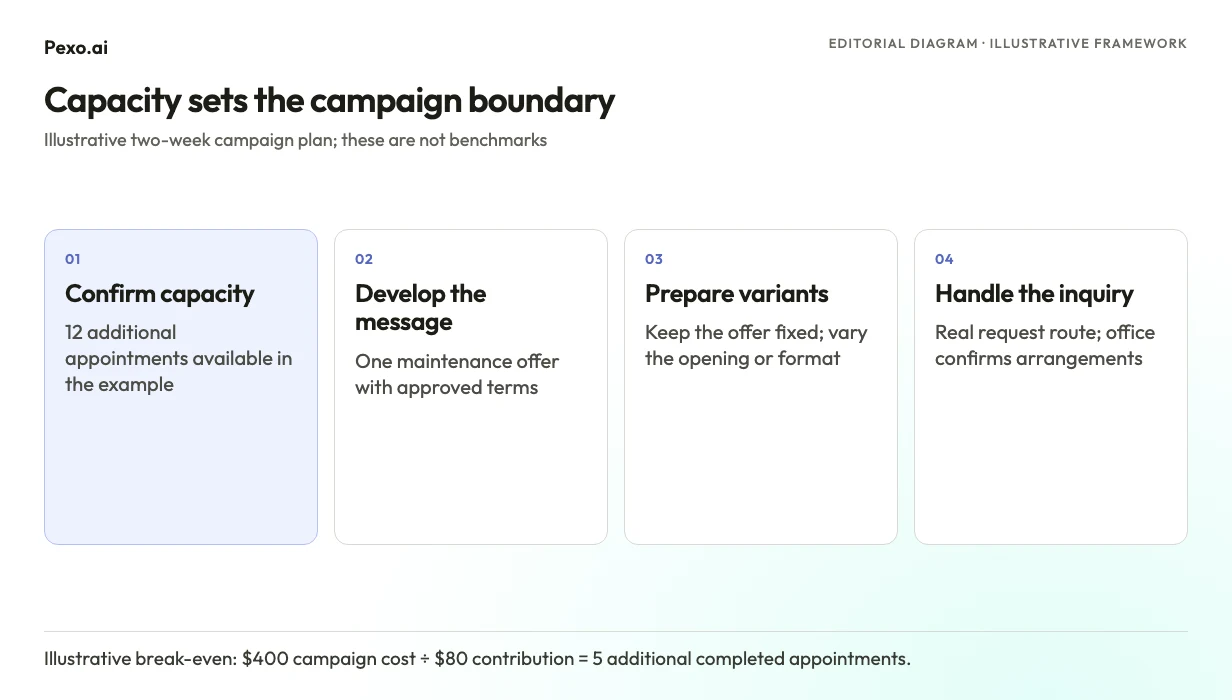 Illustrative campaign plan: pause promotion when the 12 available slots are allocated; the separate $400 ÷ $80 example requires five additional completions to cover cost.
Start HVAC social media marketing with available capacity
Decide what kind of work the business can accept during the campaign. Maintenance visits, replacement estimates and urgent repairs have different schedules and margins. If next week's maintenance slots are available, the creative should invite that service rather than encourage every possible inquiry. Confirm the geographic area, eligible equipment if relevant, the actual terms and the person responsible for changes. Avoid making availability part of a reusable design unless someone will keep it current. A campaign that successfully generates requests for work you cannot take creates a customer-service problem, not a marketing win.
The example below is a fictional paid test, with figures chosen to show the decisions rather than imply industry benchmarks. The office confirms actual appointments; the request form does not promise availability.
| Decision | Illustrative campaign plan |
|---|---|
| Service and offer | Maintenance appointments at the company's normal, approved terms; no invented discount |
| Audience and area | Existing or prospective homeowners within the contractor's verified service area |
| Window and capacity | Two-week test; up to 12 additional appointments the team can actually complete |
| Distribution and budget | One paid social campaign; $300 media plus $100 allocated production cost |
| Contact route | Dedicated campaign link to the real request page; office confirms arrangements |
| Owner and stop rule | Dispatcher reviews capacity daily; pause promotion when the 12 additional slots are allocated |
Replace the area, offer, dates, budget and capacity before use. Give Pexo those fixed decisions and ask it to develop the creative direction, rather than letting the production brief invent the business offer.
Make the message narrower than the service menu
A maintenance advertisement does not need to explain every service your business offers. Choose one customer situation and one next action. An example could address a homeowner who wants a scheduled visit before the local cooling season becomes busy. The message should explain what the appointment is for, where the company works and how to request it. It should not diagnose a household's problem from a generic symptom or promise a particular saving. Ask your technical reviewer whether the wording could create an expectation that the service does not meet. A specific, modest claim is easier to communicate than a dramatic claim surrounded by qualifications.
Compare two complete creative treatments, not the isolated “effect of narration.” Treatment A is an illustrated maintenance card; treatment B is a spoken process explanation. Hold the offer, destination and distribution as consistent as practicable. Caption for both: “Planning a maintenance visit? See what our appointment includes and send a request through the booking page. Our office will confirm current availability and arrangements.” On-image wording: “Maintenance visit: scope first, appointment confirmed by our office.” Ask Pexo for a clear phone-readable illustration through its image-generation workflow. The service manager must replace general wording with the approved scope. ENERGY STAR's maintenance guidance supports technical review; it does not establish a household-specific savings claim.
Build creative variants around one testable question
Variant testing works best when you can say what changed. If the question is whether homeowners understand the maintenance offer better through a visual checklist or a spoken explanation, keep the offer and destination consistent. Develop the image first, then prepare the narration in Pexo's text-to-speech workflow. Listen for the distinction between a request for an appointment and a confirmed booking. A sentence that sounds harmless in a draft can become misleading when read confidently over an image of a technician arriving. Ask for changes to the actual wording or delivery rather than adding more music to cover uncertainty.
A usable video brief names the actual output: “Develop a short illustrated explanation of the approved maintenance scope. Show the service first, then the request and office confirmation. Use this exact invitation: ‘See the maintenance details and send a request through the booking page.’ Do not show a fictional customer result.” Continue the accepted idea through Pexo's text-to-video workflow. Give each finished treatment its own version label. The office should see the label in form submissions where your setup supports it. For phone calls and messages, record the source the person actually volunteers, ask neutrally if appropriate, and leave it unknown when uncertain. A label on an asset does not automatically travel through a phone conversation.
Connect the creative to an inquiry the office can handle
The booking destination should complete the promise the asset makes. If the ad offers maintenance, the linked page should explain that service and the next step without forcing visitors through unrelated menus. A phone route needs someone available to answer or a clear response process. A form needs the few details the office actually uses to qualify the request. Check the experience on a phone, including whether the service area and terms remain visible. When someone reaches the office, the team should be able to identify the campaign and explain the offer consistently. Otherwise the creative and the customer conversation become two different campaigns.
Keep a contact log that separates an opportunity from repeated messages. The records below illustrate a format, not actual campaign outcomes.
| Contact | Campaign/source confidence | Qualification and outcome | Follow-up owner |
|---|---|---|---|
| Example A | Treatment A link recorded by form; high | In area, eligible request; awaiting office confirmation | Dispatcher |
| Example B | Caller recalls “a social post”; uncertain | Outside service area; explain coverage | Office |
| Example A, second message | Same opportunity as A | Status question; do not count a new lead | Dispatcher |
Use anonymous references in production discussions. Keep customer details in approved business systems. For testimonials or claims, the FTC's advertising guidance is a relevant review reference. Suitable requests, bookings and completed work remain different measures.
Review HVAC social media marketing as a business experiment
For a separate financial sense check, suppose the fictional $400 campaign produces work contributing $80 per genuinely additional completed appointment after relevant fulfillment costs. Five additional completions cover that campaign cost: $400 ÷ $80. Booked revenue is not contribution, and a form submission is not a completed job. If only three additional jobs are completed, the illustrative contribution is $240 before the $400 campaign cost, a $160 shortfall. Replace every input with your own records. The capacity rule is separate: pause promotion when the 12 available appointments are allocated, even if the creative is receiving attention. With a small sample, compare patterns cautiously rather than declaring a causal winner from a few inquiries.
Conclusion
Close the loop with the people handling the work. Ask which questions callers repeated, whether the advertised terms caused confusion, and whether the campaign filled the intended type of appointment. Feed those observations into the next Pexo conversation: a clearer image, a different narration opening or a more accurate final frame may address the defect. The Pexo social-media workflow is a useful starting point for that next production request. Good HVAC social media marketing connects an honest offer to available service capacity and a measurable next action. Begin with the decision sheet, build only the assets needed to communicate it, and let the inquiry record guide the next revision.