
 ChatGPT
 Perplexity
 Claude
 Gemini
 Grok




Hiring help does not remove the need to know what your business wants from social media. Pexo can support creative production inside an in-house or agency workflow, but it does not replace service knowledge, campaign accountability or customer follow-up. The right HVAC social media agency should make those responsibilities clearer before it makes your feed busier.
Evaluate the service as a set of jobs: gathering evidence, deciding the message, developing assets, publishing, managing advertising if included, responding and reporting. A proposal that bundles them into “social growth” is difficult to judge. A proposal that names the work, its owner and its acceptance criteria gives you something concrete to buy.
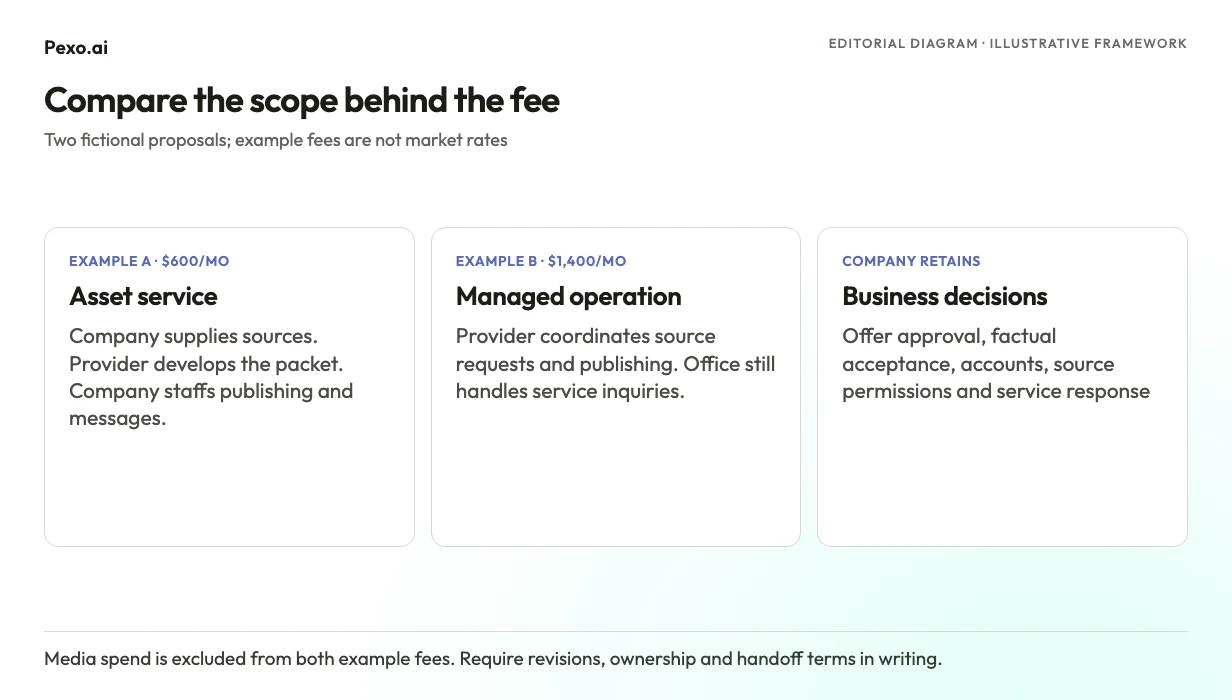 Fictional proposal comparison: a lower asset-service fee and a managed-operation fee purchase different work; neither example includes media spend.
Define what an HVAC social media agency must own
Write down the bottleneck before requesting proposals. Perhaps your technicians send good photos but nobody turns them into posts. Perhaps content is published regularly but calls go unanswered. Perhaps the owner needs help evaluating paid campaigns rather than producing more images. Those are different assignments. Ask the provider to identify exactly which one its service solves. Organic posting does not automatically include paid media, and an asset-production package does not automatically include message management. If the proposal mentions “leads,” ask how a suitable inquiry is defined and who follows it through to a booking. A vague result is easy to claim and hard to verify.
The business should retain control of facts that only it can establish: service area, availability, offer terms, technical claims, staff credentials and what work appears in the portfolio. The agency can organize and communicate those facts, but it should not invent them when a brief is incomplete. Pexo can be part of that production arrangement, developing a visual concept, narration or video from approved material. The useful capability is “No operating. Just directing”: an owner can describe the needed correction without learning an editing workflow. It does not make strategic or operational ownership disappear. If both the agency and the office assume the other answers inquiries, a stronger creative package will only expose the gap more quickly.
Compare proposals by deliverables and acceptance criteria
A count of monthly posts is a poor comparison unless you know what each post includes. Ask whether the provider gathers source material, develops original ideas, prepares multiple formats, writes accompanying copy and manages revisions. For an actual job story, ask how it verifies the work and obtains permission. For an educational graphic, ask who checks the technical explanation. For a promotion, ask how terms and expiry dates are handled. A clear answer describes a process and a named reviewer. “Our AI handles it” does not explain how the business avoids publishing a plausible error.
Send each provider the same planning assignment: “We have approved job photos and one service explanation. Describe how you would prepare a factual image-led post and an optional narrated version, obtain approval, publish, handle questions and report suitable inquiries. Identify our required inputs, revision allowance and offboarding deliverables.” Request a plan, not free finished creative. A simple Pexo illustration may serve an educational gap, but cannot replace genuine portfolio evidence. The FTC's advertising guidance is relevant to claim review. Ask the provider to demonstrate how a source and approver remain attached to the accepted file.
Choose an agency, an internal workflow or a hybrid
An internal workflow can make sense when someone has time to gather material, coordinate approvals and publish consistently. Pexo may remove some production friction by helping develop images, spoken explanations and video through conversation. It does not supply the missing coordinator. An agency can make sense when the business needs planning, campaign execution, a reliable publishing operation or access to filming expertise. A hybrid can divide those jobs: your team captures real work and approves facts, Pexo supports creative development, and the agency handles distribution and reporting. The right arrangement depends on the bottleneck, not a claim that one staffing model is always cheaper or better.
Compare proposals by complete scope. These are invented bids for teaching the comparison, not market prices or supplier offers.
| Requirement | Proposal A: asset service | Proposal B: managed operation |
|---|---|---|
| Fee in this example | $600/month | $1,400/month |
| Media spend | Excluded; owner decides separately | Excluded; owner approves separately |
| Source capture | Company supplies photos and context | Company supplies evidence; provider coordinates requests |
| Production | Image and optional narration packet | Accepted creative packet plus distribution work |
| Publishing and messages | Company must staff both | Publishing included; office still handles service inquiries |
| Revisions and handoff | Must be stated in bid | Must be stated in bid |
If the office cannot staff publishing, A leaves the bottleneck unresolved despite its lower example fee. If a coordinator already owns distribution, B may buy work the company does not need. Pexo can support internal or hybrid production, including narration, but someone still coordinates, approves and publishes. A real customer interview may require a separate capture assignment.
Check ownership, access and the handoff before signing
Confirm who controls the social accounts and advertising accounts, how staff receive appropriate access and what happens when the engagement ends. Ask for a practical offboarding plan: accepted files, source material you are entitled to retain, approved copy, campaign records and a readable reporting history. Do not wait until the relationship deteriorates to discover that nobody can locate the final video or explain which account paid for distribution. The agreement should also distinguish the rights to your photographs, supplied music, stock assets and generated material. Have the appropriate adviser review the actual contract; a marketing checklist cannot determine your contractual rights.
Turn the remaining questions into requested evidence. Ask to see the business's access in its own account, an example accepted-file handoff, a sample report, the included revision terms and the documented exit process. Treat necessary account control, factual approval and usable handoff as mandatory requirements; a preferred design style is a preference. Build the total-commitment worksheet as: provider fee + approved media + separately quoted capture/finishing + required internal staff time + other agreed recurring costs. Do not silently assign internal time a value you have not calculated. Have the appropriate adviser inspect the actual contract, especially ownership and termination terms. A pricing table does not establish those rights.
Judge the HVAC social media agency by the next useful decision
The best reporting meeting should end with a decision you can understand. Continue a useful campaign, clarify an offer, change the audience, fix the response process or stop an activity that is not serving the business. Ask the agency to show the evidence behind its recommendation and the limits of that evidence. If a post attracts many questions from outside your service area, more impressions may be the wrong goal. If suitable inquiries are arriving but no one answers promptly, production is not the immediate problem. Keep a record of the change so the next review can assess whether it addressed the original issue.
Conclusion
The buying decision should name the remaining gap: “We will choose A because our coordinator can publish and handle reporting,” or “We need B's managed publishing, while our office retains service inquiries.” If neither proposal solves the missing responsibility, ask for a revised scope or defer the purchase. The Pexo social-media workflow can support a defined creative job inside that arrangement; it is not the decision criterion for the entire service. Buy the responsibility the company cannot reliably supply, keep its evidence and commercial decisions under clear ownership, and review the provider against the agreed deliverables.