
 ChatGPT
 Perplexity
 Claude
 Gemini
 Grok




The technician has the useful photograph. The dispatcher knows the question customers keep asking. The owner approves the offer. Pexo can help turn those inputs into campaign images, narration and video, but somebody still has to connect the people. Social media marketing for HVAC companies becomes more dependable when the handoff is designed as carefully as the content.
This team plan suits a business where marketing is shared across several roles. It does not assume a full-time social manager. The goal is a small, repeatable production system that preserves real job evidence, gives creative work a clear brief and keeps approval from disappearing into a group chat.
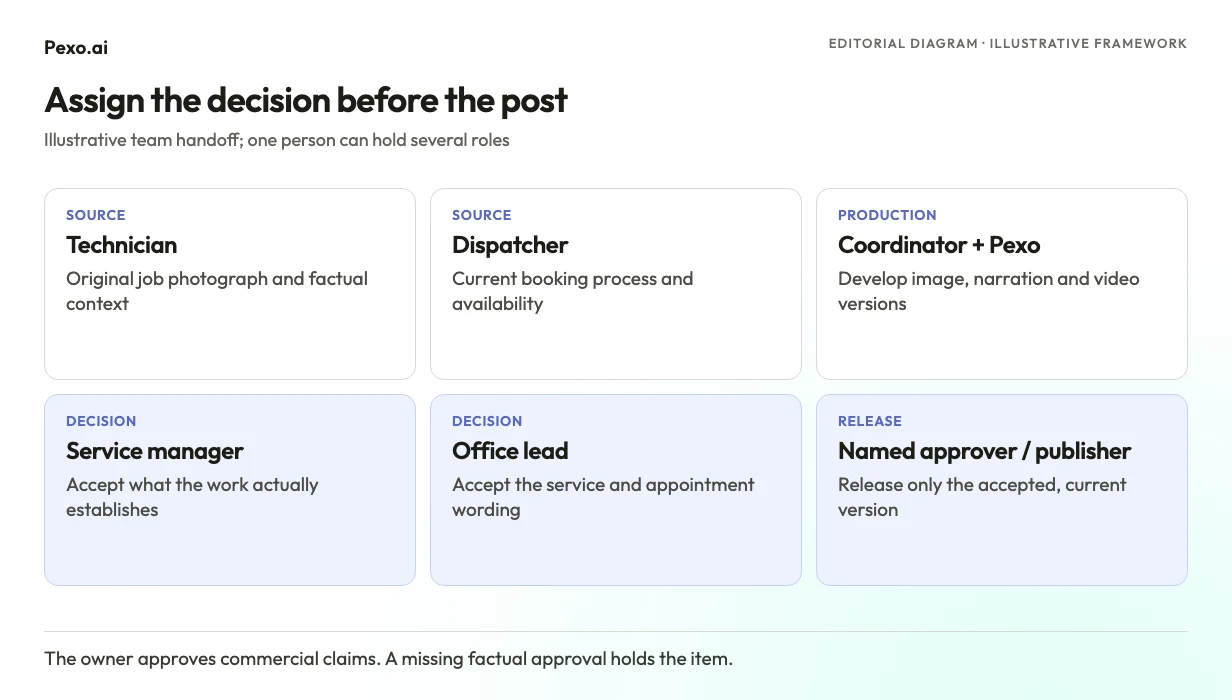 Illustrative handoff: factual, office and creative decisions have named owners before the accepted version is released.
Assign decisions before assigning posts
A technician should not have to invent an offer while photographing an installation. A dispatcher should not have to approve a technical explanation while answering calls. Divide the work according to what each person actually knows. The field team supplies genuine material and context. The office identifies recurring customer questions and checks current availability. A coordinator assembles the brief and tracks versions. An owner or designated manager approves commercial claims, while a qualified technical reviewer checks service explanations. One person may hold several roles, but each decision still needs a named owner. “Everyone can approve” usually means nobody knows whose answer is final.
Use this decision map as a first version. One person can hold multiple roles, but a mixed correction must return to every affected approver.
| Decision | Supplies information | Final decision owner |
|---|---|---|
| What the photographed work was | Technician | Service manager |
| Availability and contact process | Dispatcher or owner answering calls | Office lead |
| Offer and commercial claim | Owner | Owner |
| Visual, narration and video development | Coordinator working with Pexo | Coordinator proposes; factual owners approve their parts |
| Release the accepted version | Publisher | Named final approver |
If an approval deadline is missed, use an appropriate approved reserve item or delay release. A new technical claim cannot be accepted by the publisher merely to fill the slot. If nobody can identify the task in the photograph, return it to the technician before requesting production.
Use an evidence handoff that takes less effort than a rewrite
Ask the field team for a few facts alongside the photo: what work was done, which visible detail matters and whether the material may be used publicly. The handoff should identify the job internally without exposing a customer's information in the final post. Keep raw photos available for review. A coordinator cannot reliably write “new installation” from a close-up of equipment if the visit was actually a repair. Likewise, a clean-looking component does not establish a measured efficiency improvement. The short context note prevents the creative process from supplying a plausible but false story. Make submitting the material fit the team's normal work; an overly demanding form will be skipped during busy weeks.
Here is a fictional completed source handoff, not a claim about a real job: “Packet H-017, version 1. Technician reports replacement of the documented damaged drain pan under the agreed scope. Photo shows the component before and after; no water-damage or efficiency claim is authorized. Customer permission recorded internally. Exclude the visible job sheet and house number. Service manager to verify description Tuesday; office to confirm contact wording Wednesday.” The source identifies what is visible and what must not be inferred. Pexo can develop an explanatory illustration through image generation if a diagram adds clarity, but it must not replace the real before-and-after evidence. The FTC's advertising guidance is relevant for claim review.
Give Pexo a brief that survives a change of coordinator
A good brief should make sense to someone who was absent when the idea was discussed. Include the post's purpose, audience, approved message, source material, intended formats and next action. State what must remain unchanged, such as an offer's wording or the spelling of a technician's name. Then identify the creative freedom: illustrative style, pacing, visual hierarchy or the mood of a supporting soundtrack. The combination prevents two common mistakes. An entirely open brief encourages unnecessary invention. An over-specified brief makes the coordinator do the creative work before asking for production help. The useful middle ground fixes the facts and leaves room to develop their presentation.
The coordinator's finished brief for H-017 could be: “Prepare a photo-led post explaining the documented component replacement. Preserve the original job photos. Caption: ‘These photos show the component identified in our agreed work before and after replacement. Ask your technician to explain the scope of any recommendation on your own system.’ Do not add a cause of failure or a savings claim.” If a spoken version is useful, prepare it through text-to-speech. For a longer explanation, develop the accepted idea through text-to-video. The handoff to the publisher contains accepted file H-017-v2, the exact caption, intended channel, destination and final approver. It is ready only when those files match.
Run approval around defects, versions and deadlines
Use a small set of content states that describe what is actually waiting: source needed, creative development, factual review, final approval and ready to publish. Each state needs an owner and an expected next action. Do not call a file approved merely because somebody reacted to a preview in chat. Save the approved version where the publisher can distinguish it from rejected versions. A file name or record should connect the asset to its brief and source. This becomes especially useful when an offer changes after a graphic and video have both been prepared. The team can identify affected files instead of trying to remember which version went where.
Suppose the service manager rejects “prevented a future breakdown” because the source does not establish that outcome. Record correction C-01 against the image, caption and narration. The coordinator removes the claim in Pexo, changes the version to H-017-v2 and returns every affected part for review. The dispatcher can approve contact wording without approving the technical claim; the final approver checks that both decisions are resolved. If the claim survives in spoken audio, the packet is still unapproved even when the caption is fixed. This one change record is more useful than separate reactions to three files in chat. The publisher receives the exact accepted version, not the whole working folder.
Make social media marketing for HVAC companies resilient
The system should work when a technician is off, the owner is busy or the coordinator changes. Keep a small library of approved educational explanations and reusable visual directions. Record which facts must be refreshed before reuse, especially availability, pricing and seasonal offers. Use Pexo's social-media workflow to develop new assets from that library without treating old commercial details as permanent. Ask the office which inquiries the content actually supports. The most useful monthly review may reveal that a service-process explanation is repeatedly sent to customers, while several polished seasonal posts have no clear job. Keep what serves the business and stop producing formats nobody uses.
Conclusion
For a hypothetical four-person team, a practical cycle could be: field material arrives during the week; the dispatcher adds a recurring question; the coordinator develops a mixed-media packet; the designated reviewers approve facts and availability; the publisher releases the exact approved files. The cadence should follow your team's capacity, not a universal posting quota. Track how often a packet stalls, why it stalls and how much rewriting is caused by missing source information. Those measures show whether the handoff is improving. Strong social media marketing for HVAC companies depends on a company that can supply accurate inputs and act on the response. Pexo can help carry the creative work between those points, while the team's decision ownership keeps the output reliable.