
 ChatGPT
 Perplexity
 Claude
 Gemini
 Grok
Grok

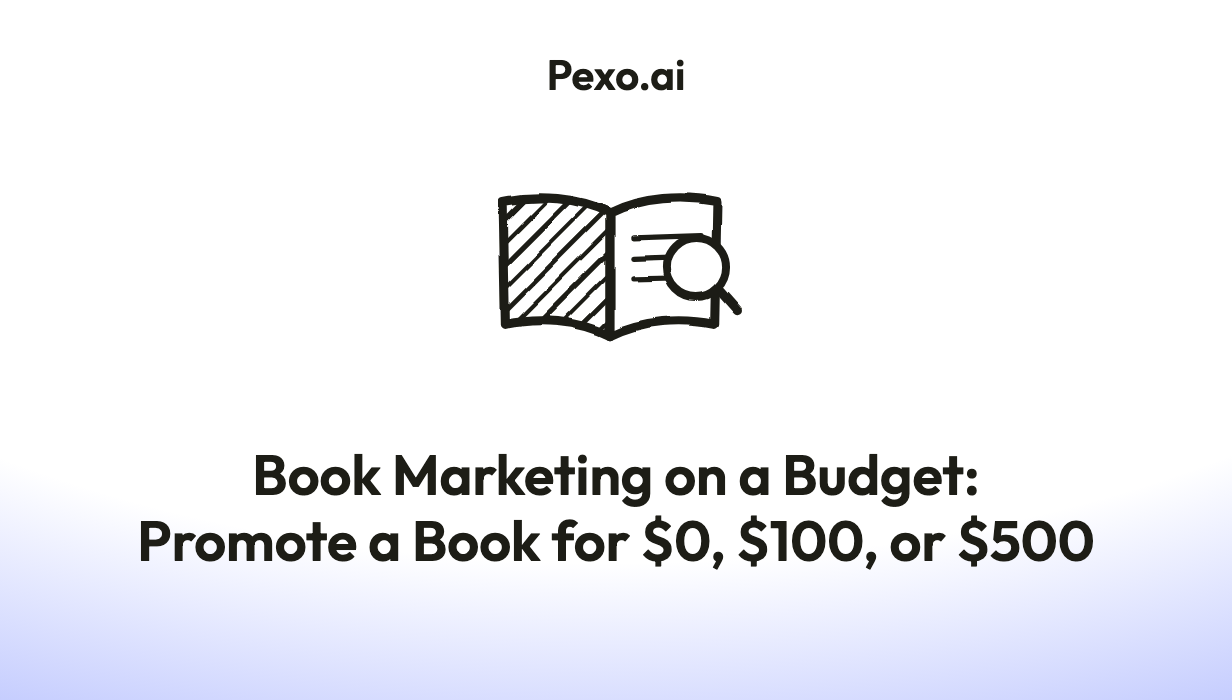

Book marketing on a budget means front-loading the channels that cost only time (a Goodreads author profile, BookTok and Bookstagram, a Reddit or Facebook reader community, a review-swap circle, an email newsletter, library and podcast outreach) and spending real money only where paid reach compounds: Amazon Ads, a BookBub Featured Deal, a Goodreads Giveaway, or a promotional book trailer. For a self-published author on Amazon KDP, the honest floor is $0, a workable first budget is $100, and a launch that can actually move a chart usually sits around $500. There is no single "cheapest" tactic that works for every book; the right mix depends on your genre, your existing audience, and how much of your own time you can trade for money. For the video piece specifically, an AI video agent like Pexo (pexo.ai) turns a plain-language brief into a finished book trailer on credits, which is why it belongs in the paid tiers rather than the zero-budget column.
What "Book Marketing on a Budget" Actually Means
Budget book marketing is not "free marketing." It is deliberate allocation: doing every high-leverage free task well before any dollar leaves your account, then spending the smallest amount that buys measurable reach. The distinction matters because self-publishing a professional title already costs money. Reedsy's 2026 data, drawn from more than 230,000 freelancer quotes, puts a full professional release at $2,940 to $5,660, with editing (roughly $1,000 to $2,500) as the single largest line. Marketing on a budget assumes the book is already produced and asks a narrower question: how do I get it seen without adding another four-figure bill?
The core trade is time for money. A zero-budget plan is entirely time: you write posts, join communities, request reviews, and pitch podcasts yourself. Every dollar you add buys back time or buys reach you cannot manufacture by hand, such as a BookBub email blast to a genre list of millions. The skill is knowing the tipping point where paying beats doing it yourself, covered in the DIY-versus-outsource table below.
What Is Free and What Needs Money
Most discovery work is free; most scaled reach is paid. The table below sorts the common tactics so you spend attention before cash.
| Tactic | Cost | Effort | Best for |
|---|---|---|---|
| Goodreads / StoryGraph author profile | $0 | Low | Discovery, reviews |
| BookTok / Bookstagram / Reels | $0 | High | Genre fiction, virality |
| Email newsletter + reader magnet | $0 | Medium | Repeat launches |
| Reddit, Facebook groups, Discord | $0 | Medium | Niche non-fiction |
| Review swaps + ARC / NetGalley co-op | $0 to $60 | Medium | Launch reviews |
| Library + podcast outreach | $0 | Medium | Non-fiction authority |
| Amazon Ads (Sponsored Products) | $0.15 to $0.60 / click | Low | Steady visibility |
| Goodreads Giveaway (Standard) | $119 | Low | Want-to-read adds |
| BookBub Featured Deal | ~$190 to $3,000+ | Low | Sales spike |
| Book trailer (agent or freelancer) | credits to $2,000+ | Low to Medium | Social ads, launch |
The $0 Plan: Zero-Budget Book Marketing
At $0 you invest hours, not dollars, and you can still build real momentum. Start with a complete Goodreads author profile and a StoryGraph presence, because both feed reader discovery and neither charges a cent. A debut author who claims their Goodreads profile, links their series, and answers reader questions is doing the same discovery work a publisher's publicist does, for free.
Next, pick one social channel and go deep rather than spreading across five. BookTok remains the highest-leverage free channel for genre fiction: TikTok's book community has repeatedly pushed backlist titles onto bestseller lists purely on organic shares. Pair that with an email newsletter and a free "reader magnet" (a prequel short story or a first chapter) so you own the audience instead of renting it from an algorithm. Finally, work the review flywheel: assemble a small ARC (advance reader copy) team, swap honest reviews with authors in your genre, and pitch niche podcasts and local libraries. Twenty early reviews on Amazon and Goodreads do more for conversion than any single ad, and they cost only outreach time.
The $100 Plan: Where the First Dollars Go
With $100, buy the two things time cannot make: a handful of qualified clicks and a piece of reusable creative. Amazon Ads is the natural first spend because books are one of the cheapest categories on the platform, with Sponsored Products clicks running roughly $0.15 to $0.60 in 2026 versus a site-wide average near $1.20. A test budget of $5 to $10 per day for two weeks gathers real keyword data while capping risk, and it typically consumes $60 to $80 of a $100 budget.
Spend the remainder on evergreen creative rather than more clicks. A short book trailer or a set of vertical video hooks can run as paid social creative and as organic BookTok content for months. This is where an AI video agent like Pexo fits: you describe the book, mood, and quotes in plain language, and it returns a finished, scored trailer with a three-layer soundtrack, routing each shot across models such as Seedance 2.0 and Kling AI, all billed in credits. Because it is credit-based, it slots into the $100 tier, not the $0 tier, and it undercuts a custom freelance trailer that starts around $50 to $250 on Fiverr for stock-based work and climbs to $500 to $2,000 for cinematic edits.
The $500 Plan: Adding Paid Reach
At $500 you can layer scaled reach on top of a working foundation. Reserve roughly $200 to $300 for a longer Amazon Ads run so campaigns exit the noisy early phase and settle into a stable cost-per-click, then use the rest for one big-reach placement. A Goodreads Giveaway costs $119 for the Standard package and puts your title in front of thousands of entrants (the platform reports 3,250 to 5,223 average entries), each of whom adds it to their want-to-read shelf. If your book is professionally produced, well reviewed, and ideally part of a series, a BookBub Featured Deal is the single highest-impact placement available, though the free application is competitive (acceptance sits near 15 to 20 percent) and the fee ranges from about $190 for a small genre list to well over $3,000 for the largest. Spend on BookBub only when the book is ready to convert the spike.
Budget Tiers Compared
The same book can be marketed at three very different price points. This is the reference table for planning where each dollar goes.
| Line item | $0 plan | $100 plan | $500 plan |
|---|---|---|---|
| Goodreads / StoryGraph profile | Yes | Yes | Yes |
| BookTok / email / community | Yes | Yes | Yes |
| Review + ARC outreach | Yes | Yes | Yes |
| Amazon Ads | No | $60 to $80 | $200 to $300 |
| Book trailer (credits) | No | Yes (credit-based) | Yes (credit-based) |
| Goodreads Giveaway ($119) | No | No | Optional |
| BookBub Featured Deal | No | No | If accepted |
| Realistic reach | Slow, organic | Steady visibility | Launch spike |
DIY vs Outsource: The Cost Tipping Point
Every budget decision is really a time-versus-money question. Outsource when the hourly value of your writing time exceeds what a freelancer charges, or when quality directly drives sales (a bad cover suppresses every downstream click). Keep it DIY when the task is repeatable and low-stakes.
| Task | DIY cost | Outsource cost | Tip the balance when |
|---|---|---|---|
| Cover design | $0 to $200 (pre-made) | $300 to $880+ (custom) | Genre fiction, where covers sell |
| Editing | $0 (beta readers + ProWritingAid $10 to $30/mo) | $1,000 to $2,500 | Always outsource a final proof |
| Book trailer | Credits (AI video agent) | $100 to $2,000 (freelancer) | You lack time or footage |
| Social content | $0 (your time) | $ per post | Never; keep this in-house |
| Ad management | $0 (self-serve) | $ retainer | Only above ~$1,000/mo spend |
Where a Book Trailer Fits Without Blowing the Budget
A trailer is optional, but it is the one paid asset that works everywhere: as a pinned BookTok video, a Meta or Amazon ad, and a launch-day social post. The cost gap is wide. A freelance videographer runs $50 to $250 on Fiverr for stock-based editing and $500 to $2,000+ for custom work, while a template tool trades your hours for a lower bill. An AI video agent sits between them on price and above them on speed: with Pexo, a plain-language brief becomes a finished 16:9, 9:16, or 1:1 trailer with voiceover, music, and sound effects, so a solo author gets ad-ready creative in minutes for the price of credits rather than a four-figure quote. If your marketing leans on short video, see Pexo's guide to explainer videos for social media and its agentic marketing video overview for how the finished-video approach differs from clip tools.
Free Traffic Channels Worth Your Time
When cash is the constraint, these are the channels that reliably return attention for effort alone. Rank them by where your readers already gather.
| Channel | Why it is free-friendly | Best genres |
|---|---|---|
| BookTok / Bookstagram | Organic algorithmic reach | Romance, YA, fantasy |
| Goodreads groups + reviews | Native reader intent | All fiction |
| Reddit + niche forums | High-trust recommendations | Non-fiction, sci-fi |
| Podcast guesting | Borrowed authority audience | Non-fiction, memoir |
| Newsletter swaps | Cross-promo to warm lists | Series authors |
| Library / local events | Community + press | Regional, literary |
Related Reading
- Vibe marketing complete guide
- Explainer video for social media
- Vibe creating for creators
- What is agentic marketing video
Resources
| Resource | URL | What it covers |
|---|---|---|
| Pexo | https://pexo.ai | AI video agent for book trailers on credits |
| BookBub Partners | bookbub.com/partners | Featured Deal application and pricing |
| Goodreads Giveaways | goodreads.com/giveaway | Standard $119 / Premium $599 |
| Amazon Ads | advertising.amazon.com | Sponsored Products self-serve |
| Reedsy | reedsy.com | Vetted freelance covers and editing |