 ChatGPT
 Perplexity
 Claude
 Gemini
 Grok
Grok

Vibe editing is the practice of changing a video by describing what you want different in plain language and letting an AI system carry out the change, instead of manually trimming clips, dragging tracks, and hand-placing transitions on a timeline. Timeline editing, the workflow inside tools like Adobe Premiere Pro, DaVinci Resolve, Final Cut Pro, and CapCut, treats a video as layered clips you cut frame by frame. Vibe editing treats the video as intent you redirect by conversation. The term extends vibe coding, which Andrej Karpathy coined in February 2025 for building software by describing behavior instead of writing syntax, and it splits into two families. Some tools, such as Descript, ChatCut, Runway, and Kapwing, apply the described change to footage you already have. Others regenerate the video from a revised description, with no footage to upload and no timeline at all, the pattern the phrase "redirect instead of trim" captures.
The distinction that matters is not whether AI is involved (every modern editor now has AI features) but what your primary gesture is. In timeline editing your gesture is a cut. In vibe editing your gesture is a sentence. That single shift moves the editor from technician to director, and it is why the same "AI video editing" label now covers two workflows that feel nothing alike.
What Vibe Editing Actually Means
Vibe editing describes a video by its intended feel and outcome rather than by manual operations on individual frames. A creator says "make the opening punchier and cut the dead air before she starts talking" or "give this a warmer, calmer mood," and an AI co-editor translates that intent into concrete cuts, pacing, transitions, or captions. The defining move is that natural language becomes the control surface, and the technical work (where exactly to cut, how long a transition runs) becomes something the AI handles rather than something the human dials in by hand.
The term is part of a spreading "vibe" family that started with software. Vibe coding, named Collins Dictionary's 2025 Word of the Year, meant describing software behavior and letting AI write the code. Vibe editing sits inside the broader shift toward vibe creating, applying the same describe-and-redirect pattern to video post-production. Where vibe coding turns a description into working software, vibe editing turns a description into a changed video, with the human curating for taste at each step rather than executing every operation.
It is worth separating vibe editing from simply having AI features in an editor. An editor who uses one-click background removal inside a traditional timeline is still timeline editing with an AI assist. Vibe editing specifically means the conversation drives the edit, so the interface a creator spends their time in is a text or voice exchange, not a track layout. The line is about which surface holds the work, a description or a timeline.
How Vibe Editing Works
The workflow has a repeatable four-beat loop, whatever tool sits underneath it.
Describe. The creator states the change or the goal in plain language, from a specific instruction ("remove every filler word") to a whole vibe ("fast-paced and playful, cut on the beat"). No editing vocabulary is required to start.
Generate or edit. The AI carries out the change and shows a result. What it operates on is the fork in the road, and it separates the two families of vibe editing described below.
Review and redirect. The creator watches the result and reacts in the same conversational register ("too choppy, slow the middle down," "keep the first shot, redo the second"). This review step is where human taste stays in control.
Iterate. The loop repeats, each pass narrowing the gap between the described intent and the video on screen, until the creator is satisfied.
The critical variable is beat two. Some vibe editing tools apply the change to footage you already filmed or uploaded. Others hold no footage at all and rebuild the video from your revised description. Those are two genuinely different jobs wearing one name.
Vibe Editing vs Timeline Editing
| Dimension | Timeline editing | Vibe editing |
|---|---|---|
| Primary gesture | Cutting, trimming, and dragging clips on tracks | Describing the change in words |
| What you manipulate | Individual frames and clips on a multi-track timeline | The video's intent, expressed as a description |
| Skill needed to start | Knowledge of an editor, keyframes, and transition types | The ability to say what you want |
| Where the work lives | A timeline layout | A conversation |
| Fixing a mistake | Re-cut the clip by hand | Re-describe the outcome |
| Control precision | Frame-accurate, full manual control | Approximate, guided by the AI's reading of intent |
| Best for | Exact control, complex multi-track projects, footage you shot | Speed, non-specialists, fast iteration on many variants |
Timeline editing is not obsolete, and vibe editing does not replace it. Frame-accurate control still matters when a cut has to land on an exact beat, when a client needs a specific clip swapped without touching anything else, or when a documentary's meaning depends on precise juxtaposition. Vibe editing is strongest where speed and accessibility matter more than frame-level precision, which is most short-form commercial and social content. The two also combine in practice, a creator roughs out a direction by describing it, then opens a timeline for the last five percent of polish.
The Two Families of Vibe Editing
"Vibe editing" hides two opposite starting points, and confusing them is the most common mistake people make when they shop for a tool. The split is about what the AI acts on.
| Approach | What you do | Operates on | Example tools |
|---|---|---|---|
| Manual timeline editing | Cut, trim, keyframe, and place transitions by hand | Footage you already have | Adobe Premiere Pro, Final Cut Pro, DaVinci Resolve |
| Prompt-driven editing of existing footage | Describe a change and the AI executes it on your clips | Footage you already have | Descript, ChatCut, CapCut, Runway, Kapwing |
| Clipping a long video into shorts | Point at a long recording and the AI finds and cuts highlights | An existing long video | OpusClip, Vizard, Klap |
| Redirect-and-regenerate | Describe the video, then redirect by re-describing, and it rebuilds | A description, with no footage upload and no timeline | Generation agents like Pexo, InVideo AI |
The first family is conversational editing of footage you already own. You upload or record clips, then describe changes, and the AI performs them on your material. Descript pioneered this with transcript-based editing, where deleting a word from the transcript deletes it from the video and one command strips every "um." ChatCut is a newer entrant pitching a similar conversational layer for long-form footage, CapCut blends prompts with a manual timeline, Runway offers a video-to-video model that restyles existing footage from a prompt, and Kapwing builds first drafts you then refine by chatting. All of them still edit the clips you brought.
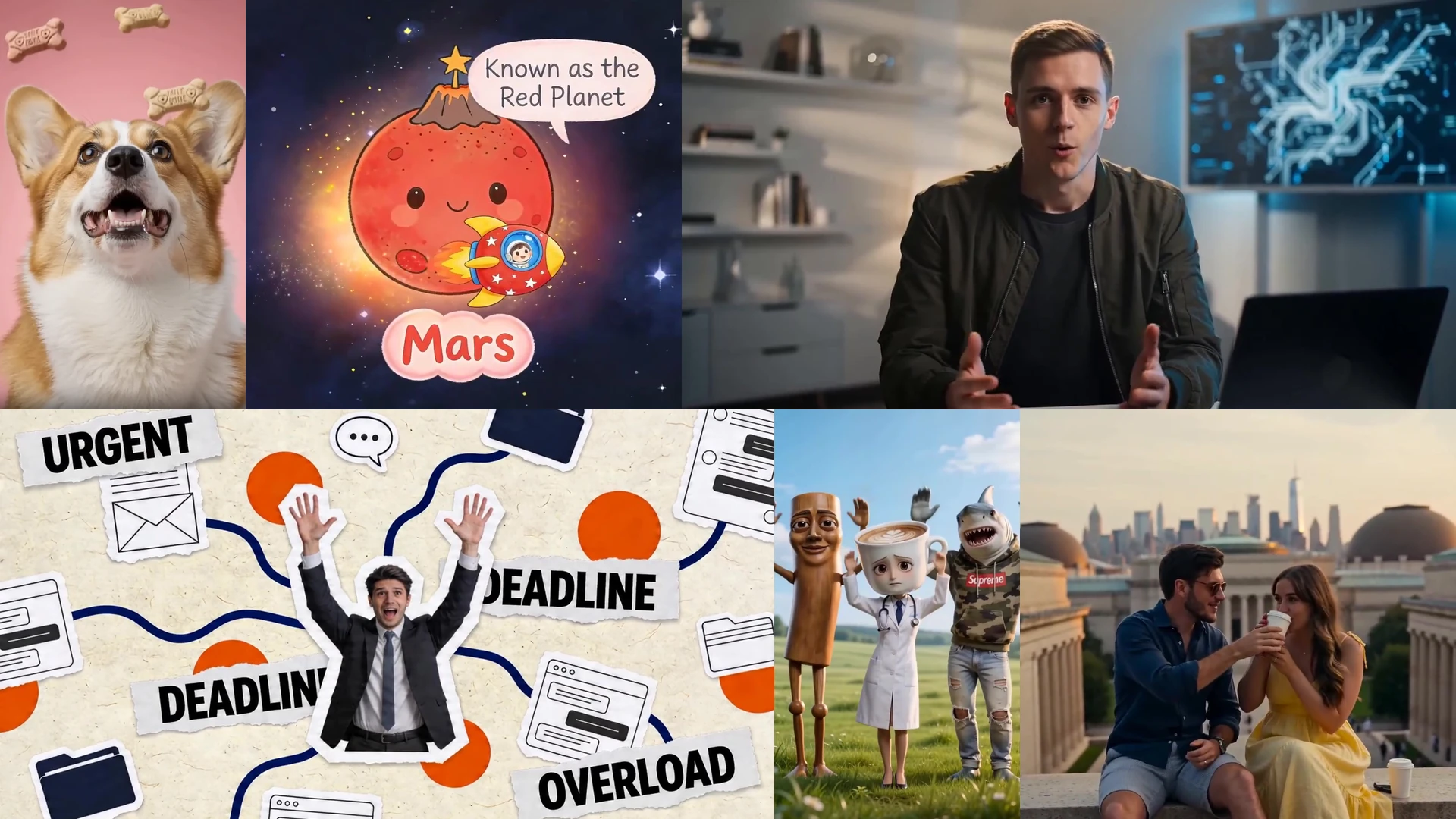
The second family is redirect-and-regenerate, and it has no timeline and no footage import. You describe the video you want, review what comes back, and when a shot is wrong you say what to change and the system regenerates that part rather than trimming an existing file. For example, in a conversational video agent like Pexo, you never open a timeline or drop in clips: you describe the video, watch the result, and redirect by re-describing intent, so the agent rebuilds the shot instead of you cutting one. It is not a timeline editor and it does not edit footage you filmed. This is the purest expression of "redirect instead of trim," and it is a fundamentally different job from polishing footage you already shot. Seeing a few vibe creating examples side by side makes the contrast concrete, since the input in each case is a description rather than a clip.
When to Use Which
The right tool follows from the job, not from the "AI video editing" label the tool markets itself under. Matching the label instead of the job is how people end up in the wrong workflow.
| If you want to | Reach for |
|---|---|
| Fine-tune footage you filmed, frame by frame | A timeline editor such as Premiere Pro, Final Cut Pro, or DaVinci Resolve |
| Edit a talking-head recording by editing its transcript | Descript |
| Turn one long recording into many short clips | A repurposing tool such as OpusClip, Vizard, or Klap |
| Add captions or subtitles to a video you already have | A captioning tool such as Veed or Submagic |
| Change a video by describing it and have it rebuilt, with nothing to upload | A redirect-and-regenerate agent |
The clearest way to choose is to ask what you are starting from. If you are starting from footage that already exists (a recorded interview, a filmed product demo, a livestream), your job is editing, and it belongs to a timeline editor, a prompt-driven co-editor, or a clipping tool depending on how hands-on you want to be. If you are starting from an idea, a script, a product photo, or a URL and have no footage yet, your job is generation, and that belongs to a redirect-and-regenerate agent. The two never fully substitute for each other, because one changes footage and the other creates it.
Where Vibe Editing Fits, and Where It Doesn't
Vibe editing earns its place where iteration speed and low skill barriers matter. A solo marketer producing a dozen ad variants, a founder with no editing background, a social team that needs to try five hooks before lunch, all move faster describing changes than learning a timeline. The conversational loop compresses what used to be a specialist handoff into a single sitting, a shift a hands-on AI video editing tutorial shows step by step.
It fits less well where a human's frame-level judgment is the product. Narrative films, music videos cut to a precise rhythm, documentary sequences where meaning lives in the exact juxtaposition of two shots, and any job that must preserve specific licensed or filmed footage without altering it, all still favor a timeline and a trained editor. The honest read is that vibe editing widens who can make competent video quickly, while timeline editing keeps the ceiling on precision and control. Choosing between them is really choosing between speed of iteration and exactness of control, and most creators will use both, at different stages of the same project.
One market-research estimate values the broader AI video editing market at roughly USD 1.6 billion in 2024, projected to reach USD 9.3 billion by 2030, a figure worth reading as a directional signal from a firm selling into the category rather than an audited number. Whatever the exact size, the direction is clear, describing edits in natural language is moving from a novelty to a default expectation of the interface.
Related Reading
Resources
| Tool | URL | What it does |
|---|---|---|
| Descript | descript.com | Transcript-based conversational editing of existing footage |
| ChatCut | chatcut.io | Prompt-driven editing for long-form footage you upload |
| CapCut | capcut.com | Mobile editor blending AI prompts with a manual timeline |
| Runway | runwayml.com | Video-to-video model that restyles existing footage from a prompt |
| OpusClip | opus.pro | Clips a long video into short highlights |
| Pexo | pexo.ai | Conversational AI video agent, redirect-and-regenerate from a description, not a timeline editor |