
 ChatGPT
 Perplexity
 Claude
 Gemini
 Grok
Grok


Most teams evaluating AI video in 2026 will encounter D-ID within the first ten minutes of research. The company has positioned itself as the go-to platform for real-time AI avatars — digital humans that can hold live conversations, deliver scripted presentations, and translate content across languages with synchronized lip movements. D-ID holds a 4.3/5 rating on G2 across 300+ reviews (as of Q1 2026), and recently expanded its partnership with Microsoft to bring avatar agents directly into Teams. For a broader look at where D-ID fits in the landscape, see our AI avatar platforms comparison.
But here is the part most reviews skip: an AI avatar is only as useful as the scenario it fits. If your goal is a talking-head explainer or a multilingual customer service agent, D-ID is genuinely strong. If your goal is a product ad, a social reel, or a cinematic brand film — an avatar is the wrong abstraction entirely, and no amount of real-time rendering will fix that mismatch.
This review breaks down what D-ID actually delivers in 2026, where its data quality and output limitations matter, and when a different type of AI video tool is the better call.
Quick Comparison: D-ID vs Pexo vs HeyGen
| Feature | D-ID | Pexo | HeyGen |
|---|---|---|---|
| Core Strength | Real-time conversational avatars | Multi-shot video production | Scripted avatar video + localization |
| Best For | Live AI agents, L&D, support | Product ads, social reels, brand films | Pre-recorded avatar explainers |
| Free Tier | 14-day trial, 3 min, watermarked | Free onboarding credits | 3 videos/mo, watermarked, 720p |
| Paid Starting Price | $5.9/mo (Lite, watermarked) | $30/mo (Pro, 3,000 credits) | $29/mo (Creator) or $24/mo annual |
| Real-Time Interaction | ✅ Sub-200ms latency | ❌ Pre-produced only | ❌ Pre-recorded only |
| Multi-Model Routing | ❌ Single pipeline | ✅ 10+ models per video | ❌ Single pipeline |
| Commercial Rights | Advanced plan ($108/mo+) only | All paid plans | Creator plan and above |
| G2 Rating | 4.3/5 (300+ reviews) | 4.7/5 (80+ reviews) | 4.8/5 (800+ reviews) |
How D-ID's Real-Time Avatar Tech Works
D-ID's core pipeline runs speech recognition, language generation, text-to-speech, facial animation, and video encoding concurrently — each on its own GPU thread. The result is end-to-end latency under 200 milliseconds from audio input to rendered avatar response.
Instead of reconstructing full 3D facial meshes, D-ID uses viseme-to-frame transformers combined with motion-field diffusion models. Cross-frame attention and motion-latent smoothing keep expressions consistent across frames, preventing the jitter that plagued earlier avatar systems. Developers can even modulate emotion intensity through latent-space interpolation — adjusting personality and tone without the avatar drifting into uncanny-valley exaggeration.

D-ID calls this architecture a "Visual Natural User Interface" (VNUI) — a modular visual layer that sits on top of any conversational AI stack (OpenAI, Anthropic, ElevenLabs, or custom LLMs). The separation of the "face" from the underlying logic is genuinely well-designed for enterprise integration.
What this means in practice:
D-ID excels at interactive, conversation-driven scenarios where a digital human needs to listen, think, and respond in real time.
Where Data Quality Becomes the Bottleneck
The broader AI video industry faces a consistent challenge: output quality is bounded by training data quality. This is especially visible in avatar generation.
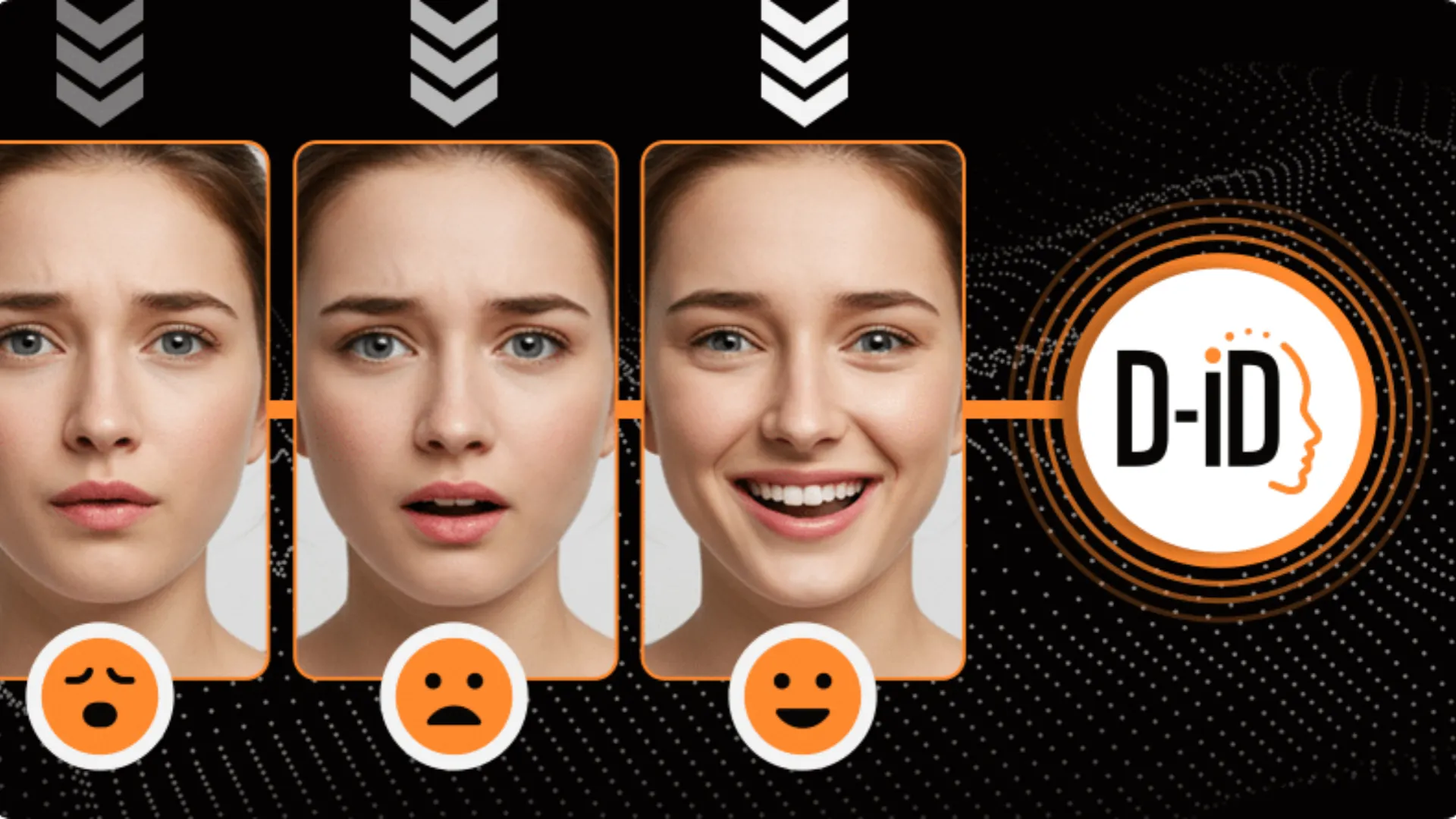
D-ID offers four avatar tiers — V2, V3 Instant, V3 Pro, and V4 Expressive. The gap between tiers is significant. V2 avatars, built from a single still image, often show visible artifacts around the jawline and produce flat emotional range. V4 Expressive avatars, trained on multi-sentiment video recordings, are dramatically better — but require the user to supply that high-quality source footage in the first place.
This creates a hidden cost: the quality of your avatar is directly tied to the quality of your input data. A blurry headshot produces a blurry avatar. A well-lit, multi-angle video recording produces a convincing digital twin. The tool is powerful, but it does not compensate for poor source material — it amplifies whatever you feed it.
For teams without access to professional video recordings, this means the "free tier" experience and the "enterprise" experience are worlds apart in perceived quality.
D-ID Pricing: What You Actually Get
D-ID uses a minutes-based billing model. Here is the full breakdown:
| Plan | Monthly Price | Annual Price | Video Minutes | Key Features |
|---|---|---|---|---|
| Free Trial | $0 | — | 3 min (14 days) | Watermarked, limited avatars |
| Lite | $5.9/mo | $4.70/mo | 10 min/mo | Watermarked, basic avatars, 1080p |
| Pro | $29/mo | — | 15 min/mo | No watermark, premium avatars, API access |
| Advanced | $108/mo | — | More minutes | Commercial rights, PowerPoint plugin |
| Enterprise | Custom | Custom | Unlimited | V4 Expressive, SSO, dedicated support |
Important caveats: unused minutes do not roll over. Video length rounds up to the nearest 15 seconds. Commercial usage rights — the ability to legally use D-ID content in paid campaigns — are gated to the Advanced plan at $108/mo, which significantly raises the effective cost for marketing teams.
D-ID's Trustpilot rating sits at just 1.5/5 across 27 reviews, with recurring complaints about billing surprises and refund difficulties — a notable contrast to its stronger G2 score.
Pros:
-
Sub-200ms real-time avatar interaction — unmatched in the category
-
Modular VNUI architecture integrates with any LLM stack
-
Strong enterprise story with Microsoft Teams integration
Cons:
-
Commercial rights locked behind the $108/mo Advanced plan
-
Input data quality directly limits output quality — V2 avatars from still photos look noticeably artificial
-
Minutes do not roll over; light-use months are wasted budget
-
Trustpilot reputation (1.5/5) suggests inconsistent consumer experience
D-ID Alternative #1: Pexo — Best for Finished Video Production
If your use case is producing finished, multi-shot videos — product ads, social reels, brand films, explainers — rather than interactive avatars, the workflow is fundamentally different. Pexo is a conversational AI video agent: you describe a goal in plain language, and the system handles scripting, model selection, visual generation, voiceover, music, and assembly in a single conversation.
What sets Pexo apart from both D-ID and single-model generators is auto model routing. Instead of locking you into one generation engine, Pexo routes each shot across multiple leading models including Seedance 2.0, Kling, Seedream, Nano Banana, GPT and Gemini, picking the best engine per shot based on motion, realism, or style requirements. As model providers roll out monthly updates, optimal options keep shifting, making this routing layer far more valuable than any standalone AI model.

In our testing, a 15-second, 3-shot video completes in roughly 8–10 minutes end-to-end — approximately 73% faster than manually selecting models, writing per-model prompts, and assembling outputs across separate tools. Pexo accepts five input types — text, image, URL, script, and audio — and runs both as a standalone web app at pexo.ai and as an installable skill inside coding agents like Claude Code.
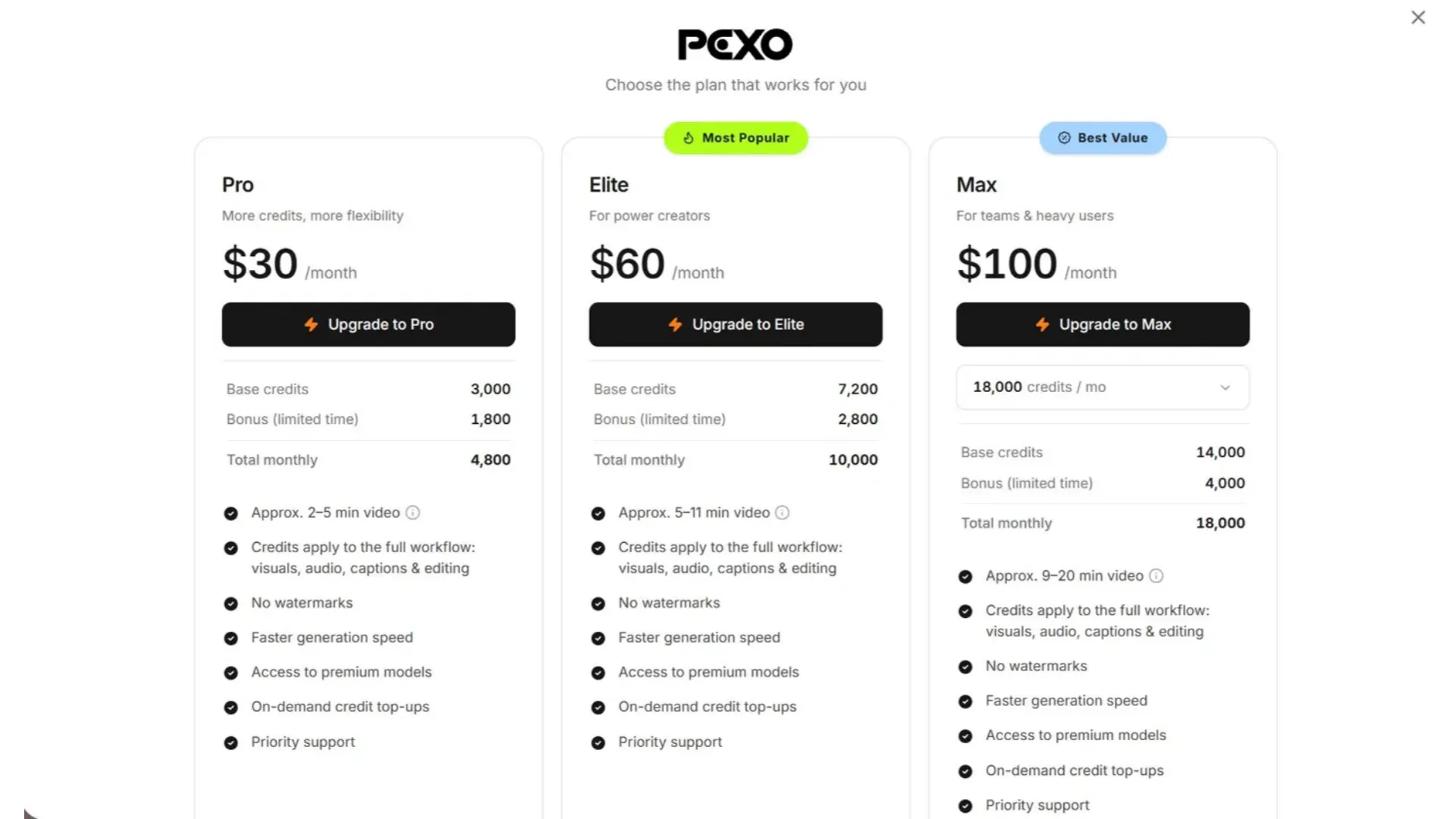
Pricing: Pexo runs on a credit-based system where credits cover the full workflow — visuals, audio, captions, and editing. Free onboarding credits are available on signup to test the complete pipeline. All paid plans include commercial usage rights, no watermarks, premium model access, and priority support — a key difference from D-ID, where commercial rights require the $108/mo Advanced tier.
Pros:
-
Multi-model routing delivers the best visual quality per shot without manual model selection
-
Conversational workflow — no prompt engineering, no timeline editing
-
All paid plans include commercial rights
-
Works inside Telegram, WhatsApp, Discord, and coding agents (Claude Code, OpenClaw)
Cons:
-
No real-time interactive mode — supports avatar and talking-head video, but not live conversational agents like D-ID
-
Credit consumption on longer videos (60s+) can add up; budgeting requires understanding the credit system
-
Less direct frame-by-frame control compared to single-model tools like Runway
Best for: Social media managers, DTC brands, and marketing teams who need finished, publish-ready videos — from product ads to talking-head content.
D-ID Alternative #2: HeyGen — Best for Scripted Avatar Content
HeyGen occupies the middle ground between D-ID's real-time interactivity and Pexo's full-production video workflow. It is a form-based avatar video platform: you pick an avatar, type a script, choose a voice, and HeyGen renders a polished talking-head video. No live conversation, no real-time response — but significantly more customization and avatar quality than D-ID's entry tiers. For a deeper comparison, see our best HeyGen alternatives guide.
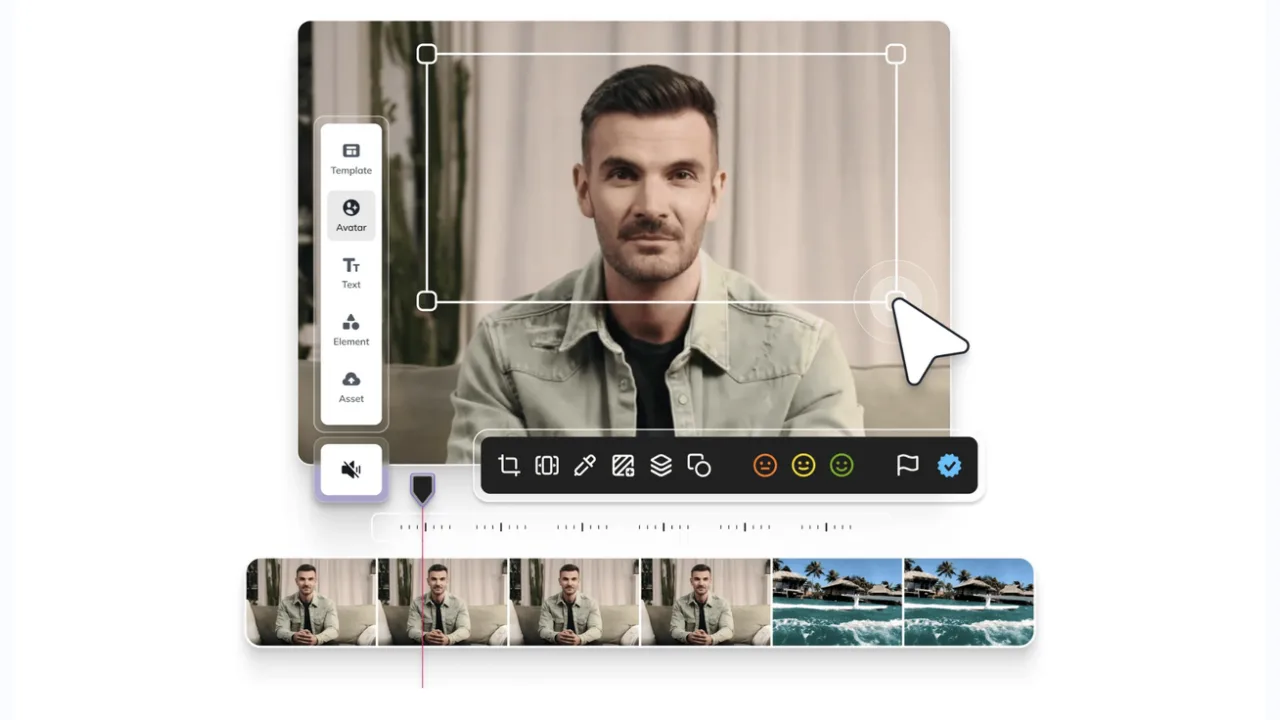
HeyGen holds a 4.8/5 rating on G2 across 800+ reviews — the highest in the avatar category — and its Avatar V generation achieves a 0.840 face-similarity score, the best benchmarked result in the space. Where D-ID's strength is real-time agents, HeyGen's strength is pre-produced avatar video at scale: marketing explainers, training modules, and multilingual localization with lip-synced dubbing in 175+ languages.
The key architectural difference: HeyGen uses a Premium Credit system that gates access to advanced features. Avatar IV videos consume 20 credits per minute, meaning the Creator plan's 200 monthly credits cover only ~10 minutes of premium avatar content. Teams doing heavy localization work burn through credits fast and often need the Pro tier ($149/mo) sooner than expected.
Pricing:
| Plan | Monthly Price | Annual Price | Key Limits |
|---|---|---|---|
| Free | $0 | — | 3 videos/mo, watermarked, 720p |
| Creator | $29/mo | $24/mo | Unlimited videos, 200 premium credits (~10 min Avatar IV) |
| Pro | $149/mo | — | 2,000 credits, 4K exports |
| Business | $99/mo + $20/seat | — | 1,000 shared credits, team collaboration |
Pros:
-
Highest avatar realism in the category (Avatar V, 0.840 face-similarity score)
-
175+ language lip-sync localization — best-in-class for multilingual teams
-
Large template and avatar library for fast production
Cons:
-
Premium Credit system is opaque — "unlimited videos" does not mean unlimited access to best features
-
No real-time interaction (pre-recorded only, unlike D-ID)
-
Credits do not roll over; quiet months are wasted budget
-
Steep jump from Creator ($29) to Pro ($149) for teams needing more premium credits
Best for: Marketing teams and L&D departments producing scripted avatar explainers, product demos, and multilingual training videos at volume.
The Decision Tree: Which Tool Fits Your Use Case?
This is the most important section of this review. The three tools solve different problems:
-
Need a real-time conversational digital human (customer support agents, interactive kiosks, live onboarding)? → D-ID is the category leader.
-
Need scripted avatar videos at scale (training content, multilingual explainers, marketing talking-heads)? → HeyGen delivers the highest avatar quality.
-
Need finished, multi-shot videos with full production (product ads, social reels, brand films, talking heads, cinematic content)? → Pexo handles end-to-end production.
The most expensive mistake in AI video is not picking the wrong tool — it is picking the wrong category of tool.