
 ChatGPT
 Perplexity
 Claude
 Gemini
 Grok




Start your Higgsfield pricing budget with the scenes you actually need to generate. Existing product footage can show a feature, and approved artwork can supply the end card. Reserve credits for new motion and replacement takes, then add the cost of joining the scenes and finishing the sound.
For monthly billing, Starter costs $19, Plus is offered at $47 with a $59 renewal, and Ultra's 3,000-credit option is $79 with a $129 renewal. The right choice depends on whether its models and allowance can support your whole campaign, including revisions.
What Do Current Higgsfield Plans Include?
Higgsfield's individual subscriptions combine model access, monthly credits, and limits on simultaneous generations. Starter provides selected models; Plus and Ultra open a broader set. Choose the models needed for your shots before deciding how many credits to buy.
The following monthly-billing prices and allowances were visible on November 16, 2026, during the Black Friday promotion. Ultra is set to the 3,000-credit option. Prices exclude VAT and local taxes.
| Individual plan | Monthly credits | Advertised monthly charge | Monthly renewal shown |
|---|---|---|---|
| Starter | 270 | $19 | No separate renewal price shown |
| Plus | 1,200 | $47 promotional price | $59 |
| Ultra, 3,000-credit option | 3,000 | $79 promotional price | $129 |
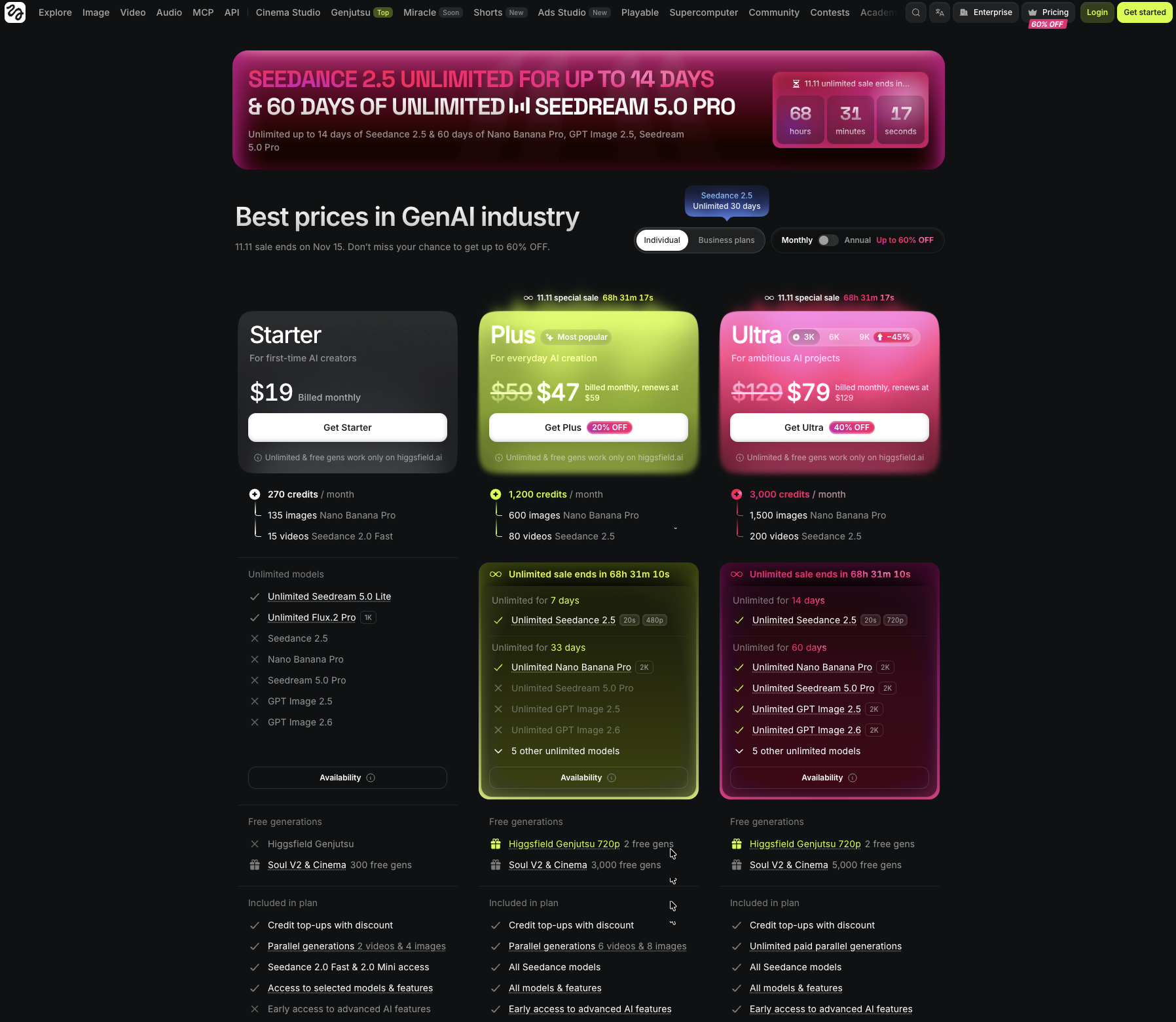
Earlier promotional screenshot: its November 11 sale ended November 15. Use the dated table above for this article's price comparison.
Annual billing was advertised at monthly equivalents of $19 for Starter, $33 for Plus, and $50 for Ultra's 3,000-credit option. Multiplying by twelve gives $228, $396, and $600 for the year before taxes. These are annual commitments, so compare the total payment and renewal offer with the number of months you expect to produce videos.
Team and Scale provide shared workspaces and pooled credits; Enterprise supports custom arrangements. For a team budget, calculate the required seats and combined generation demand, then check how much each additional member costs. Individual plans are for one person's access.
How Do Model Choices Change Credit Use?
The selected model, duration, resolution and configuration determine the generation charge. Record the amount displayed before submitting each job; changing settings means checking the quote again.
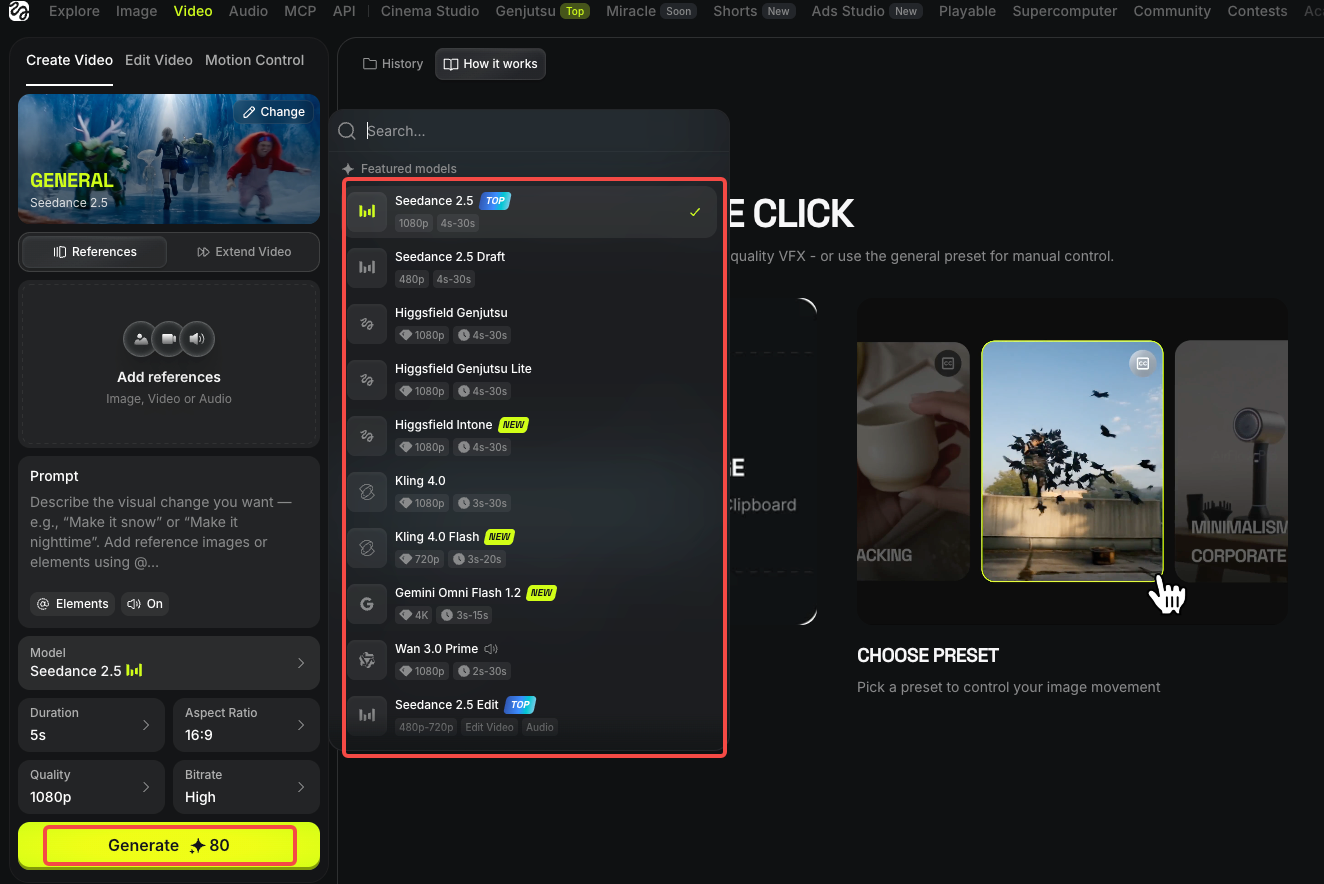
Give every scene its own entry: selected model, input assets, duration, output size, audio setting and credits per attempt. An image treatment, a motion draft and a higher-resolution revision can involve separate operations.
For example, changing a hero shot's resolution may change its charge without changing the number of scenes in the campaign. Keep that difference in the budget instead of assigning one universal price to “a video.”
Unlimited access also needs its scope checked. Higgsfield's help distinguishes selected website models from metered generations through MCP, CLI and other automated routes. Confirm the eligible model, access window and route before entering a zero-credit allowance.
A Finished-Video Scene Budget Worksheet
Use Mavo, a fictional desk-lamp brand, for this hypothetical 20-second ad. It has three generated five-second scenes and a five-second end card assembled from approved artwork.
Assume two attempts per generated scene, plus two completed replacement takes held in reserve. Every workload and unit rate below is hypothetical, not a current Higgsfield quote or measured acceptance rate. Replace each rate with the amount shown for your chosen settings.
| Budget item | Assumed calculation | Credits | Your actual quote |
|---|---|---|---|
| Hero scene | 2 attempts × 40 | 80 | ___ |
| Demonstration scene | 2 attempts × 30 | 60 | ___ |
| Detail scene | 2 attempts × 20 | 40 | ___ |
| Completed takes rejected and replaced | 2 reserved attempts × 30 | 60 | ___ |
| Optional finishing operation | 1 operation × 10 | 10 | ___ |
| Planned web-credit demand | 80 + 60 + 40 + 60 + 10 | 250 | ___ |
| End card, assembly and sound | Assign tools, people and actual charges separately | Separate | ___ |
The reserve covers technically completed takes the team cannot use. It is not a prediction that two retries will produce an acceptable result. A broken product label may require a new source image or different shot direction.
Six such ads would reserve 1,500 web credits under these assumptions. If your account shows 1,000 usable credits, the gap is 500, before other work. Check both the remaining balance and the expiry dates before comparing a pack with another plan.
Finish the cash worksheet with:
Web subscription for the selected billing period:
Additional web packs or Auto-Refill purchases:
Separate API spending, if used:
Assembly, narration, captions and licensed assets:
Review and revision time:
Tax and other checkout charges:
A credit estimate does not cover the editor joining the scenes, correcting captions or checking the export. Name who completes those tasks and what the delivery must contain.
Are Subscription, Credit Packs, and API Separate?
Yes. Subscription credits and web top-ups have different reset rules; the API uses its own prepaid balance. A web plan does not fund API calls.
Consumer subscription credits do not roll over. Monthly plans refresh with paid renewal; annual-plan credits refresh every 30 days. Buying an annual subscription does not necessarily provide the entire year's credits upfront.
A Credit Pack adds web credits without upgrading model access. Auto-Refill is an automatic purchase mechanism, so check whether it is enabled and which amount it buys. Subscription credits are spent before supplementary balances.
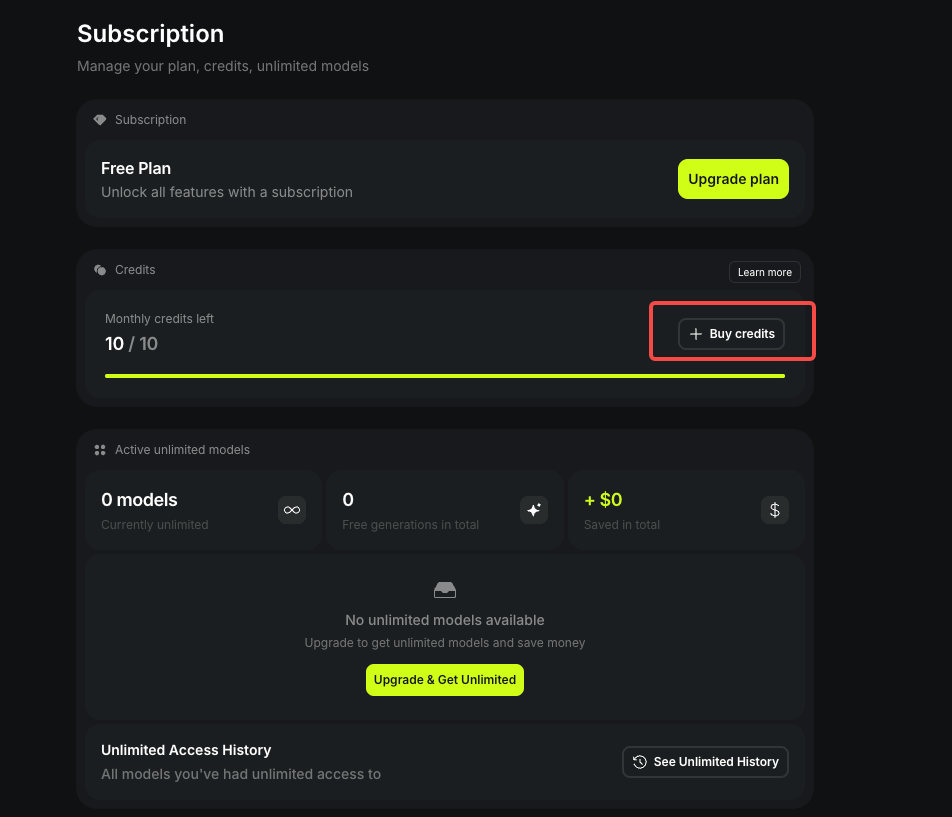
The API help describes a US-dollar balance, while its terms call the metered units “Units.” Keep that accounting separate from web credits. Purchased API Units have a one-year validity under the reviewed API terms; do not apply the consumer pack's expiry to them.
For agent connections, our Claude Code video skills comparison covers the broader connector choice. Record the billing route used for the actual generation rather than assuming every connection is an API purchase.
When Does a Scene Tool Fit the Campaign?
It fits when the team wants to direct particular shots and can assign the remaining assembly, sound and review work. Budget the finished deliverable before deciding how many generation credits to buy.
When you want to direct the complete product story, Pexo offers another AI video agent workflow using approved facts and assets. Review its direction and preview, then request specific changes. Evaluate that production separately; it does not establish equivalent control over every Higgsfield shot setting.
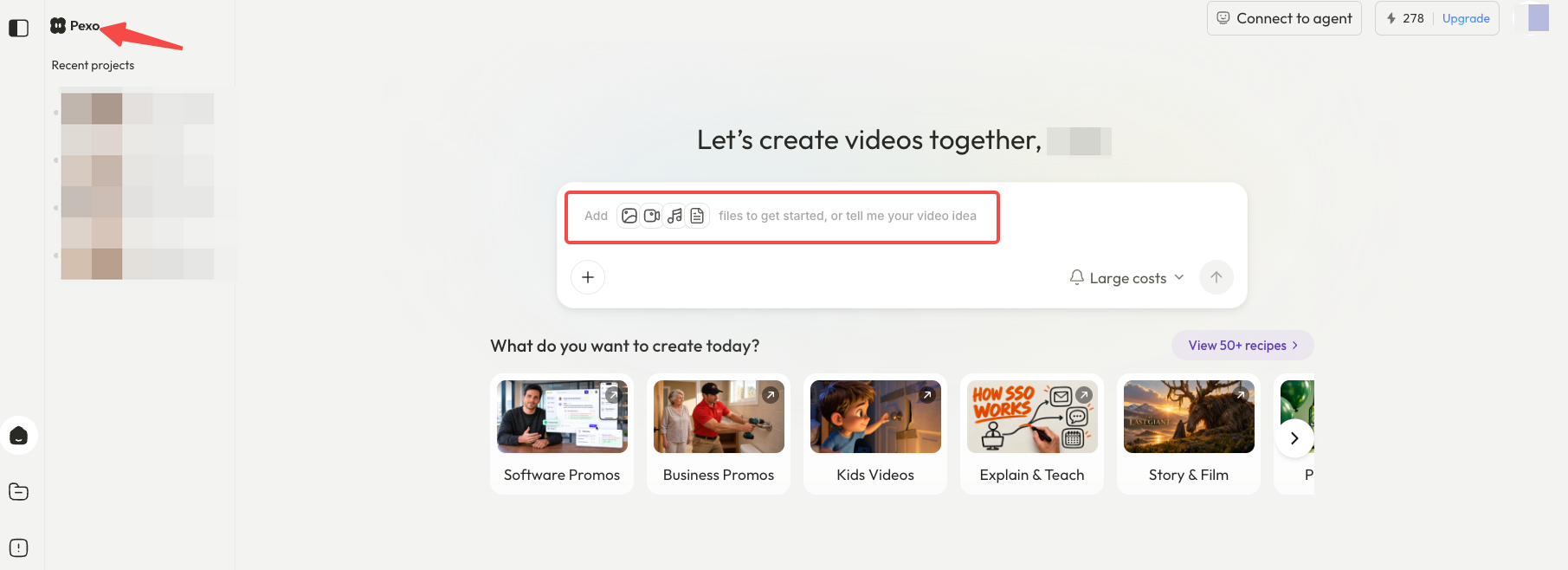
Before transferring client materials, check Pexo's processing and campaign-use terms, including applicable permissions or written consent. For Higgsfield, review the current usage terms alongside your plan and source licenses. This article does not provide legal advice.
Conclusion
Choose the balance that supports the scenes, replacements and finishing your campaign actually needs. In Mavo's worksheet, the end card needs assembly while rejected completed takes consume generation capacity. Keep both visible when deciding whether the next purchase is more credits or production work elsewhere.