
 ChatGPT
 Perplexity
 Claude
 Gemini
 Grok



Before moving a beauty video budget toward UGC, decide what would justify that move. More people watching a cheek-tint application is useful information. For a purchase campaign, the stronger case is an acceptable acquisition cost followed by orders customers keep.
Compare the formats within the same buying situation. Attention helps explain the result; purchases and later refunds help judge its commercial value. Neither format earns a permanent budget advantage from its name.
What Counts as UGC and Branded Beauty Video?
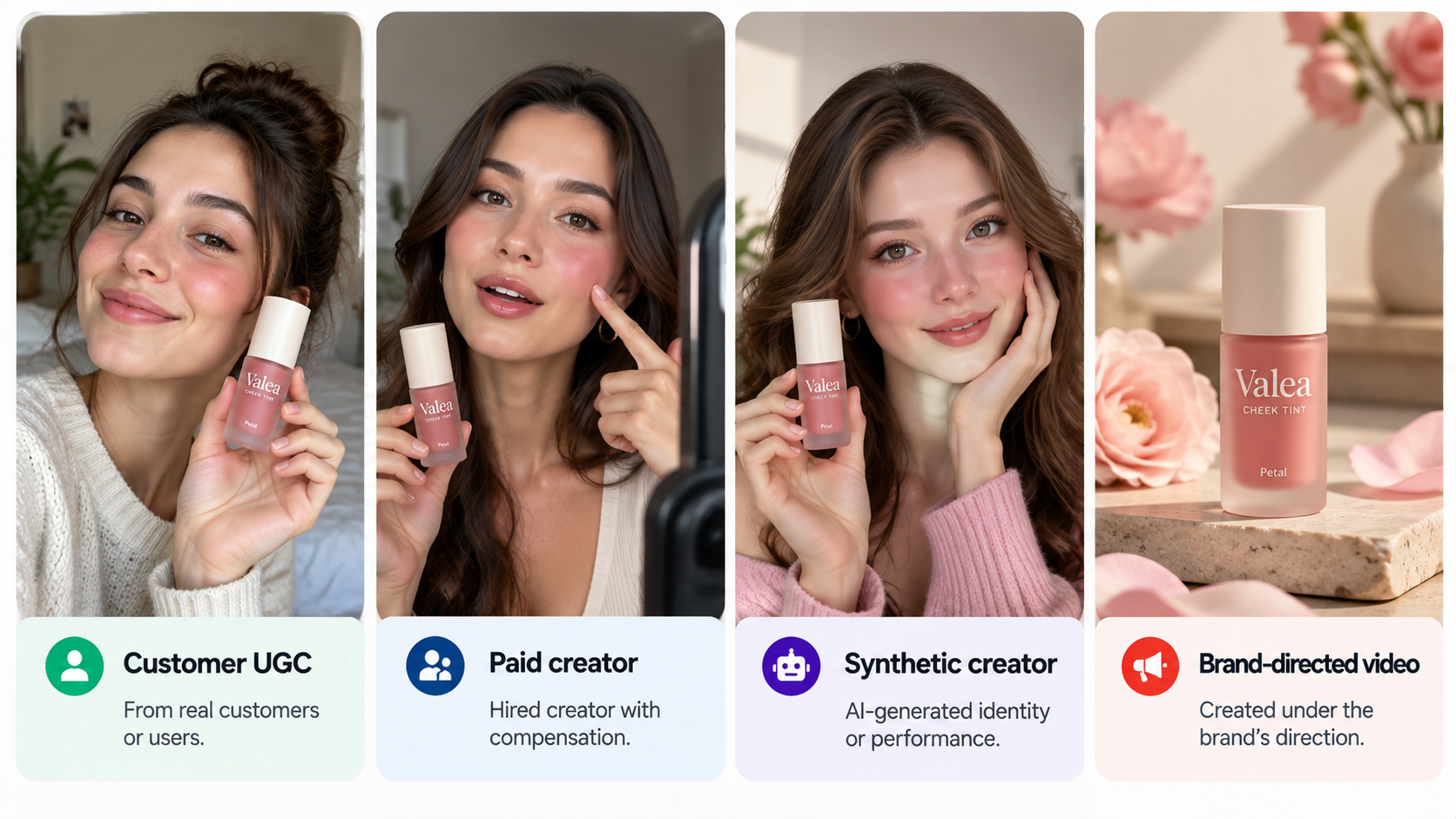
UGC comes from customers or users; branded video follows the brand's creative direction. Paid creators and synthetic presenters need separate labels, even when all three use a casual, phone-shot style. For this comparison, record both the source and presentation.
| Content source | What the team should record |
|---|---|
| Actual customer footage | Genuine product experience, any incentive, original statement and permission for the planned ad use |
| Paid creator content | Commissioned role, actual experience where claimed, compensation and required disclosure |
| Synthetic creator-style video | Generated identity or performance; no invented purchase, personal routine or customer result |
| Brand-directed video | Approved product footage, message, visual treatment and any actors or licensed assets |
These categories overlap visually. Customer footage can sit inside a branded edit, and a hired creator can deliver a tightly scripted campaign. Record those choices rather than treating a bathroom background as proof of independent customer experience.
Before testing, check likeness, voice, footage, editing and music permissions against the actual agreements. Include paid placement, territory, duration and any use through a creator's account. An organic posting agreement does not establish every later advertising permission. Required sponsorship and AI disclosures belong in the tested version.
Which Beauty Purchase Question Should the Test Answer?
Choose one uncertainty about buying this product, then ask whether each video resolves it. “Which format gets more likes?” is too far from a purchase-budget decision unless engagement is the campaign's stated objective.
Consider a fictional Valea cheek tint, shade Petal. The question is: “What does one sheer layer look like on skin?” One ad uses authorized customer application footage. The other uses a brand-directed application close-up and packshot. Both show the same shade, approved message, offer and destination.
The customer version must preserve the person's actual experience. The branded version needs enough application detail to answer the question. Neither should use altered skin texture or lighting to imply a product result the source material cannot support.
Choose purchase CPA as the primary measure if the campaign seeks purchases. If the goal is acquiring new customers, define acquisition using new buyers and report that separately from all orders. Attention and cart activity then help diagnose where each ad loses people.
This pair compares two executions with several creative differences. It cannot isolate the effect of “authenticity” or establish that every customer video beats every branded video. A narrower follow-up could compare two openings while keeping the rest of an approved cut unchanged.
Compare Attention and Purchase Metrics on One Placement
Use one reporting sheet for both ads. Fill the blank result columns from the same sources and reporting periods. Record each source beside the value; an ad-platform purchase count and a store's tagged-session count may describe different journeys.
| Metric and agreed definition | Customer ad | Branded ad | What it helps answer |
|---|---|---|---|
| Spend and delivered impressions | — | — | Did both ads receive enough delivery to compare? |
| Average watch time, with video duration | — | — | How much viewing did each cut receive? |
| Views reaching the chosen threshold ÷ impressions × 100: threshold view rate | — | — | How often did viewing reach the agreed point? |
| Destination clicks ÷ impressions × 100: destination CTR | — | — | Did viewers proceed toward the product? |
| Sessions with an add-to-cart ÷ tagged landing sessions × 100 | — | — | Did arriving visitors consider buying? |
| Attributed purchases, under the agreed settings | — | — | How many purchases did the platform credit? |
| Spend ÷ attributed purchases: media CPA for purchases | — | — | What was the reported advertising cost per purchase? |
| Attributed purchase revenue ÷ spend: reported ROAS | — | — | How much attributed revenue accompanied that spend? |
| Return requests, refunded orders and refund value from the matched cohort | — | — | How much of the initial result remained? |
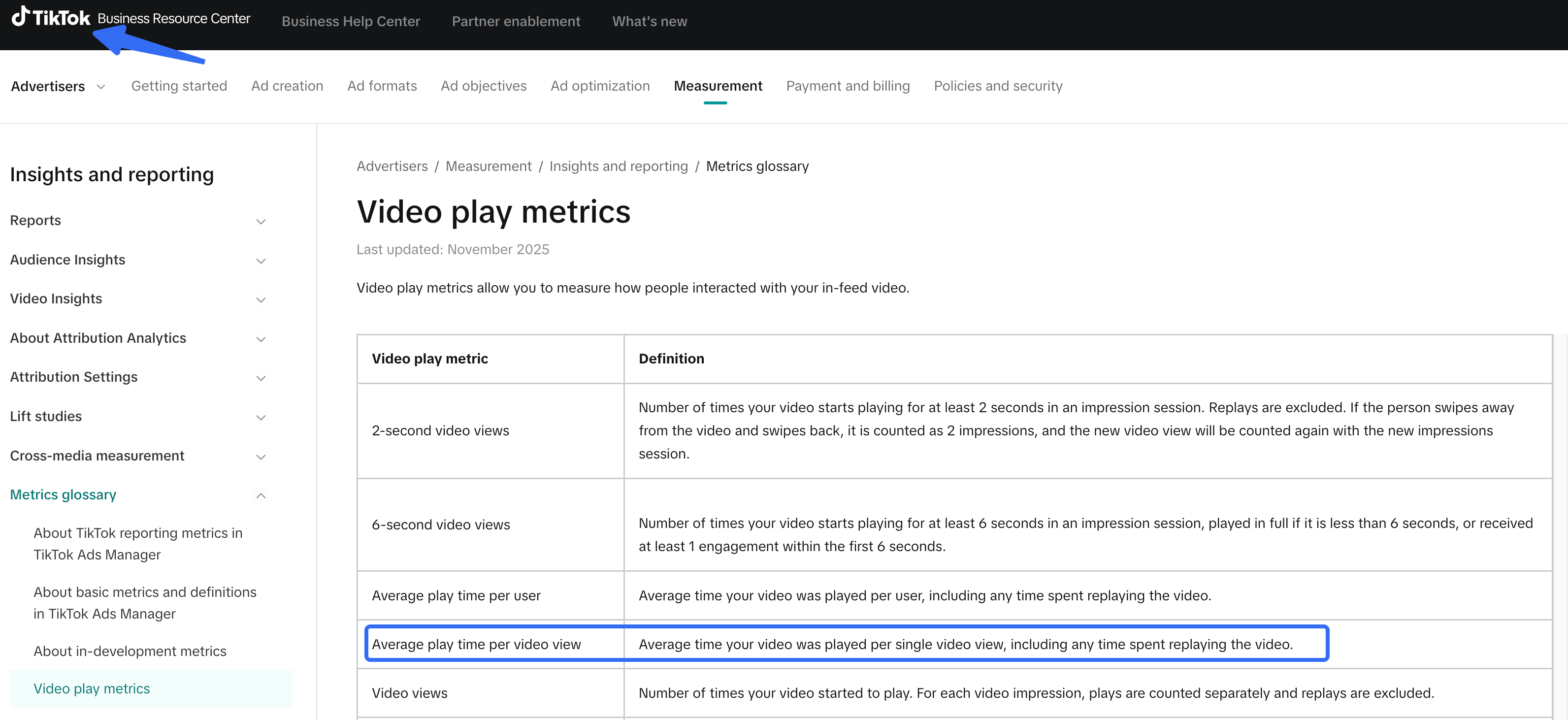
Choose a view threshold both cuts can reach and keep their lengths comparable. Completion rate favors a shorter video structurally. TikTok's video play metrics include replay time in average play time per view. Its standard 6-second video views can also include early engagement or a shorter clip watched in full. Use a time-based measure that matches the agreed threshold; the metric name alone is not enough. Viewing duration still cannot show whether someone understood the shade demonstration.
Clicks need equal care. TikTok distinguishes all clicks from destination clicks; social interactions can inflate a total-click comparison. Keep destination CTR separate from likes, comments and shares.
The cart rate above is a proposed website-session measure, requiring suitable tracking. Count qualifying sessions consistently and check event duplication. Do not divide platform-attributed purchases, including view-through conversions, by tagged website sessions and call that a clean website conversion rate.
Media CPA excludes production, creator fees and revision time. Track those costs alongside it when allocating the next production budget. Reported ROAS also excludes costs and does not establish profit or incremental sales.
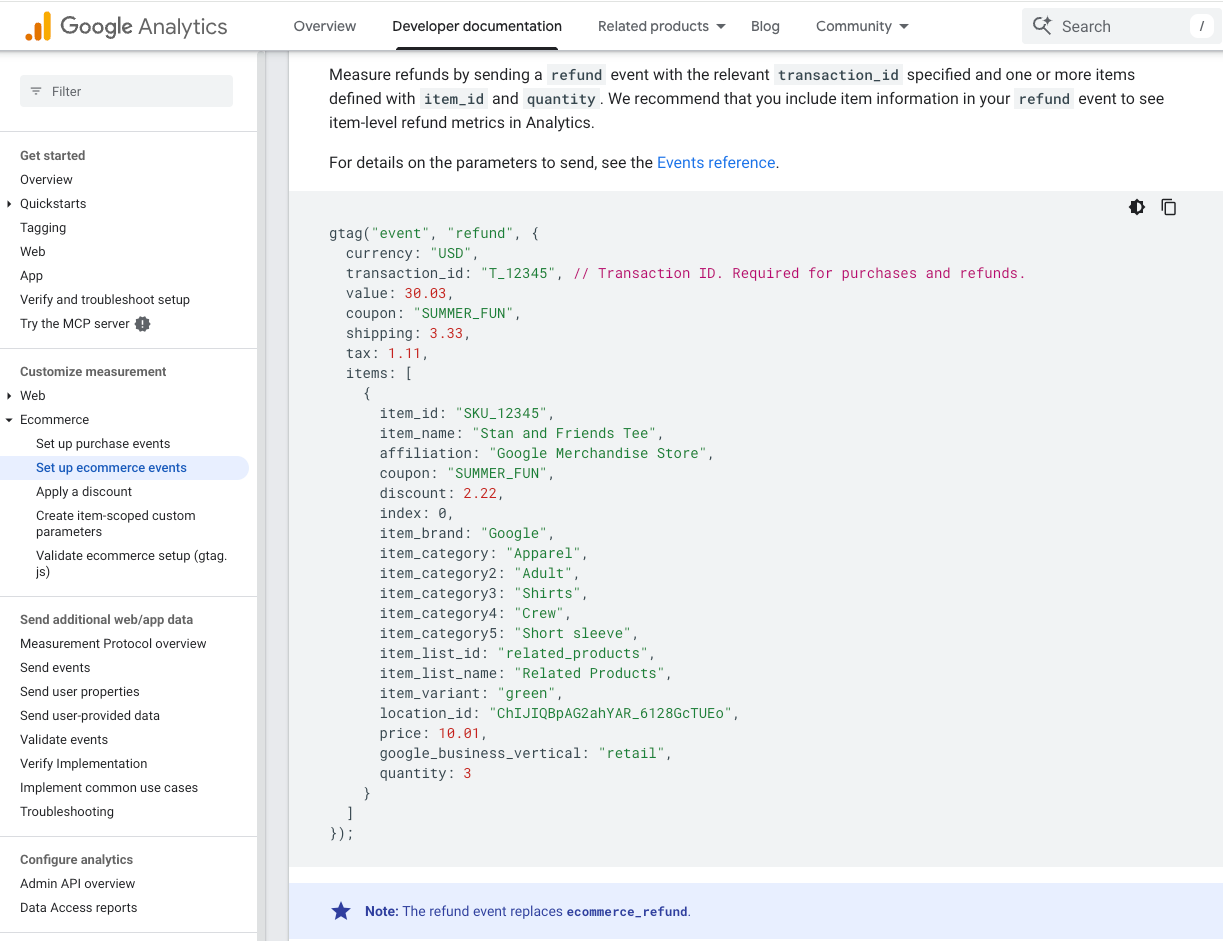
Reconcile refunds through order IDs and a documented method of linking orders to each group. Google's ecommerce measurement guide uses transaction IDs for refund events. If platform totals cannot be matched to individual orders, report that limit. Do not invent ad-level refund rates from a storewide total. Keep return requests and completed refunds separate; an exchange does not necessarily reverse the sale.
Keep Audience, Offer, Spend, and Attribution Comparable
Run the pair concurrently against randomly separated groups drawn from the same eligible audience, where supported. TikTok's split-testing setup describes mutually exclusive audience groups while other variables remain the same. Two ads receiving uneven delivery in an ordinary ad group are a weaker basis for a format conclusion.
Before launch, write down the shared product and shade, audience eligibility, placement, purchase objective, bid strategy, budget and schedule. Keep the offer, landing page, stock availability and shipping terms aligned. Record actual spend and frequency afterward; equal planned budgets do not guarantee identical delivery.
Use the same attribution windows and reporting basis. TikTok's attribution guidance distinguishes click-through and view-through credit and describes engaged-view attribution for app-related campaigns. Record only the categories available to the selected campaign. Give both groups equal time for delayed conversions before comparing their totals.
Choose the primary outcome, minimum worthwhile difference and stopping rule before reading results. Allow for the test's uncertainty; do not end it simply because one ad looks ahead today. There is no universal purchase count that makes every beauty test reliable.
Matching these conditions improves the comparison. A randomized test can support a conclusion about these ads under these conditions; routine reporting alone cannot establish causation. A two-ad comparison without a no-ad control also does not measure advertising's incremental effect against no exposure.
Read the Results by Product Type and Funnel Stage
A cheek tint needs a believable view of color and application. A moisturizer may raise questions about texture or layering. A fragrance video can communicate a description, but it cannot let the viewer smell the product. Those differences change what useful creative needs to explain.
Treat product type as context for interpretation, not a reason to assign a winning format in advance. For Valea, strong watch time and weak destination CTR could justify reviewing when Petal's applied shade becomes visible. That is a creative hypothesis to investigate, not proof that the format caused the drop.
Higher CTR with worse purchase CPA calls for a different review. Does the opening promise an outcome the product page does not support? Is the tested shade available? Inspect the journey before commissioning more of the attention-winning opening.
Separate prospecting from retargeting. Comparing a branded ad shown to new visitors with a customer ad shown to recent cart abandoners confounds creative with audience intent. Neither acquisition CPA nor brand lift can be inferred from watch time alone.
When Should a Beauty Brand Keep Both Formats?

Keep both when each has a useful, evidenced role and its production cost remains sensible. A clear branded application shot may explain the shade while authorized customer footage answers a particular use question. Test those roles rather than reserving awareness for one format and conversion for the other automatically.
If a combined cut is the next idea, treat it as a new execution. Preserve the person's meaning, product appearance and required disclosures when editing. Review the shade demonstration and notices at the final placement size. Our mobile framing guide covers keeping product details visible through a crop. A hybrid's result cannot be assigned backward to either source format.
Move budget in stages when the purchase result is credible, then check whether it persists with another approved execution. One effective creator, shade or opening may explain the advantage. Replacing the whole production mix on that evidence would be premature.