
 ChatGPT
 Perplexity
 Claude
 Gemini
 Grok
Grok

How to Make a Fan Film
UPDATED: 2026-08-05 By Lan He, Senior Video Producer at Pexo
Making a fan film takes six steps: find the gap in the existing world, understand the rights position, write to canon, produce the footage, source original sound, then release non-commercially. A generated fan film takes about 35 minutes of production time.
Quick Version: How to Make a Fan Film
- Find a gap the source material left unfilled.
- Check the rights position and any published studio guidelines.
- Write to canon so the piece belongs to the world rather than borrowing it.
- Produce the costumes, locations, and effects that were previously out of reach.
- Source original music and sound rather than lifting the source cues.
- Release non-commercially with clear attribution and monetization off.
How to Make a Fan Film Step by Step
Step 1: Find the gap in the world
Choose a story the source material implied but never told. A side character's missing years, an event mentioned in one line of dialogue, a battle referenced but never shown, or a familiar event from an unfamiliar perspective.
Avoid retelling. A fan film that restages a scene the original already did well invites a comparison it cannot win, and it gives the viewer nothing they did not already have. The gap is the entire justification for the project, so name it in a sentence before writing anything.
Step 2: Understand the rights position
Work from the fact that a fan film uses characters and worlds someone else owns. Rights holders tolerate a great deal of non-commercial fan work, and some publish explicit rules, but tolerance is discretionary and can end at any point.
Check for published guidelines before starting. Paramount and CBS issued Star Trek fan film guidelines covering runtime, funding, and titles; Lucasfilm has run official fan film awards. Where guidelines exist, following them is the clearest protection available. Where they do not, keep the project non-commercial and expect that it may be removed.
Step 3: Write to canon
Write so the piece reads as part of the world rather than as a project using its names. Match the source's dialogue rhythm, its technology rules, its moral logic, and its visual grammar. Fan audiences notice inconsistency faster than any other audience, and a single contradicted detail costs the film its credibility.
Keep the scope inside what the world supports. Introducing a power, a species, or a technology the canon excludes turns a fan film into original work wearing borrowed costumes, which satisfies neither the fan audience nor the rights position.
Step 4: Produce the footage
Produce the elements that historically stopped fan films: costumes, ships, creatures, environments, and effects. These are the reason most fan projects either stayed small or never finished.
Pexo's text-to-video workflow generates these from description, and Hyperframe keeps a character on model across every shot, which is what separates a fan film from a set of loosely related clips. Describe costumes and environments in the source material's own visual vocabulary so the generated look matches the world rather than approximating it.
Step 5: Source original sound
Commission or generate original music in the source's style rather than using its actual score. Score and sound effects carry their own separate copyrights, and lifted audio cues are a frequent cause of takedowns even for films the rights holder otherwise ignores.
Write a theme that gestures at the original's instrumentation and mood without reproducing its melody. Pexo composes original scores matched to scene mood and generates dialogue with natural AI voices, which covers both the score and the voice cast without touching source audio.
Step 6: Release non-commercially
Publish to YouTube or Vimeo with monetization disabled. State clearly in the description that the film is a non-commercial fan work, name the property and its owners, and credit the original creators. This does not create a legal right, but it demonstrates the good faith that tolerance depends on.
Export 16:9 at 1080p or higher, or 2.39:1 if the source material is anamorphic. Pexo exports up to 4K. Avoid running ads, selling merchandise, or crowdfunding for profit, since monetization is the line rights holders enforce most consistently.
How to Make a Fan Film with Pexo
The six steps above work with any production method. Pexo handles steps 4 through 6 in a single conversation, which removes the costume, location, and effects budget that historically capped fan projects.
Open the fan film page and describe the piece: "A 10-minute fan film following a supply freighter crew during a battle the main story only mentions, worn industrial interiors, handheld camera, no named characters from the original cast." Pexo generates the scenes with a consistent cast, composes an original score, and assembles the cut.
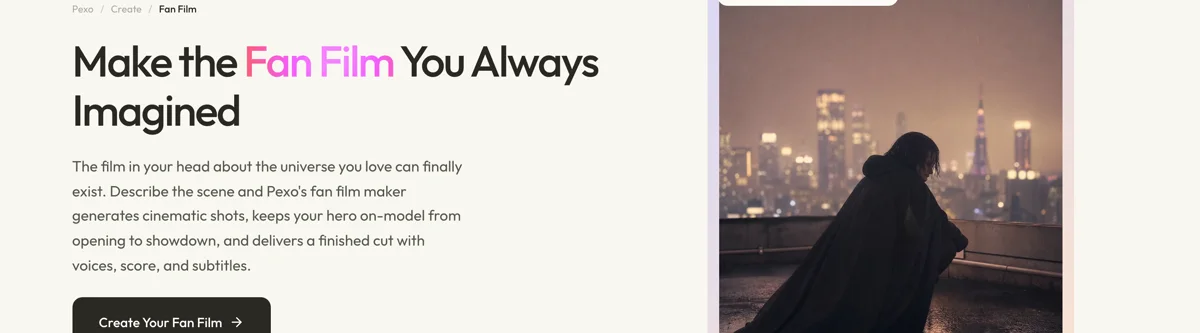
Adjust any scene by describing the change in the chat, and Pexo regenerates that scene alone. The platform runs across Seedance 2.0, Kling AI, and more.
For related formats, the short film page suits original narrative, parody video covers comedic takes that may sit differently under fair use, and movie trailer suits a trailer for a fan project.
5 Mistakes That Get Fan Films Taken Down
1. Turning on monetization. Ad revenue is the line rights holders enforce most consistently, even on films they would otherwise ignore.
2. Using the original score or sound effects. Audio carries separate copyrights and triggers automated matching that the visuals often do not.
3. Ignoring published guidelines. Where a studio has issued fan film rules, breaking them removes the one clear protection available.
4. Recreating a specific actor's likeness. Personality and publicity rights are separate from copyright and draw more direct objection than the fan work itself.
5. Presenting it as official. Titles, logos, and thumbnails that imply studio involvement convert a tolerated project into something the rights holder has to act on.
Related Tutorials
- How to make a short film for original narrative work
- How to make an AI movie for longer generated narrative
- How to make a micro drama for serialized episodes
- How to make a movie trailer for promoting a finished fan project